Which one of the following statements regarding electrolytic solution is not correct?
Answer & explanation
Correct answer: option 2
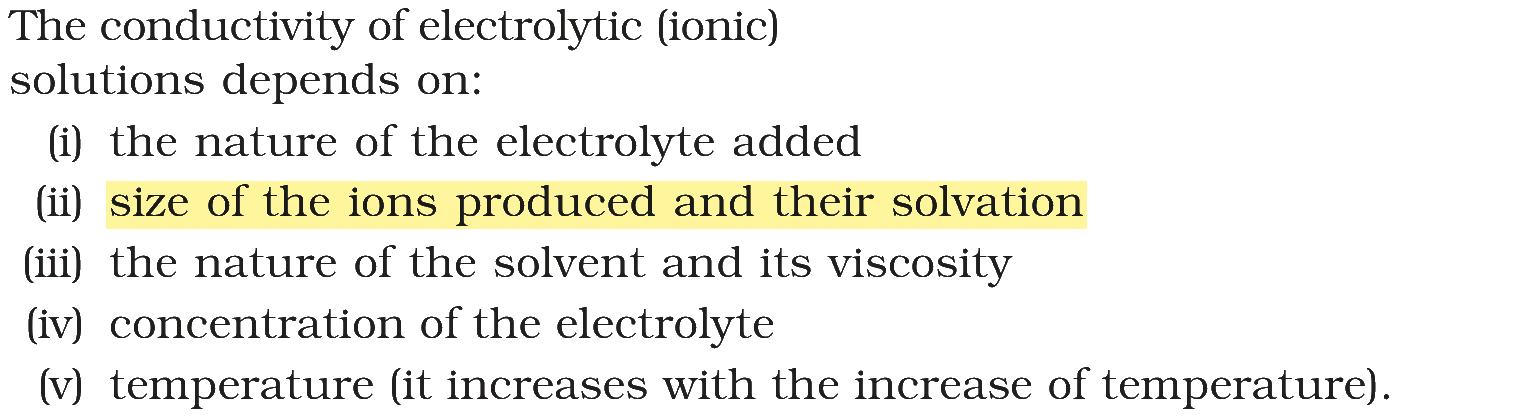
The correct answer is Option (2) → conductivity does not depend upon solvation of ions present in solution.
In an electrolytic solution, current is carried by the movement of ions. Anything that changes the number of ions or how fast they move changes the conductivity.
A solvated ion carries a shell of solvent molecules with it. The more strongly an ion is solvated, the larger it effectively becomes and the more slowly it moves, so solvation does change the conductivity. For example, \( \ce{Li+} \) is the smallest alkali metal ion but is the most heavily hydrated, so it moves more slowly in water than \( \ce{Na+} \) or \( \ce{K+} \).
Option (1) conductivity of solution depends upon the size of ions. — A correct statement about conductivity. The size of the moving ion (with its solvent shell) decides how much drag it meets.
Option (2) conductivity does not depend upon solvation of ions present in solution. — Not a correct statement about conductivity (it does depend on solvation). A strongly solvated ion moves more slowly, so solvation changes the conductivity.
Option (3) conductivity depends upon viscosity of solution. — A correct statement about conductivity. In a more viscous solvent the ions move more slowly, so the conductivity is lower.
Option (4) conductivity depends on the temperature. — A correct statement about conductivity. A rise in temperature lowers the viscosity and increases ionic mobility (and, for weak electrolytes, the dissociation), so the conductivity of an electrolytic solution increases with temperature.
NCERT (2026-27 edition):
Conductance of Electrolytic Solutions – …