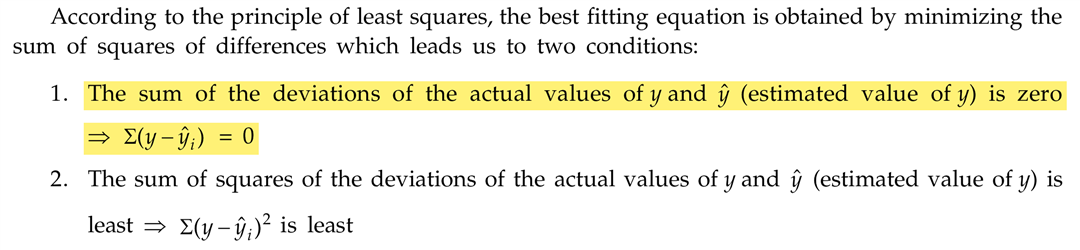
If \((t_1, y_1), (t_2, y_2), (t_3, y_3), \ldots, (t_n, y_n)\) denote the time series and \(y_t\), are the trend values of the variable \(y\), then \(\sum(y-y_t)\), the sum of deviations of \(y\) from their corresponding trend value is equal to:
Answer & explanation
Correct answer: option 3
The correct answer is Option (3) → 0
Let the trend line fitted by the method of least squares be \(y_t = a + bt\). Its first normal equation is
\(\sum y = na + b\sum t\)
Adding the trend values over all n points:
\(\sum y_t = \sum (a + bt) = na + b\sum t\)
So \(\sum y = \sum y_t\), and hence
\(\sum (y - y_t) = \sum y - \sum y_t = 0\)
The positive and negative deviations from the trend line cancel out.
CBSE Applied Mathematics (Class XII):
Computation of Straight-line Trend by using Method of Least Squares