
A ball is thrown upwards from the plane surface of the ground. Suppose the plane surface from which the ball is thrown also consists of the points A(1, 0, 2), B(3, −1, 1) and C(1, 2, 1) on it. The highest point the ball reaches is D(2, 3, 1) as shown in the figure. Using this information answer the question.
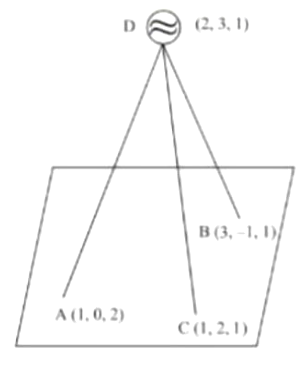
The maximum height of the ball from the ground is
Answer & explanation
Correct answer: option 1
The correct answer is Option (1) → \(\displaystyle\frac{5}{\sqrt{29}}\) units
The ground is the plane through A, B and C. With \(\vec{CA} = -2\hat{\jmath} + \hat{k}\) and \(\vec{CB} = 2\hat{\imath} - 3\hat{\jmath}\), its normal is \(\vec{CA} \times \vec{CB} = 3\hat{\imath} + 2\hat{\jmath} + 4\hat{k}\), and through A(1, 0, 2) the plane is
\(3x + 2y + 4z - 11 = 0\)
The maximum height is the perpendicular distance of D(2, 3, 1) from this plane:
\( \displaystyle d = \frac{|3(2) + 2(3) + 4(1) - 11|}{\sqrt{3^2 + 2^2 + 4^2}} \)
\( \displaystyle = \frac{|16 - 11|}{\sqrt{29}} = \frac{5}{\sqrt{29}} \text{ units} \)
Note: This topic was not in the CUET 2026 syllabus.