
CUETMOCK
  • Pricing
  • Mentors
Log inStart freeStart free mocks→

First test, then trust

Try a free CUET mock test.

Join 5,00,000+ students who rehearsed exam day on the exact NTA screen before sitting CUET. On the web and on Android.

Start free mocks →Get the Android app
CUETMOCK

India's #1 CUET Mock Test Platform. Original NCERT-based questions on the exact NTA exam screen — trusted by 5,00,000+ students since CUET 2022.

Get it onGoogle PlayScan to download the CUETMOCK app

Mock tests

  • CUET mock test series
  • Commerce mocks
  • Humanities (Arts) mocks
  • Science mocks
  • Languages & GAT mocks
  • Free practice questions
  • Pricing

Resources

  • CUET exam guide
  • CUET syllabus
  • Universities accepting CUET
  • Expert blogs
  • News & notifications
  • Webinars & counselling
  • CUET score calculator
  • How we estimate your rank
  • FAQs

Company

  • About us
  • Our leadership & team
  • Our toppers
  • Mentors
  • For schools
  • Contact us
  • Terms
  • Privacy
  • Refund policy

Talk to us

+91 7696 6630 56info@cuetmock.comWhatsApp us

Our other platforms

  • JEE Mock — For IIT-JEE aspirants
  • NEET Mock — For NEET aspirants

Newsletter

Exam updates, study material and offers — no spam.

© 2026 NYC Ventures Pvt. Ltd.

701-702, Royal Business Park, Zirakpur, Punjab - 140603

  • Terms of use
  • Privacy policy
  • Refund policy
  • Contact us

iCUETMOCK is an independent preparation platform, not affiliated with the National Testing Agency (NTA). Always check exam details on the official NTA website.

  • Home
  • Mock tests
  • CUET guide
  • Pricing
  • Log in
Home/Practice questions/Biology
BiologyEcosystem

What happens to the amount of energy at successive trophic levels?

What happens to the amount of energy at successive trophic levels?

Answer & explanation+

Correct answer: option 3

The correct answer is Option (3) → It decreases.

Energy enters an ecosystem when producers capture sunlight. It then passes from producers to herbivores to carnivores. At every step, much of the energy is used by the organism for its own life processes and is lost as heat. Only a small part is passed on to the next level. So the amount of energy becomes smaller at each higher trophic level.

Option (1) It remains constant. — Incorrect. Energy cannot stay the same, because some of it is lost as heat at every transfer.

Option (2) It increases. — Incorrect. No trophic level can pass on more energy than it receives. Energy flow is one-way and shrinking.

Option (3) It decreases. — Correct. Because of the heat loss at each step, the amount of energy decreases at successive trophic levels.

Option (4) It varies depending on the ecosystem. — Incorrect. The decrease happens in every ecosystem. This is why the pyramid of energy is always upright.

NCERT Extract:
Energy Flow – “… All organisms are dependent for their food on producers, either directly or indirectly. So you find unidirectional flow of energy from the sun to producers and then to consumers. … The important point to note is that the amount of energy decreases at successive trophic levels.”
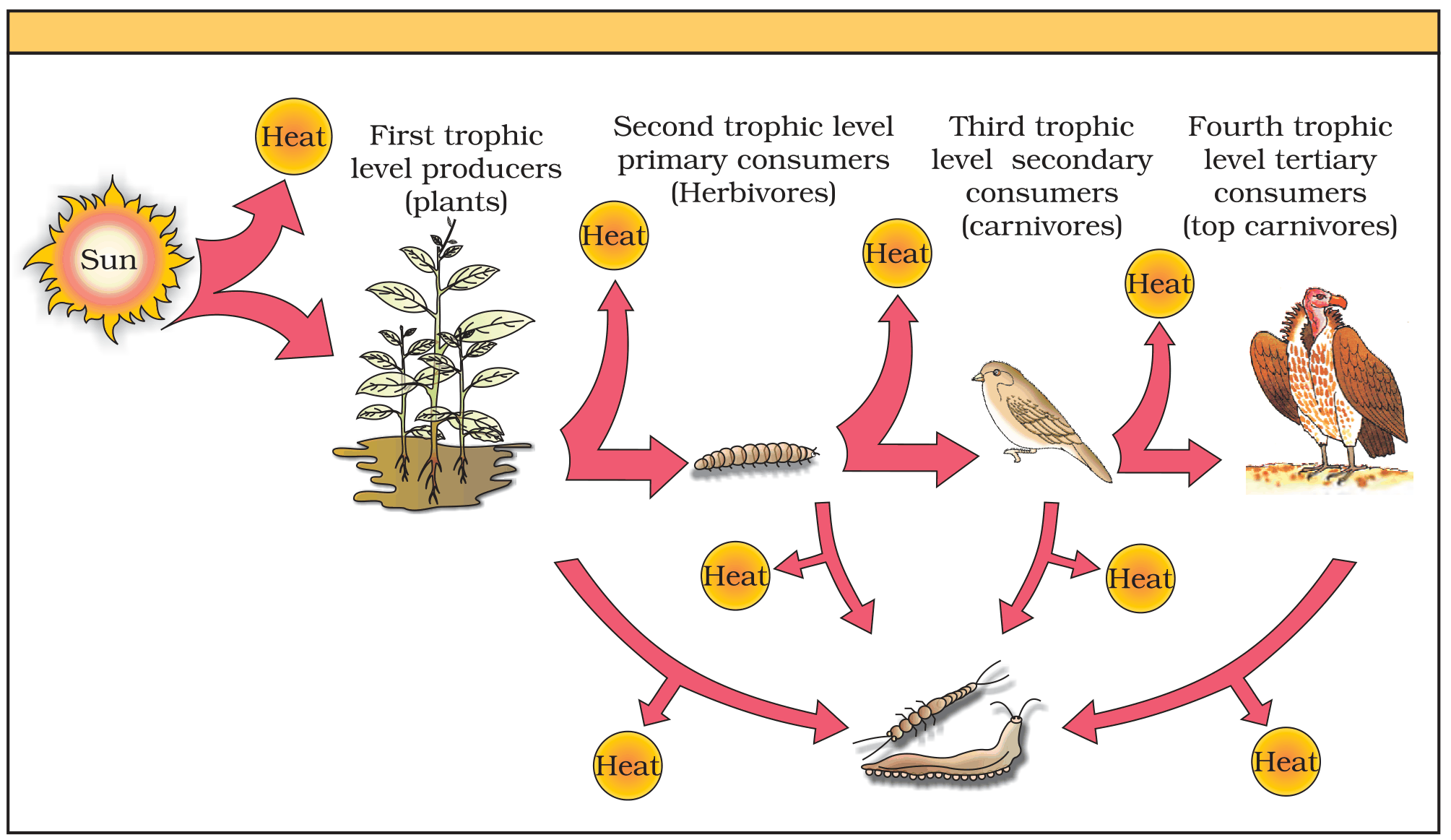
Textbook figure

Figure 12.3 Energy flow through different trophic levels

Advertisement

Practise more on Ecosystem

Chapter-wise mocks on the real NTA exam screen, with solutions and your rank. Your first mocks are free.

Start free mocks →

Advertisement

Next questions

  1. Which of the following rivers originates in a spring at Verinag in the south-eastern part of Kashmir?General Aptitude Test · General Knowledge
  2. The corner points of the feasible region determined by the following system of linear inequalities x+3y ≤ 60 , x+y ≥ 10 , x, y ≥ 0 are (0,…Maths. Section B1 · Linear Programming
  3. The money received from applicants to whom no debentures have been allotted will be:Accountancy Part A · Issue and Redemption of Debentures
  4. Select the INCORRECTLY spelt word.English · Spelling Check
  5. If the ratio of A : B is 5 : 4 and B : C is 3 : 5 then the ratio of A : B : C is:General Aptitude Test · Numerical Ability
  6. Nominal share capital is:Accountancy Part A · Accounting for Shares
  7. The value of tan^-1(-√3)+cos^-1≤ft(-displaystyle1/2) is:Maths. Section B1 · Inverse Trigonometric Functions
  8. In psychodynamic therapy, the chief method of treatment involves:Psychology · Therapeutic Approaches
  9. Seven girls A, B, C, D, E, F and G are sitting around a circular table facing opposite the centre (not necessarily in the same order). E is…General Aptitude Test · Verbal Reasoning
  10. What is the name of the process of recharging groundwater by collecting rainwater?General Aptitude Test · General Knowledge