Identify the correct statements.
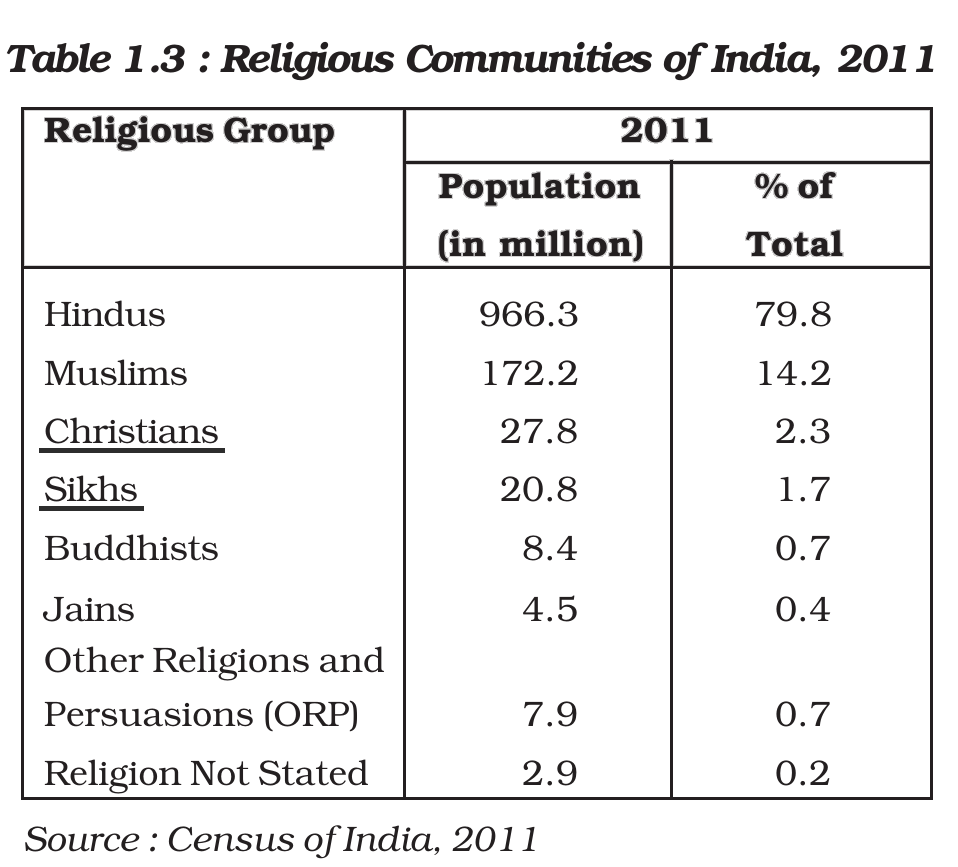
(A) The Sikh religion comprises the third largest religious community of India.
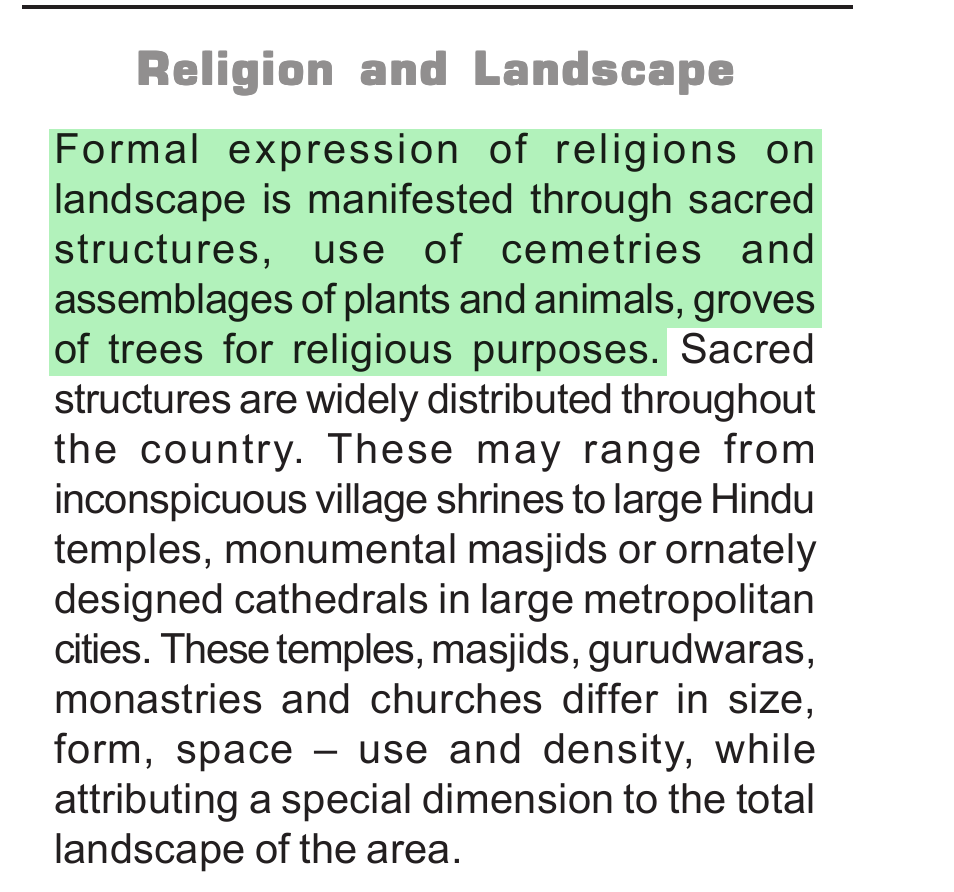
(B) The dominance of sacred structures exhibits the impact of religion on the landscape.
(C) The religious composition of the Indian population has high spatial variability.
(D) Muslims form majority in Lakshadweep.
Choose the correct answer from the options given below:
Answer & explanation
Correct answer: option 4
The correct answer is Option (4) → (B), (C) and (D) only
(A) The Sikh religion comprises the third largest religious community of India. Incorrect. The 2011 table puts Christians third (2.3 per cent), after Hindus and Muslims. Sikhs (1.7 per cent) come fourth.
(B) The dominance of sacred structures exhibits the impact of religion on the landscape. Correct. Religion is expressed on the landscape through sacred structures — village shrines, temples, masjids, gurudwaras, monasteries and churches — along with cemeteries and sacred groves.
(C) The religious composition of the Indian population has high spatial variability. Correct. Some states and districts have a large numerical strength of one religion while the same religion is barely present in other states. Hindus, for example, are a major group in many states but not in the hill states of the North-East or along the borders.
(D) Muslims form majority in Lakshadweep. Correct. Muslims, the largest religious minority, form a majority in the Kashmir valley and Lakshadweep.
NCERT (2025-26): “Religious Composition … Hindus are distributed as a major group in many states (ranging from 70 - 90 per cent and above) except the districts of states along Indo-Bangladesh border, Indo-Pak border, Jammu & Kashmir, Hill States of North-East and in scattered areas of Deccan Plateau and Ganga Plain.…” “Religious Composition … Muslims, the largest religious minority, are concentrated in Jammu & Kashmir, certain districts of West Bengal and Kerala, many districts of Uttar Pradesh , in and around Delhi and in Lakshadweep. They form majority in Kashmir valley and Lakshadweep.”
|