Match List-I with List-II
| List-I | List-II | ||
|---|---|---|---|
| (A) | Provident Fund (PF) | (I) | Net Salary |
| (B) | Compensation for erosion in the purchasing power of wage earner due to price rise | (II) | Statutory Deductions |
| (C) | Total Earnings (TE) – Total Deductions (TD) | (III) | DA |
| (D) | Spreadsheet application to calculate pay | (IV) | Payroll Accounting |
Choose the correct answer from the options given below:
Answer & explanation
Correct answer: option 2
The correct answer is Option (2) → (A) - (II), (B) - (III), (C) - (I), (D) - (IV)
Payroll accounting works out each employee’s salary from its earnings and deductions; match each item to where it sits in that working.
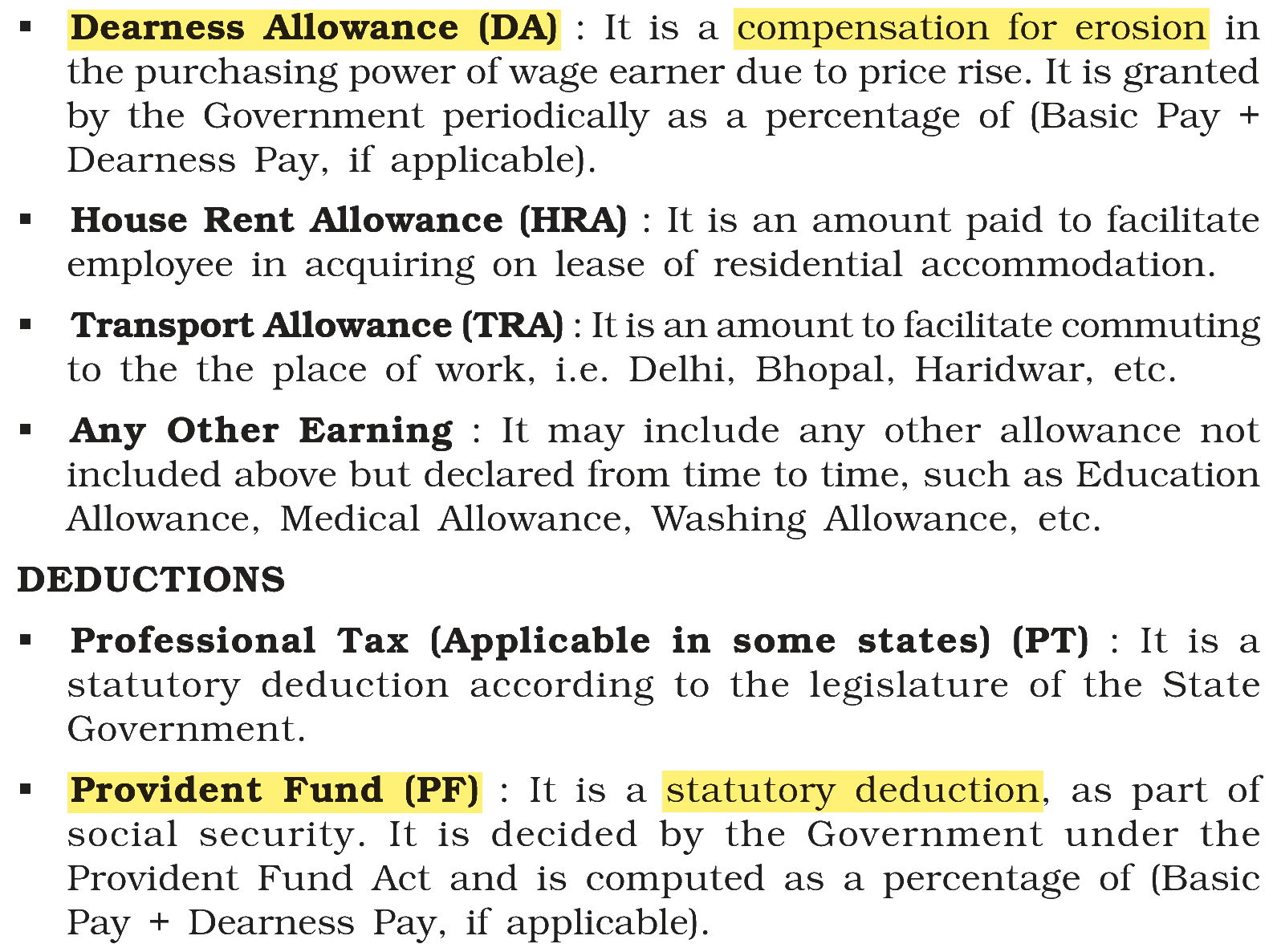
(A) Provident Fund (PF) — this matches (II) Statutory Deductions. PF is deducted from salary under the Provident Fund Act, as part of social security.
(B) Compensation for erosion in the purchasing power of wage earner due to price rise — this matches (III) DA. Dearness Allowance is an earning given as a percentage of pay to make up for rising prices.
(C) Total Earnings (TE) – Total Deductions (TD) — this matches (I) Net Salary. It is the amount actually payable to the employee.
(D) Spreadsheet application to calculate pay — this matches (IV) Payroll Accounting. Using a spreadsheet to compute every employee’s pay is the payroll application of Excel.
NCERT (2026-27 edition):
NCERT (2026-27 edition):
NCERT (2026-27 edition): |