Passage
Preparation & Chemical reactions of amines
Preparation:
Nitro compounds are reduced to amines by passing hydrogen gas in the presence of finely divided nickel, palladium, or platinum as catalyst. Nitriles on reduction with lithium aluminum hydride or catalytic hydrogenation produce primary amines. The Gabriel synthesis is used for the preparation of primary amines. Phthalimide on treatment with ethanolic potassium hydroxide forms potassium salt of phthalimide.
Chemical reactions:
Aliphatic and aromatic primary and secondary amines react with acid chlorides, anhydrides, and esters by nucleophilic substitution reaction. This reaction is known as acylation. Both aliphatic and aromatic primary amines on heating with chloroform and ethanolic potassium hydroxide give corresponding isocyanide. Benzenesulphonyl chloride also known as Hinsberg’s reagent reacts with primary and secondary amines to form sulphonamide. Aniline reacts with bromine water at room temperature to give a white precipitate of 2,4,6-tribromoaniline. Aniline reacts with HNO3 in the presence of H2SO4 to give nitro derivatives. Aniline reacts with concentrated sulphuric acid to form anilinium hydrogensulphate which on heating with sulphuric acid at 453-473K produces p-aminobenzene sulphonic acid or sulphanilic acid.
Which of the following will not respond to carbylamine test ?
Answer & explanation
Correct answer: option 2
The correct answer is Option (2) → N,N-Dimethylaniline
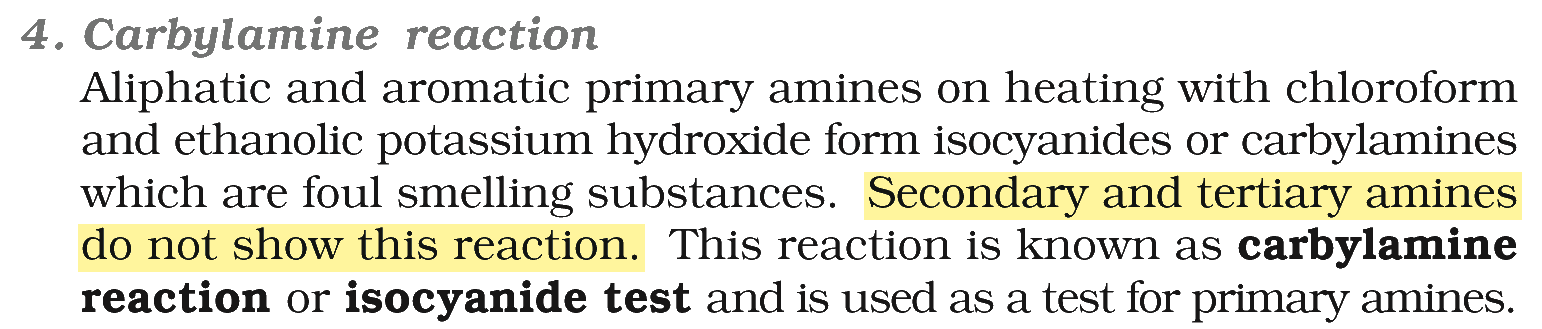
In the carbylamine test, an amine is heated with chloroform and ethanolic potassium hydroxide. A primary amine (aliphatic or aromatic) gives an isocyanide (carbylamine), recognised by its very unpleasant smell:
\( \displaystyle \ce{R-NH2 + CHCl3 + 3KOH} \xrightarrow{\text{heat}} \ce{R-NC + 3KCl + 3H2O} \)
The reaction needs two hydrogens on the nitrogen (–\( \ce{NH2} \)). Secondary and tertiary amines do not give this test, so it is used to identify primary amines.
Option (1) Aniline — Responds to the carbylamine test. \( \ce{C6H5NH2} \) is a primary aromatic amine.
Option (2) N,N-Dimethylaniline — Does not respond to the carbylamine test. \( \ce{C6H5N(CH3)2} \) is a tertiary amine with no hydrogen on nitrogen.
Option (3) p-Bromoaniline — Responds to the carbylamine test. The ring bromine does not affect the free –\( \ce{NH2} \) group; it is a primary aromatic amine.
Option (4) Ethylamine — Responds to the carbylamine test. \( \ce{C2H5NH2} \) is a primary aliphatic amine.
NCERT (2026-27 edition):
Carbylamine Reaction