Identify the correct sequence of events involved in pollen-pistil interaction.
(A) Pollen tube grows through stigma, style and reaches the ovary.
(B) Pollen tube enters one of the synergids through the filiform apparatus.
(C) The pollen grain germinates on the stigma to produce a pollen tube.
(D) Pollen tube, after reaching the ovary, enters the ovule through the micropyle.
Answer & explanation
Correct answer: option 2
The correct answer is Option (2) → (C), (A), (D), (B)
(C) The pollen grain germinates on the stigma to produce a pollen tube — first. Germination on a compatible stigma starts the whole process.
(A) Pollen tube grows through stigma, style and reaches the ovary — second. The tube can grow only after it has formed.
(D) Pollen tube, after reaching the ovary, enters the ovule through the micropyle — third. It must be at the ovary before it can reach the ovule.
(B) Pollen tube enters one of the synergids through the filiform apparatus — last. The synergids lie inside the embryo sac, which is inside the ovule, so this step comes after entry through the micropyle.
Note: A similar question was also asked in CUET (UG) 2026 on 22-05-2026 (Slot 1).
NCERT Extract:
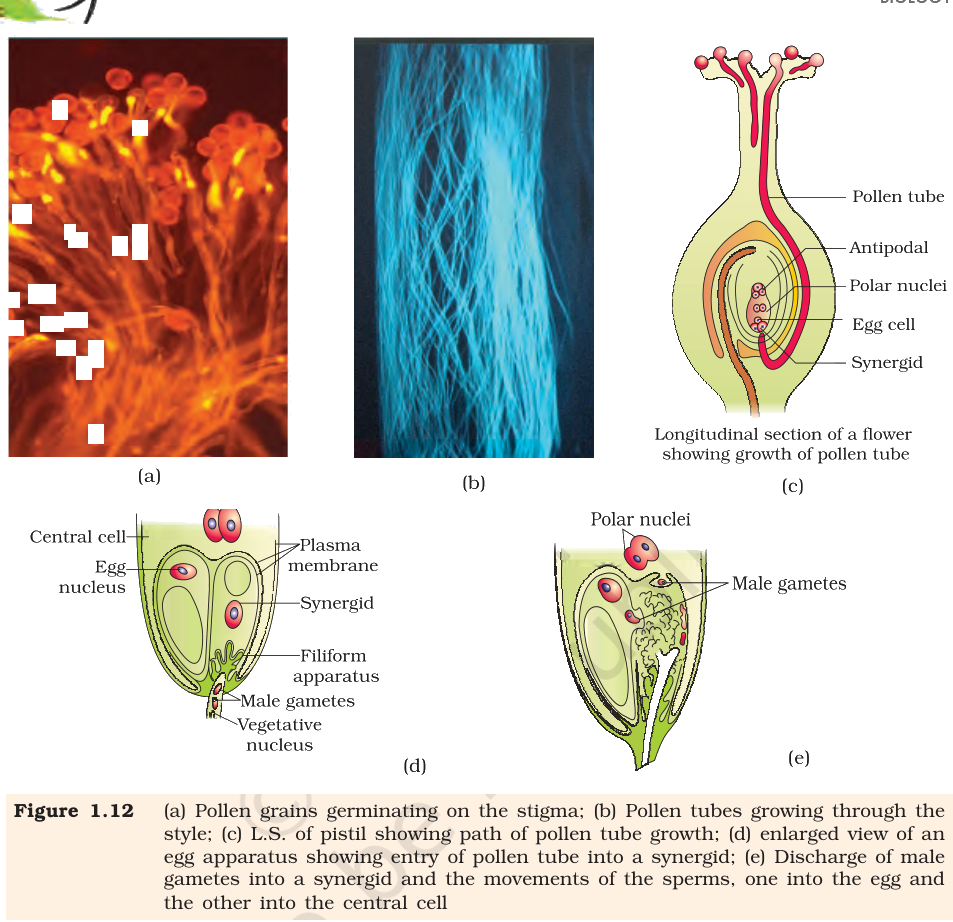
Pollination – “… As mentioned earlier, following compatible pollination, the pollen grain germinates on the stigma to produce a pollen tube through one of the germ pores (Figure 1.12a). The contents of the pollen grain move into the pollen tube. Pollen tube grows through the tissues of the stigma and style and reaches the ovary (Figure 1.12b, c). You would recall that in some plants, pollen grains are shed at two-celled condition (a vegetative cell and a generative cell). In such plants, the generative cell divides and forms the two male gametes during the growth of pollen tube in the stigma. In plants which shed pollen in the three-celled condition, pollen tubes carry the two male gametes from the beginning. Pollen tube, after reaching the ovary, enters the ovule through the micropyle and then enters one of the synergids through the filiform apparatus (Figure 1.12d, e).”