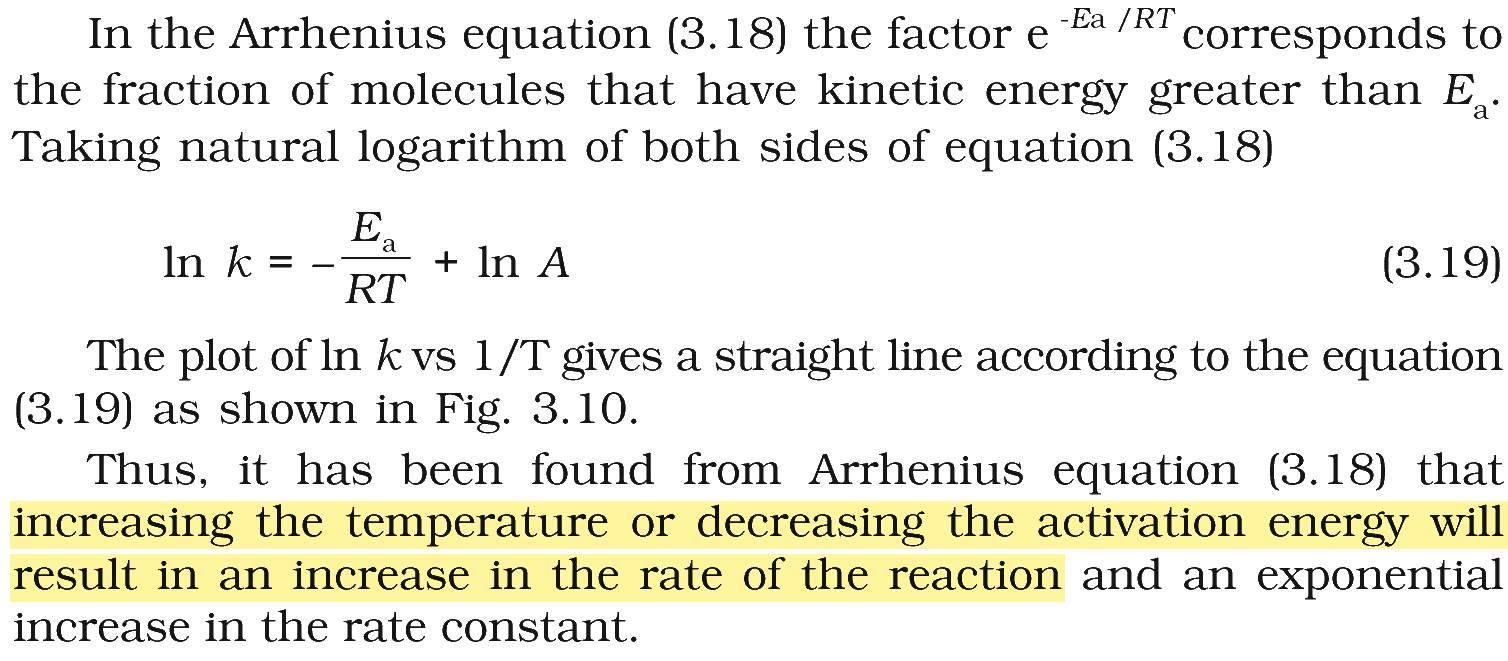
Consider and interpret the Arrhenius equation given below and mark the correct option(s):
\( k=Ae^{-E_a/RT} \)
(A) Rate constant increases with increase in activation energy and with decrease in temperature.
(B) Rate constant decreases with decrease in activation energy and with decrease in temperature.
(C) Rate constant increases with decrease in activation energy and with decrease in temperature.
(D) Rate constant increases with decrease in activation energy and with increase in temperature.
Answer & explanation
Correct answer: option 4
The correct answer is Option (4) → (D) only
In the Arrhenius equation, k = A e−Ea/RT, the factor e−Ea/RT is the fraction of molecules whose energy is equal to or greater than the activation energy. The larger this fraction, the larger k. Look at the exponent −Ea/RT:
Lower Ea makes the exponent less negative, so e−Ea/RT and k increase.
Higher T makes Ea/RT smaller, so again k increases. Lower T decreases k.
(A) Rate constant increases with increase in activation energy and with decrease in temperature. — Incorrect. Both parts are wrong: a higher Ea and a lower temperature both decrease k.
(B) Rate constant decreases with decrease in activation energy and with decrease in temperature. — Incorrect. A decrease in Ea increases k; only the temperature part is right.
(C) Rate constant increases with decrease in activation energy and with decrease in temperature. — Incorrect. The Ea part is right, but a decrease in temperature decreases k.
(D) Rate constant increases with decrease in activation energy and with increase in temperature. — Correct. Both changes make e−Ea/RT larger.
NCERT (2026-27 edition):
Temperature Dependence of the Rate of a Reaction – …