
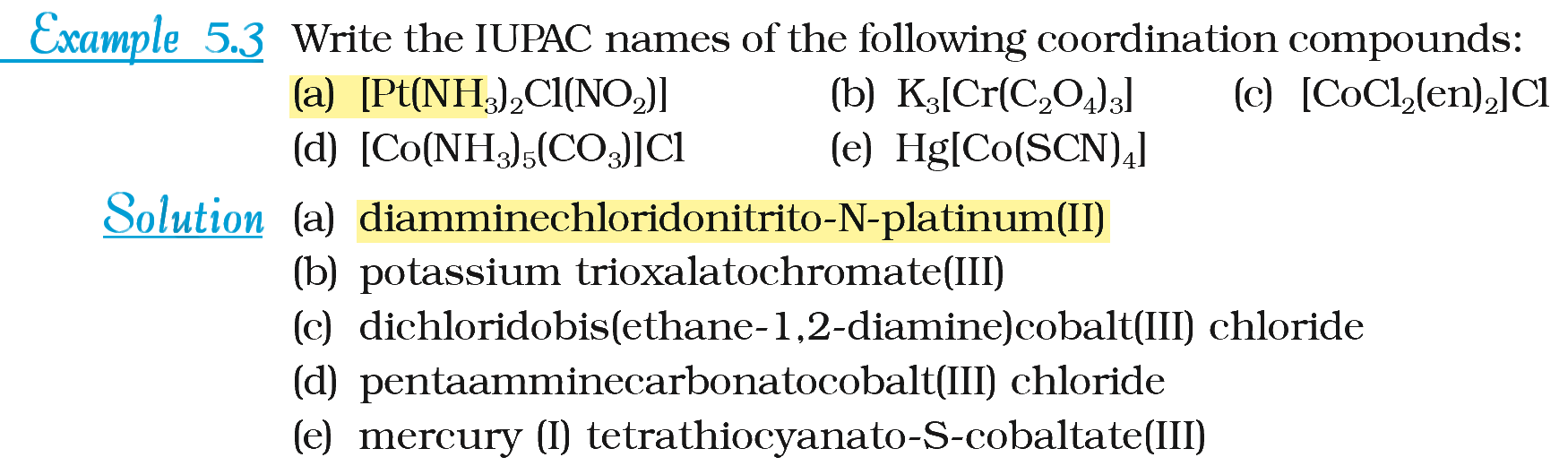
Which of the following is the correct IUPAC name for the [Pt(NH3)2Cl(NO2)] coordination compound?
Answer & explanation
Correct answer: option 1
The correct answer is Option (1) → Diamminechloridonitrito-N-platinum(II)
Coordination compounds are named by these IUPAC rules:
The ligands are named first, in alphabetical order, and then the metal. Prefixes such as di-, tri- are not counted in the alphabetical order.
Anionic ligands end in -o: \( \ce{Cl^{-}} \) is chlorido, \( \ce{CN^{-}} \) is cyanido. \( \ce{NO2^{-}} \) is nitrito-N when bound through N and nitrito-O when bound through O. Neutral ligands keep their names, except \( \ce{H2O} \) (aqua), \( \ce{NH3} \) (ammine), CO (carbonyl) and NO (nitrosyl).
The oxidation state of the metal is shown by a Roman numeral in parentheses.
If the complex is an anion, the metal name ends in -ate; for a neutral or cationic complex the metal keeps its normal name.
Applying these to \( \ce{[Pt(NH3)2Cl(NO2)]} \):
Ligands: two \( \ce{NH3} \) (diammine), one \( \ce{Cl^{-}} \) (chlorido), one \( \ce{NO2^{-}} \) written with N as the donor (nitrito-N). Alphabetical order: ammine, chlorido, nitrito.
Oxidation state of Pt:
\( \displaystyle x+2(0)+(-1)+(-1)=0 \Rightarrow x=+2 \)
The complex is neutral, so the metal is named platinum.
So the name is diamminechloridonitrito-N-platinum(II).
NCERT (2026-27 edition):
Naming of Mononuclear Coordination Compounds – …
Note: The same/similar question has been asked in different years by NTA as per the details given below:
| 2026 | 2025 | 2024 | 2023 | 2022 |
|---|---|---|---|---|
| 24-05 S1 | – | 29-05 S1 | – | – |