CUETMOCK
  • Pricing
  • Mentors
Log inStart freeStart free mocks→

First test, then trust

Try a free CUET mock test.

Join 5,00,000+ students who rehearsed exam day on the exact NTA screen before sitting CUET. On the web and on Android.

Start free mocks →Get the Android app
CUETMOCK

India's #1 CUET Mock Test Platform. Original NCERT-based questions on the exact NTA exam screen — trusted by 5,00,000+ students since CUET 2022.

Get it onGoogle PlayScan to download the CUETMOCK app

Mock tests

  • CUET mock test series
  • Commerce mocks
  • Humanities (Arts) mocks
  • Science mocks
  • Languages & GAT mocks
  • Free practice questions
  • Pricing

Resources

  • CUET exam guide
  • CUET syllabus
  • Universities accepting CUET
  • Expert blogs
  • News & notifications
  • Webinars & counselling
  • CUET score calculator
  • How we estimate your rank
  • FAQs

Company

  • About us
  • Our leadership & team
  • Our toppers
  • Mentors
  • For schools
  • Contact us
  • Terms
  • Privacy
  • Refund policy

Talk to us

+91 7696 6630 56info@cuetmock.comWhatsApp us

Our other platforms

  • JEE Mock — For IIT-JEE aspirants
  • NEET Mock — For NEET aspirants

Newsletter

Exam updates, study material and offers — no spam.

© 2026 NYC Ventures Pvt. Ltd.

701-702, Royal Business Park, Zirakpur, Punjab - 140603

  • Terms of use
  • Privacy policy
  • Refund policy
  • Contact us

iCUETMOCK is an independent preparation platform, not affiliated with the National Testing Agency (NTA). Always check exam details on the official NTA website.

  • Home
  • Mock tests
  • CUET guide
  • Pricing
  • Log in
Home/Practice questions/Sociology
SociologyIndian Society: Patterns of Social Inequality and Exclusion

Who led the movement against apartheid in Africa?

Read the passage carefully and answer the following questions

Race and Caste – A Cross-Cultural Comparison

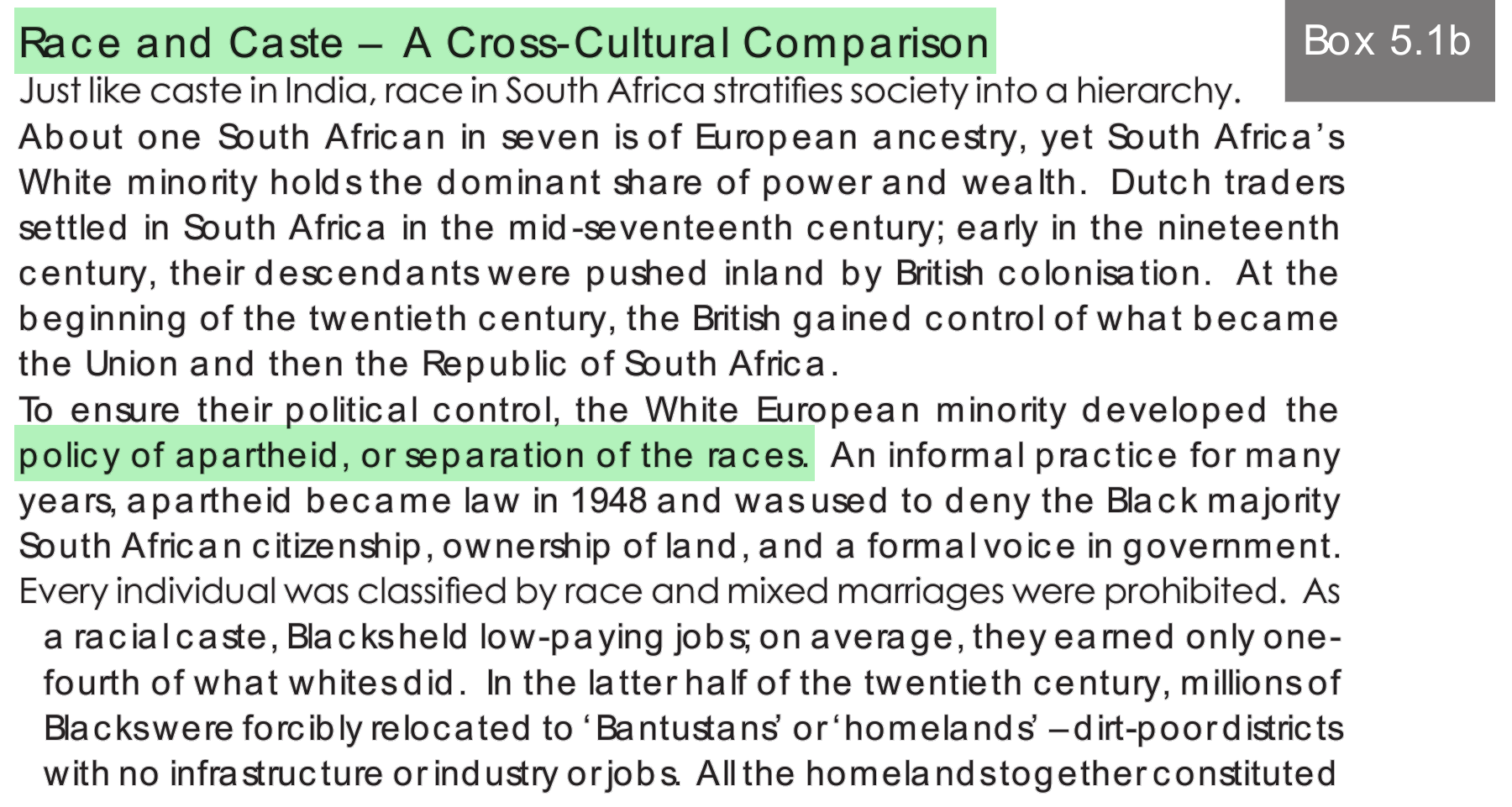
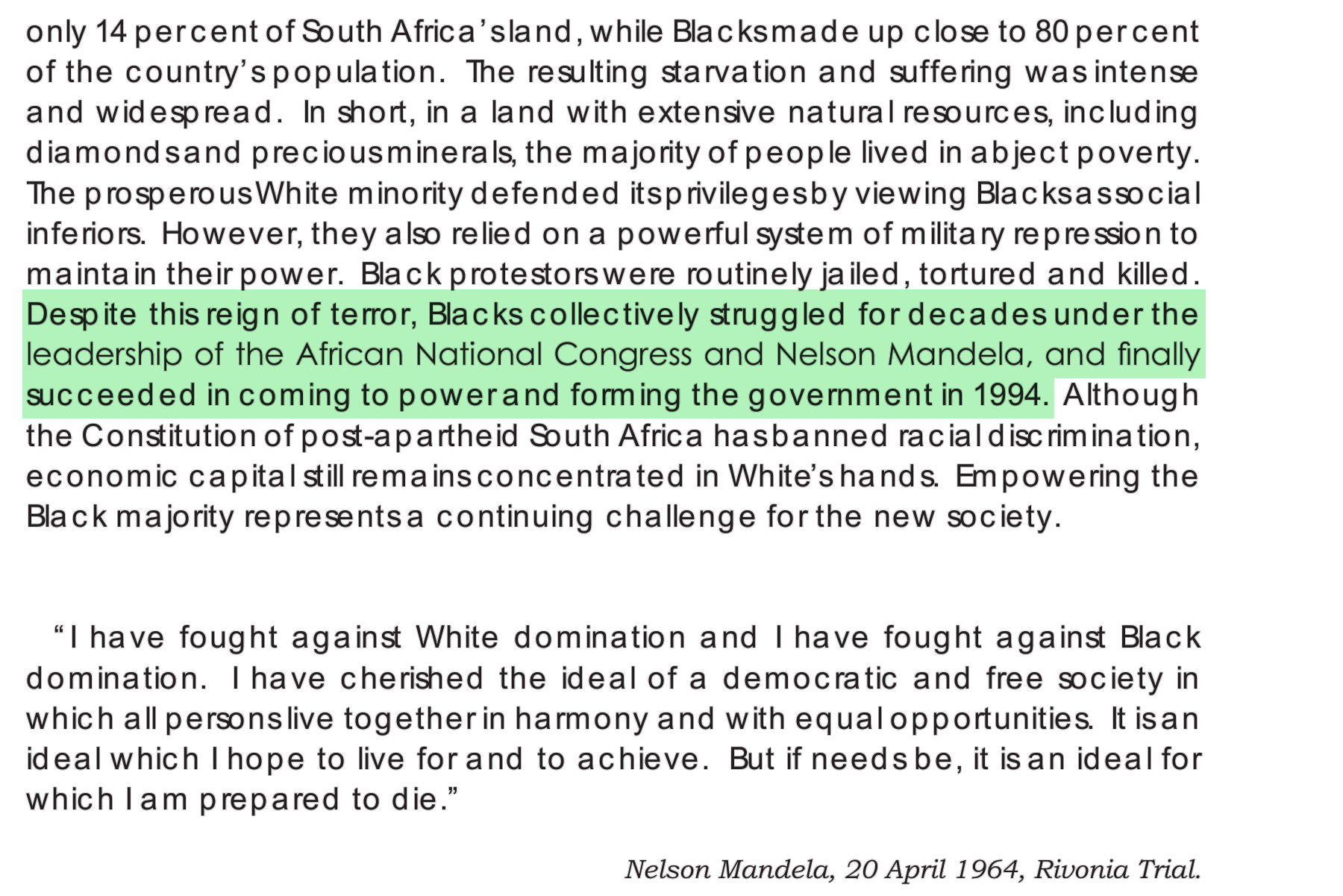
Just like caste in India, race, in South Africa stratifies society into a hierarchy. About one in seven is of European ancestry, yet South Africa’s White minority holds the dominant share of power and wealth. Dutch traders settled in South Africa in the mid-seventeenth century; early in the nineteenth century, their descendants were pushed inland by British colonisation. At the beginning of the twentieth century, the British gained control of what became the Union and then the Republic of South Africa. To ensure their political control, the White European minority developed the policy of apartheid, or separation of the races. An informal practice for many years, apartheid became law in 1948 and were used to deny the Black majority citizenship, ownership of land, and a formal voice in government. Every individual were classified by race, and mixed marriages were prohibited. As a racial caste, Blacks held low-paying jobs; on average, they earned only one-fourth of what whites did. In the latter half of the twentieth century, millions of Blacks were forcibly relocated to ‘Bantustans’ or ‘homelands’ – dirt-poor districts with no infrastructure, industry, or jobs. All the homelands together constituted only 14 percent of South Africa’s land, while Blacks made up close to 80 percent of the country’s population. The resulting starvation and suffering were intense and widespread. In short, in a land with extensive natural resources, including diamonds and precious minerals, the majority of people lived in abject poverty. The prosperous White minority defended its privileges by viewing Blacks as social inferiors. However, they also relied on a powerful system of military repression to maintain their power. Black protestors were routinely jailed, tortured, and killed. Despite this reign of terror, Blacks collectively struggled for decades under the leadership of the African National Congress and Nelson Mandela, and finally succeeded in coming to power and forming the government in 1994. Although the Constitution of post-apartheid South Africa has banned racial discrimination, economic capital still remains concentrated in White hands. Empowering the Black majority represents a continuing challenge for the new society. “I have fought against White domination and I have fought against Black domination. I have cherished the ideal of a democratic and free society in which all persons live together in harmony and with equal opportunities. It is an ideal which I hope to live for and to achieve. But if needs be, it is an ideal for which I am prepared to die.”

Who led the movement against apartheid in Africa?

Answer & explanation+

Correct answer: option 2

The correct answer is Option (2) → Nelson Mandela


NCERT: Indian Society — Chapter 5: Patterns of Social Inequality and Exclusion (2025-26)

NCERT extract

NCERT extract

Advertisement

Practise more on Indian Society: Patterns of Social Inequality and Exclusion

Chapter-wise mocks on the real NTA exam screen, with solutions and your rank. Your first mocks are free.

Start free mocks →

Advertisement

Next questions

  1. Identify the chart element that details the data values and categories below the chart.Accountancy Part C · Graphs and Charts for Business Data
  2. Three varieties of tea, A, B, C, are mixed in the ratio 1:3:1. The price of tea A is Rs. 1270 per kg and the price of tea C is Rs. 1350 per…Applied Maths. Section B2 · Numbers, Quantification and Numerical Applications
  3. Area bounded by the curves y=x^3,y=x+6 and x=0 isMaths. Section A · Application of Integrals
  4. Consider the 8th term of the following Arithmetic Progression.(A) 8, 3, −2...(B) 7, 13, 19...(C) 3, 8, 13...(D) 11, 16, 21...Arrange the 8t…General Aptitude Test · Quantitative Reasoning
  5. The 21st term of an Arithmetic Progression, whose 11th term is 38 and 16th term is 73, will be:General Aptitude Test · Quantitative Reasoning
  6. Which of the following attempts to bring a balance nullifying the ‘either’ ‘or’ dichotomy?Geography · Fundamentals of Human Geography: Human Geography-Nature and Scope
  7. The iron ore mines of Gurumahisani, Sulaipet, Kiruburu, and Bonai are located in which state of India?General Aptitude Test · General Knowledge
  8. What is the formula of tris(ethane-1,2-diamine)cobalt(III)sulphate?Chemistry · Inorganic: Coordination Compounds
  9. The function f(x)=-2x^3-9x^2-12x+5 is decreasing in the interval/s :Applied Maths. Section A · Applications of Derivatives (Section A)
  10. Three solid cubes of sides 1 cm, 6 cm and 8 cm are melted to form a new cube. The surface area of new cube is:General Aptitude Test · Quantitative Reasoning