
CUETMOCK
  • Pricing
  • Mentors
Log inStart freeStart free mocks→

First test, then trust

Try a free CUET mock test.

Join 5,00,000+ students who rehearsed exam day on the exact NTA screen before sitting CUET. On the web and on Android.

Start free mocks →Get the Android app
CUETMOCK

India's #1 CUET Mock Test Platform. Original NCERT-based questions on the exact NTA exam screen — trusted by 5,00,000+ students since CUET 2022.

Get it onGoogle PlayScan to download the CUETMOCK app

Mock tests

  • CUET mock test series
  • Browse all papers
  • Commerce mocks
  • Humanities (Arts) mocks
  • Science mocks
  • Languages & GAT mocks
  • Free practice questions
  • Pricing

Resources

  • CUET exam guide
  • CUET syllabus
  • Universities accepting CUET
  • Expert blogs
  • News & notifications
  • Webinars & counselling
  • CUET score calculator
  • How we estimate your rank
  • FAQs

Company

  • About us
  • Our leadership & team
  • Our toppers
  • Mentors
  • For schools
  • Contact us
  • Terms
  • Privacy
  • Refund policy

Talk to us

+91 7696 6630 56info@cuetmock.comWhatsApp us

Our other platforms

  • JEE Mock — For IIT-JEE aspirants
  • NEET Mock — For NEET aspirants

Newsletter

Exam updates, study material and offers — no spam.

© 2026 NYC Ventures Pvt. Ltd.

701-702, Royal Business Park, Zirakpur, Punjab - 140603

  • Terms of use
  • Privacy policy
  • Refund policy
  • Contact us

iCUETMOCK is an independent preparation platform, not affiliated with the National Testing Agency (NTA). Always check exam details on the official NTA website.

  • Home
  • Mock tests
  • CUET guide
  • Pricing
  • Log in
Home/Practice questions/Chemistry
ChemistryInorganic: D and F Block Elements

V2O5 is _______ in nature which reacts with alkalies as well as acids…

d-Block Elements

The metals of the first series with the exception of copper are relatively more reactive and are oxidised by 1M H+, though the actual rate at which these metals react with oxidising agents like hydrogen ion (H+) is sometimes slow. For example, titanium and vanadium, in practice, are passive to dilute non oxidising acids at room temperature. The E° values for M2+/M indicate a decreasing tendency to form divalent cations across the series. It is interesting to note that the E° values for Mn, Ni and Zn are more negative than expected from the general trend. Whereas the stabilities of half-filled d subshell (d5) in Mn2+ and completely filled d subshell (d10) in zinc are related to their E° values; for nickel, E° value is related to the highest negative enthalpy of hydration.

V2O5 is _______ in nature which reacts with alkalies as well as acids to give ______ and _______ respectively.

Answer & explanation+

Correct answer: option 3

The correct answer is Option (3) → Amphoteric, VO43− and VO4+ ions.

The nature of a transition metal oxide depends on the oxidation state of the metal:

  • Low oxidation states give basic oxides (e.g. MnO).

  • High oxidation states give acidic oxides (e.g. \( \ce{Mn2O7} \), \( \ce{CrO3} \)).

  • Intermediate cases can be amphoteric, reacting with both acids and alkalis.

In \( \ce{V2O5} \), the charge balance gives 2x + 5(−2) = 0, so V is +5. \( \ce{V2O5} \) is amphoteric, though mainly acidic:

  • With alkalis it gives the vanadate ion, VO43−:

        \( \displaystyle \ce{V2O5 + 6NaOH -> 2Na3VO4 + 3H2O} \)

  • With acids it gives the dioxovanadium(V) ion, VO2+:

        \( \displaystyle \ce{V2O5 + 2H^+ -> 2VO2^+ + H2O} \)

Why the other options are incorrect

  • Option (1) Acidic, VO43− and VO4+ ions — Incorrect. A purely acidic oxide would not dissolve in acids; \( \ce{V2O5} \) does.

  • Option (2) Basic, VO43− and VO4+ ions — Incorrect. A basic oxide would not react with alkalis; \( \ce{V2O5} \) does, and V in the +5 state is not basic.

  • Option (4) Neutral VO43− and VO2+ ions — Incorrect. A neutral oxide reacts with neither acids nor alkalis, and \( \ce{VO^{2+}} \) (the vanadyl ion) contains V in the +4 state, not +5.

Note: Options (1), (2) and (3) write the ion formed with acids as VO4+, as the NCERT textbook does in this sentence (extract below). Earlier in the same paragraph, the book names these as VO2+ salts (the dioxovanadium(V) ion), the ion shown in the equation above.

NCERT (2026-27 edition):
Oxides and Oxoanions of Metals – …
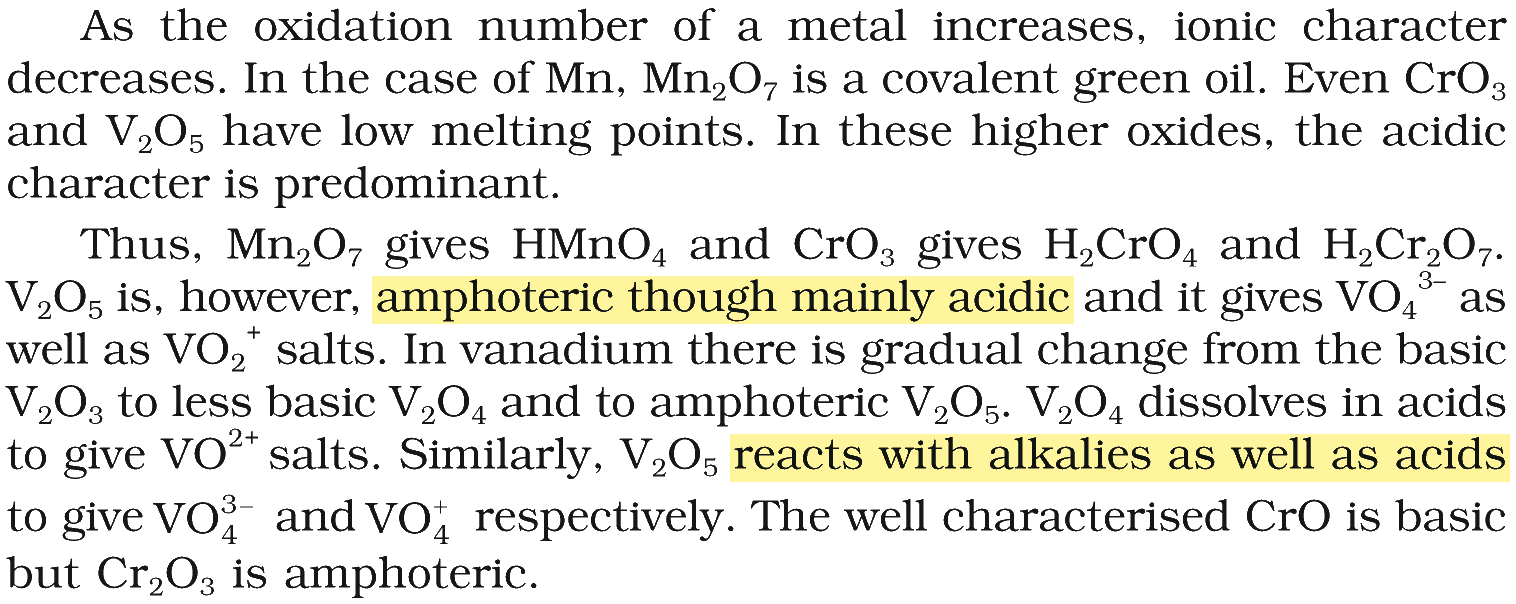
Textbook extract

Advertisement

Practise more on Inorganic: D and F Block Elements

Chapter-wise mocks on the real NTA exam screen, with solutions and your rank. Your first mocks are free.

Start free mocks →

Advertisement

Next questions

  1. 'चार किलो चावल लाना'- इस वाक्य में विशेषण का भेद बताइए।Hindi · व्याकरण - विशेषण
  2. Identify from the following, who Cannot file a complaint under Consumer Protection Act.Business Studies · Consumer Protection
  3. Identify the category of newspapers that cater to the different needs of readers in small towns and villages, some of which introduced dist…Sociology · Social Change and Development in India: Mass Media and Communication
  4. What is the formula of the exponential population growth curve?Biology · Organisms and Populations
  5. Match List I with List II List IList II A. Range of |x|I. (-5, ∞) B. Range of 9x^2 + 6x - 5 for all x ≥ 0 II. [0, ∞) C. Domain of displayst…Maths. Section B1 · Relations and Functions
  6. Arjun's teacher links the goddess from Bihar to Tantric forms of worship. Which of the following statements about Tantric practices is corr…History · Medieval India: Bhakti Sufi Traditions
  7. Q is the centre of a circle and ZXWQ is a parallelogram, where X is a point on the minor arc ZW and Z, W also lie on the circle. What is th…General Aptitude Test · Quantitative Reasoning
  8. Which of the following statements about the advantages of seeds to angiosperms are correct?A. Seed formation is more dependable as pollinat…Biology · Sexual Reproduction in Flowering Plants
  9. What is the energy stored in the capacitor with the dielectric and without the dielectric, respectively?Physics · Electrostatic Potential and Capacitance
  10. Which text mentions about a queen named Kamalavati, who tried to persuade her husband to renounce the world?History · Ancient India: Thinkers, Beliefs and Buildings