James Watson and Francis Crick gave a double strand helix structure for DNA. Two Nucleic acid chains are wound about each other and held together by hydrogen bonds between pairs of bases. The two strands are complementary to each other because the hydrogen bonds are formed between specific pairs of bases. Adenine forms hydrogen bonds with thymine whereas cytosine forms hydrogen bonds with guanine.
Nucleic acids are known as the polymers of nucleotides and these nucleotides are joined together through phosphodiester linkage. Identify the correct sequence of attachment.
Answer & explanation
Correct answer: option 1
The correct answer is Option (1) → Phosphate - Sugar - base
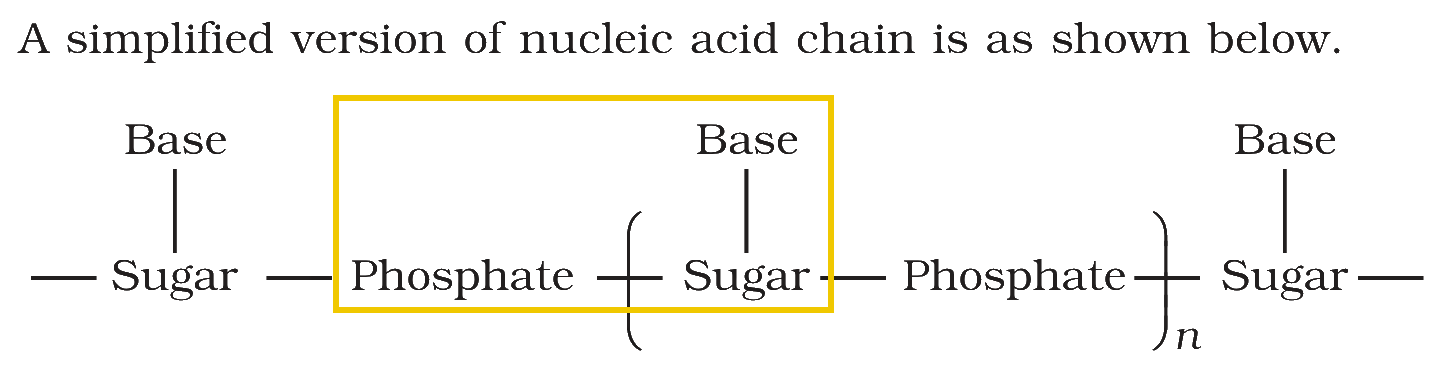
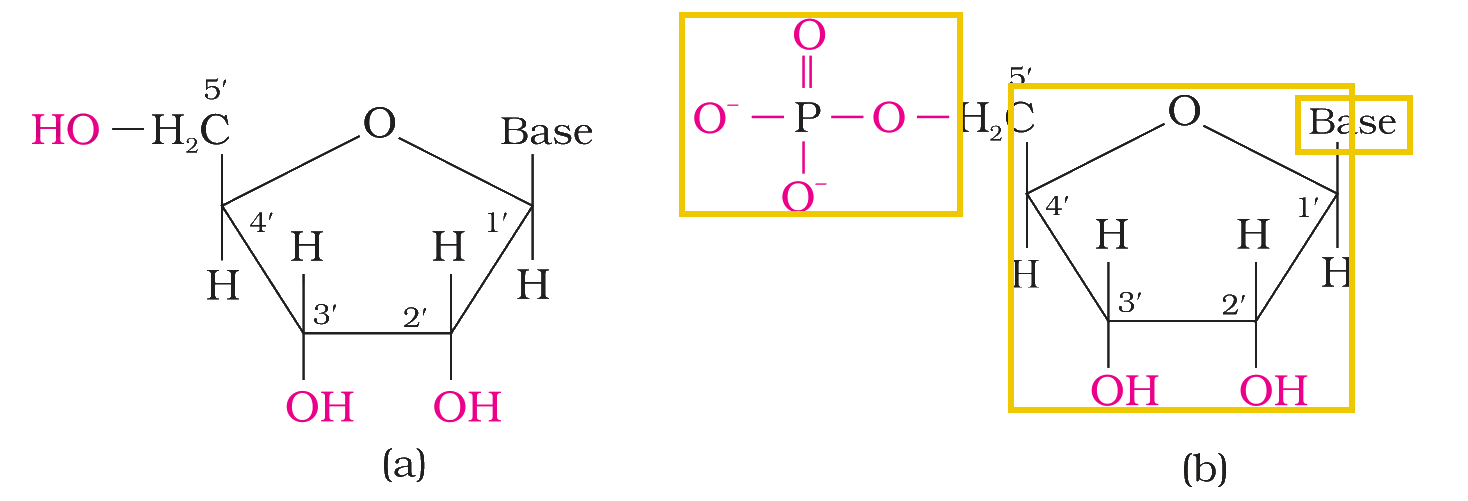
A nucleotide has three parts: a nitrogenous base, a pentose sugar and a phosphate. The base is attached to the 1′ carbon of the sugar (this unit is a nucleoside), and the phosphoric acid is attached to the 5′ carbon of the same sugar. So the phosphate and the base are both bonded to the sugar, which sits between them:
Phosphate – Sugar – Base
Nucleotides are then joined into a chain by phosphodiester linkages between the 5′ and 3′ carbons of the sugars, giving a sugar–phosphate backbone with the bases hanging from the sugars.
Why the other options are incorrect
Option (2) Base - sugar - Base — Incorrect. Each sugar carries only one base; two bases are never attached to the same sugar.
Option (3) Sugar - Base - Sugar — Incorrect. The bases are not part of the chain; they are attached to the sugars and project from the backbone.
Option (4) Phosphate - Base - phosphate — Incorrect. The phosphate is bonded to the sugar, not to the base.
NCERT (2026-27 edition):
Structure of Nucleic Acids – “A unit formed by the attachment of a base to 1′ position of sugar is known as nucleoside. In nucleosides, the sugar carbons are numbered as 1′, 2′, 3′, etc. in order to distinguish these from the bases (Fig. 10.5a). When nucleoside is linked to phosphoric acid at 5′-position of sugar moiety, we get a nucleotide (Fig. 10.5).”
Structure of Nucleic Acids – …