
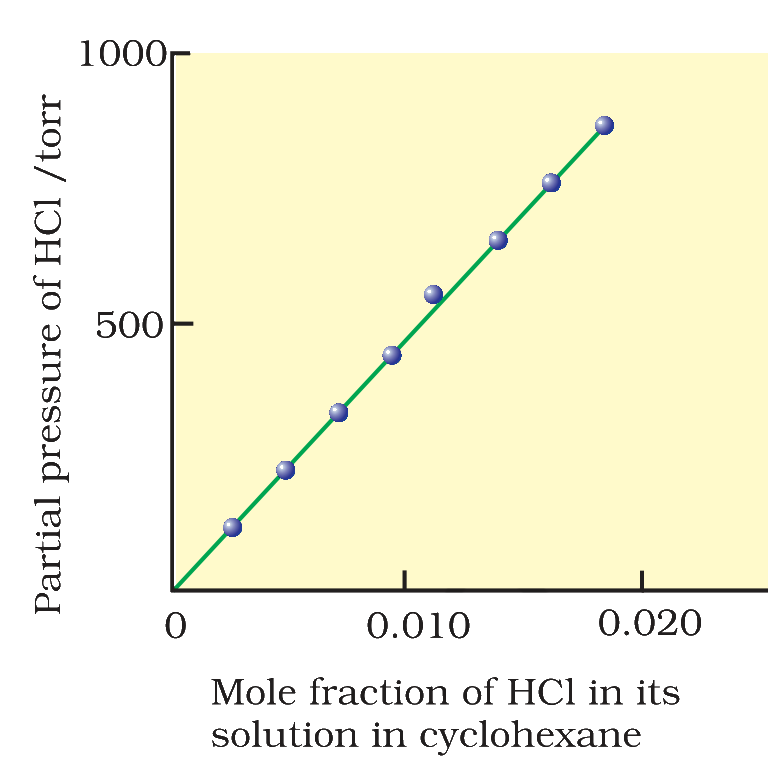
The figure shows the experimental results for the solubility of HCl gas in cyclohexane at 293 K.
According to the figure, if the partial pressure of HCl over the solution is doubled at the same temperature, what happens to the mole fraction of HCl in the solution?
Answer & explanation
Correct answer: option 3
The correct answer is Option (3) → It is doubled.
The points of the figure lie on a straight line that passes through the origin. So the partial pressure of HCl is directly proportional to its mole fraction in the solution. This is Henry’s law:
\( \displaystyle p = K_H\,x \qquad x = \frac{p}{K_H} \)
At a fixed temperature KH is constant, so when p is doubled, x is also doubled.
Why the other options are incorrect
Option (1) It is halved. — Incorrect. A halving would need the line to fall as the pressure rises. In the figure both quantities rise together along a straight line.
Option (2) It does not change. — Incorrect. An unchanged mole fraction would give a vertical line at one value of x. In the figure the mole fraction of HCl grows as its pressure grows.
Option (4) It becomes four times. — Incorrect. The mole fraction is proportional to the first power of the pressure, not to its square, so it changes by the same factor of 2.
NCERT (2026-27 edition):
1.3.2 Solubility of a Gas in a Liquid – “The most commonly used form of Henry’s law states that ‘the partial pressure of the gas in vapour phase (p) is proportional to the mole fraction of the gas (x) in the solution’ and is expressed as: p = KH x (1.11). Here KH is the Henry’s law constant. If we draw a graph between partial pressure of the gas versus mole fraction of the gas in solution, then we should get a plot of the type as shown in Fig. 1.2.”
Fig. 1.2: Experimental results for the solubility of HCl gas in cyclohexane at 293 K. The slope of the line is the Henry’s Law constant, KH.