
CUETMOCK
  • Pricing
  • Mentors
Log inStart freeStart free mocks→

First test, then trust

Try a free CUET mock test.

Join 5,00,000+ students who rehearsed exam day on the exact NTA screen before sitting CUET. On the web and on Android.

Start free mocks →Get the Android app
CUETMOCK

India's #1 CUET Mock Test Platform. Original NCERT-based questions on the exact NTA exam screen — trusted by 5,00,000+ students since CUET 2022.

Get it onGoogle PlayScan to download the CUETMOCK app

Mock tests

  • CUET mock test series
  • Commerce mocks
  • Humanities (Arts) mocks
  • Science mocks
  • Languages & GAT mocks
  • Free practice questions
  • Pricing

Resources

  • CUET exam guide
  • CUET syllabus
  • Universities accepting CUET
  • Expert blogs
  • News & notifications
  • Webinars & counselling
  • CUET score calculator
  • How we estimate your rank
  • FAQs

Company

  • About us
  • Our leadership & team
  • Our toppers
  • Mentors
  • For schools
  • Contact us
  • Terms
  • Privacy
  • Refund policy

Talk to us

+91 7696 6630 56info@cuetmock.comWhatsApp us

Our other platforms

  • JEE Mock — For IIT-JEE aspirants
  • NEET Mock — For NEET aspirants

Newsletter

Exam updates, study material and offers — no spam.

© 2026 NYC Ventures Pvt. Ltd.

701-702, Royal Business Park, Zirakpur, Punjab - 140603

  • Terms of use
  • Privacy policy
  • Refund policy
  • Contact us

iCUETMOCK is an independent preparation platform, not affiliated with the National Testing Agency (NTA). Always check exam details on the official NTA website.

  • Home
  • Mock tests
  • CUET guide
  • Pricing
  • Log in
Home/Practice questions/Chemistry
ChemistryInorganic: D and F Block Elements

The cuprous ion (Cu+) is colourless while the cupric ion (Cu2+) is co…

Transition metals form coloured ions or compounds due to partially filled d orbitals. In the presence of solvent molecules (in solutions), ligands (in complexes) or counter ions (in crystals), the d orbitals split into two sets. An electron in a transition metal ion that occupies the set of d orbitals of lower energy can be excited to the set of higher energy by absorbing energy from visible light. Since the energy difference (ΔE) between the two sets of d orbitals is small, only light of the visible region is absorbed during this excitation. The colour of a transition metal ion is due to this d–d excitation (d–d transition) of the electron. During d–d excitation the electron absorbs one colour of visible light, and the ion appears in the complementary colour of the absorbed light. Complementary colours can be identified from the colour wheel shown below (complementary colours lie opposite each other).
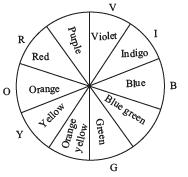
Colour wheel

The number of electrons undergoing d–d transition and the energy difference between the two sets of orbitals decide the colour.

The cuprous ion (Cu+) is colourless while the cupric ion (Cu2+) is coloured because

Answer & explanation+

Correct answer: option 4

The correct answer is Option (4) → Cu+ has completely filled d orbitals and Cu2+ has incompletely filled d orbitals

The passage states that transition metal ions are coloured because of partially filled d orbitals: an electron in the lower set of split d orbitals absorbs visible light and is excited to the higher set (a d–d transition). An ion with no d electron or a full d subshell has no such transition.

  • Configuration of Cu: Cu (Z = 29) is [Ar]3d104s1.

  • \( \ce{Cu^+} \): losing the 4s electron gives 3d10, a completely filled d subshell; no d–d transition is possible, so the ion is colourless.

  • \( \ce{Cu^2+} \): losing the 4s electron and one 3d electron gives 3d9, an incompletely filled d subshell; a d–d transition absorbs visible light, so the ion is coloured.

Why the other options are incorrect

Option (1) both ions have unpaired electrons in the d orbitals — Incorrect. In 3d10 \( \ce{Cu^+} \) all ten d electrons are paired; only \( \ce{Cu^2+} \) (3d9) has one unpaired electron.

Option (2) both ions have half-filled d orbitals — Incorrect. A half-filled d subshell is d5; the two ions are d10 and d9.

Option (3) Cu+ has incompletely filled d orbitals and Cu2+ has completely filled d orbitals — Incorrect. This is the reverse of the real configurations: \( \ce{Cu^+} \) is 3d10 and \( \ce{Cu^2+} \) is 3d9.

Advertisement

Practise more on Inorganic: D and F Block Elements

Chapter-wise mocks on the real NTA exam screen, with solutions and your rank. Your first mocks are free.

Start free mocks →

Advertisement

Next questions

  1. The function f(x)= […] is continuous at x=0 for the value of ’ λ ’ as:Maths. Section B1 · Continuity and Differentiability
  2. Which flap covers the opening of the windpipe during swallowing, so that food does not enter it?General Aptitude Test · General Knowledge
  3. The goods which are used in the production of finished goods are:Business Studies · Marketing
  4. The optimal value of linear programming problem maximum Z = 3x + 4y, subject to, x + 3y ≤ 12 x + y ≥ 8 x, y ≥ 0 isMaths. Section B1 · Linear Programming
  5. Under which method of revenue collection described in the Ain were several intelligent inspectors required, since otherwise the evil-minded…History · Medieval India: Peasants, Zamindars and the State
  6. Let A be a square matrix of order 3 such that A(adj A) = […] . Then the value of |A| + |adj A| isMaths. Section A · Determinants
  7. Choose the most appropriate synonym of the given word.SPECIOUSEnglish · Synonyms
  8. 'पहेलियाँ' शब्द का एकवचन रूप है -Hindi · वचन
  9. Which property of mature seeds is crucial for their storage, so that they can be used as food throughout the year and to raise a crop in th…Biology · Sexual Reproduction in Flowering Plants
  10. Fill in the blank with the most appropriate option:Unless you ______ the milk in the next hour, it will turn sour in this heat.English · Grammar: Tenses