Microsoft company makes an investment of 100 million USD in India. With respect to balance of payments this will be recorded in _____________.
(A) Debit side of Current Account
(B) Credit side of Capital Account
(C) Credit side of Current Account
(D) Debit side of Capital Account
Choose the correct answer from the options given below :
Answer & explanation
Correct answer: option 2
The correct answer is Option (2) → (B) Only
A foreign company investing in India is foreign direct investment, an item of the capital account. The money comes into India, so it is a credit.
(A) Debit side of Current Account — False. The current account records trade in goods and services, income and transfers. This investment is a transaction in assets, and it brings money in.
(B) Credit side of Capital Account — True. The capital account records purchases and sales of assets. Foreign exchange flows into India, as when an Indian company’s share is sold to a foreign buyer.
(C) Credit side of Current Account — False. The money does come in, but an investment is a transaction in assets, so it is outside the current account.
(D) Debit side of Capital Account — False. A debit here is money flowing out of India, as when an Indian buys a company abroad.
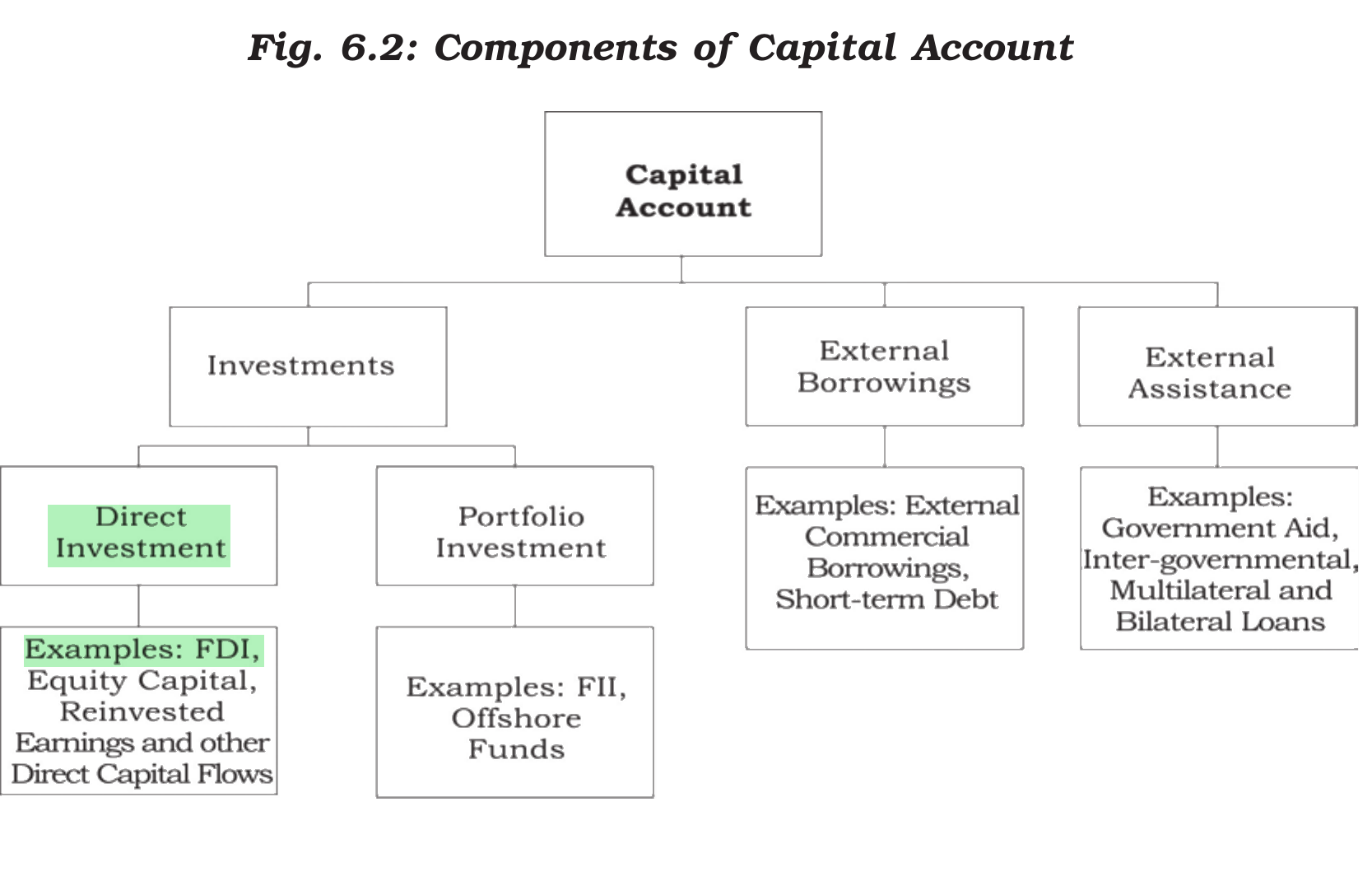
NCERT (2026-27): “6.1.2 Capital Account … Capital Account records all international transactions of assets. An asset is any one of the forms in which wealth can be held, for example: money, stocks, bonds, Government debt, etc. Purchase of assets is a debit item on the capital account. If an Indian buys a UK Car Company, it enters capital account transactions as a debit item (as foreign exchange is flowing out of India). On the other hand, sale of assets like sale of share of an Indian company to a Chinese customer is a credit item on the capital account. Fig. 6.2 classifies the items which are a part of capital account transactions. These items are Foreign Direct Investments (FDIs), Foreign Institutional Investments (FIIs), external borrowings and assistance. …Capital account is in balance when capital inflows (like receipt of loans from abroad, sale of assets or shares in foreign companies) are equal to capital outflows…”
|