The following reaction of benzene with carbon monoxide and hydrogen chloride in the presence of aluminum trichloride to give benzaldehyde is known as
Answer & explanation
Correct answer: option 2
The correct answer is Option (2) → Gatterman-Koch reaction
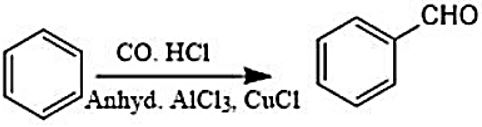
Benzene can be converted directly into benzaldehyde by treating it with carbon monoxide and hydrogen chloride in the presence of anhydrous aluminium chloride or cuprous chloride. This is the Gatterman-Koch reaction. The CO and HCl act together like formyl chloride (HCOCl), which is too unstable to be used itself; with \( \ce{AlCl3} \) they give the electrophile that attacks the ring, so the reaction is an electrophilic substitution that puts a –CHO group on the ring:
\( \displaystyle \ce{C6H6} \xrightarrow{\ce{CO},\ \ce{HCl},\ \text{anhyd. }\ce{AlCl3}/\ce{CuCl}} \ce{C6H5CHO} \)
So the reaction shown is the Gatterman-Koch reaction.
Why the other options are incorrect
Option (1) Kolbe's reaction — Incorrect. Sodium phenoxide is heated with \( \ce{CO2} \) under pressure, then acidified, to give salicylic acid; it starts from phenol, not benzene, and gives an acid:
\( \displaystyle \ce{C6H5ONa} \xrightarrow[\text{(ii) }\ce{H+}]{\text{(i) }\ce{CO2}} o\text{-}\ce{HOC6H4COOH} \)
Option (3) Williamson synthesis — Incorrect. An alkyl halide reacts with a sodium alkoxide to give an ether, \( \ce{R-X + R'ONa -> R-O-R' + NaX} \); no carbonyl compound is formed.
Option (4) Friedel-Crafts reaction — Incorrect. Benzene reacts with an alkyl halide or an acyl chloride and anhydrous \( \ce{AlCl3} \) to give an alkylbenzene or a ketone, for example \( \ce{C6H6 + CH3COCl -> C6H5COCH3 + HCl} \); with CO and HCl the reaction has its own name, Gatterman-Koch.
NCERT (2026-27 edition):
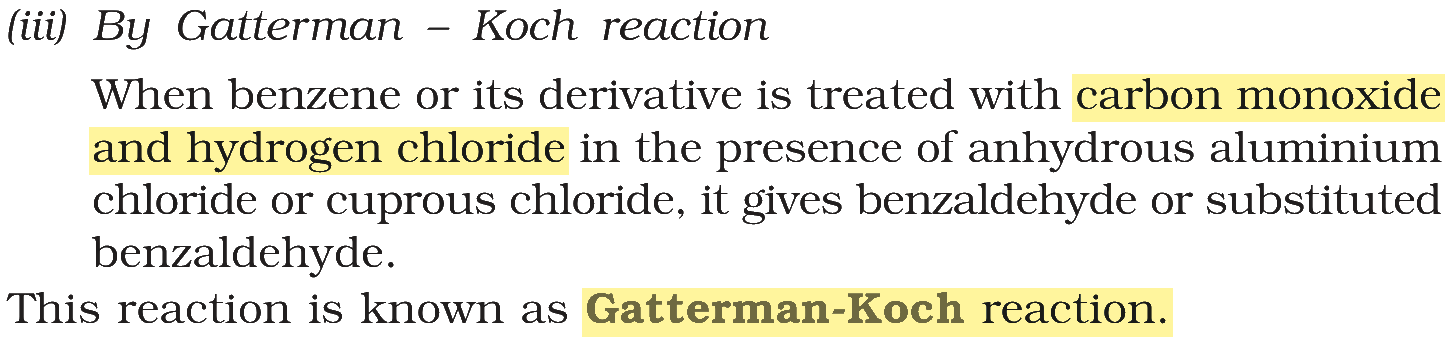
By Gatterman-Koch Reaction