
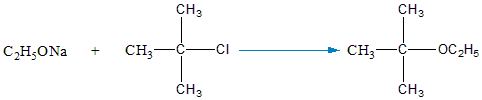
The following is not an appropriate reaction for the preparation of t-butyl ethyl ether because:
Answer & explanation
Correct answer: option 3
The correct answer is Option (3) → Sodium ethoxide is a strong base
Note: The given answer is as per the official NTA Answer Key. However, there is more than one correct option for this question, as explained below.
In Williamson synthesis an alkoxide ion attacks an alkyl halide by an SN2 mechanism. The alkoxide is a good nucleophile but also a strong base, so with secondary and especially tertiary halides elimination competes with substitution. A tertiary carbon is too crowded for backside attack, while its nine β-hydrogens are easy for a strong base to remove. So ethoxide pulls off a β-hydrogen and 2-methylpropene is formed instead of the ether:
\( \ce{C2H5ONa + (CH3)3C-Cl -> CH2=C(CH3)2 + C2H5OH + NaCl} \)
t-Butyl ethyl ether is made the other way round, from the tertiary alkoxide and the primary halide:
\( \ce{(CH3)3C-ONa + C2H5-Cl -> (CH3)3C-O-C2H5 + NaCl} \)
Option (1) Sodium ethoxide is a weak base — Incorrect. Ethoxide is a strong base (stronger than OH–), which is the very reason elimination takes over.
Option (2) Alkyl halide is tertiary in nature — Is also correct. The book says that if a tertiary alkyl halide is used, an alkene is the only reaction product and no ether is formed. The tertiary halide and the strongly basic ethoxide together cause the elimination, so this option also states a reason.
Option (3) Sodium ethoxide is a strong base — Correct. The strongly basic ethoxide removes a β-hydrogen from the crowded tertiary halide instead of attacking the carbon, so 2-methylpropene is formed.
Option (4) The ether formed is very bulky — Incorrect. t-Butyl ethyl ether is a stable compound and is easily made by the reverse combination shown above; its size is not the problem.
NCERT (2026-27 edition):
Williamson Synthesis – …
