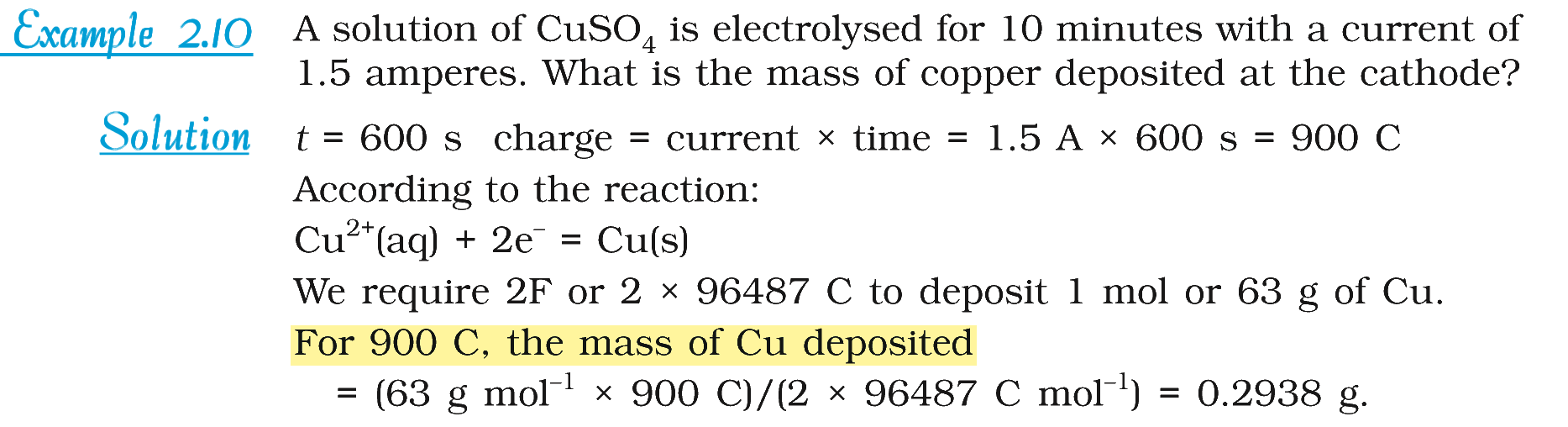
A solution of CuSO4 is electrolysed for 10 minutes with a current of 1.5 amperes. What is the mass of copper deposited at the cathode? (Molar mass of Cu is 63 g mol–1).
Answer & explanation
Correct answer: option 3
The correct answer is Option (3) → 0.293g
Faraday’s first law of electrolysis states that the mass of a substance deposited at an electrode is directly proportional to the quantity of charge passed. The charge is
\( \displaystyle Q=I\times t \)
One mole of electrons carries 1 F = 96500 C. To deposit one mole of a metal from its ion Mn+, n moles of electrons are needed:
\( \displaystyle \mathrm{M^{n+}}+n\,\mathrm{e^-}\rightarrow\mathrm{M} \)
\( \displaystyle \text{Mass deposited}=\frac{\text{Molar mass}\times Q}{n\times F} \)
Here the current is 1.5 A for 10 minutes (600 s), and copper is deposited from \( \ce{Cu^{2+}} \), so n = 2:
\( \displaystyle \ce{Cu^2+ + 2e^- -> Cu} \)
\( \displaystyle Q=1.5\ \mathrm{A}\times600\ \mathrm{s}=900\ \mathrm{C} \)
\( \displaystyle \text{Mass of Cu}=\frac{63\times900}{2\times96500} \)
\( \displaystyle \text{Mass of Cu}=\frac{56700}{193000}=0.293\ \mathrm{g} \)
So the mass of copper deposited at the cathode is 0.293 g.
Shortcut: The options differ only in the power of ten. 900 C is less than 1% of the 193000 C needed to deposit 63 g, so the mass must be well below 1 g. Only 0.293 g (Option 3) fits.
Note: This question is from NCERT (2026-27). NTA sets numerical questions from NCERT too, so do not ignore NCERT while practising numericals.
NCERT (2026-27 edition):
Electrolytic Cells and Electrolysis – …