Observe the image and answer the following question.
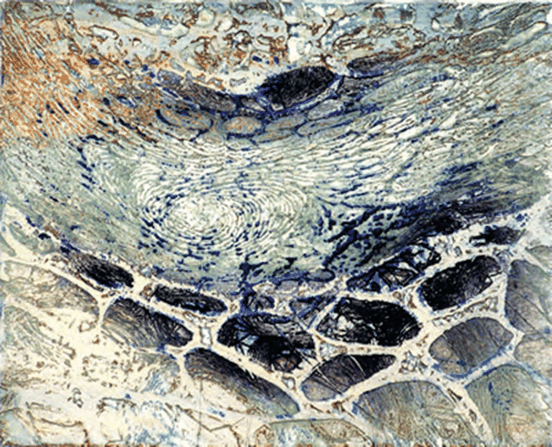
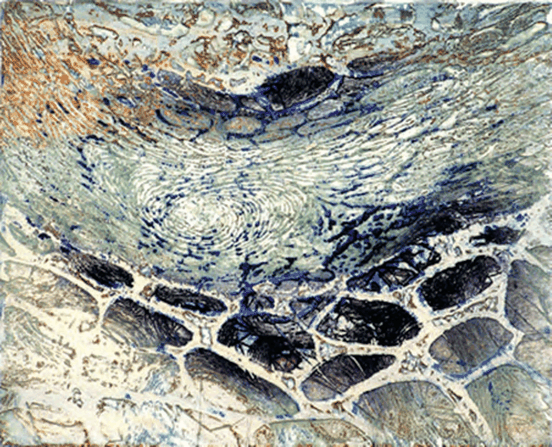
The print in the image was made by Krishna Reddy using ‘viscosity printing’. How do its colours appear in the finished composition?
Answer & explanation
Correct answer: option 2
The correct answer is Option (2) → Each colour blends into the other to create a powerful web of design
Option (1) Bright colour patches are placed close to each other to form flat shapes — Incorrect. Amrita Sher-Gil built the figures of Haldi Grinder this way, with bright colour patches and flat shapes.
Option (2) Each colour blends into the other to create a powerful web of design — Correct. In Krishna Reddy’s Whirlpool, shades of blues blend into one another to form a powerful web of design.
Option (3) Colours are applied as in quick, sketchy brush strokes — Incorrect. K. G. Subramanyan applied colours in quick brush strokes in Fairy Tales from Purvapalli.
Option (4) Highly ornate contours mark out each of the forms — Incorrect. Highly ornate contours mark Laxma Goud’s etching Rural South Indian Man–Woman.
Note: This topic was not named in the CUET 2026 syllabus, but it was part of the NCERT chapter. In 2025 and 2026, NTA also asked questions on topics in NCERT that the CUET syllabus did not name. So our mocks have questions from every part of the NCERT chapter, to give you enough practice. Read the whole chapter, not only the sub-topics named in the syllabus.
NCERT (2026-27): “Whirlpool This was a print made by India’s celebrated printmaker Krishna Reddy in 1963. It is a captivating composition created out of various shades of blues. Each colour blends into the other to create a powerful web of design. It is the result of a new technique in printmaking that he developed along with a well-known printmaker, Stanley William Hayter, in the famous studio called ‘Atelier 17’. This method came to be known as ‘viscosity printing’, in which different colours are applied on the same metal printing plate.”
|