
Select the seeds with perisperm from the following options.
Answer & explanation
Correct answer: option 4
The correct answer is Option (4) → Beet and black pepper
Perisperm and endosperm are both food-storing tissues of a seed, but they come from different parts. The endosperm forms after fertilisation from the primary endosperm nucleus. The perisperm is left over from the nucellus, the tissue of the ovule itself.
Option (1) Pea and groundnut — Incorrect. These are non-albuminous seeds. The embryo uses up the whole endosperm, and no nucellus remains either.
Option (2) Maize and black pepper — Incorrect. Black pepper has perisperm, but maize is an albuminous seed. What maize keeps is a part of its endosperm, not the nucellus.
Option (3) Beet and castor — Incorrect. Beet has perisperm, but castor is also an albuminous seed. Its food reserve is endosperm.
Option (4) Beet and black pepper — Correct. In both these seeds remnants of the nucellus persist, so both have perisperm.
NCERT Extract:
Seed – “In angiosperms, the seed is the final product of sexual reproduction. It is often described as a fertilised ovule. Seeds are formed inside fruits. A seed typically consists of seed coat(s), cotyledon(s) and an embryo axis. The cotyledons (Figure 1.15a) of the embryo are simple structures, generally thick and swollen due to storage of food reserves (as in legumes). Mature seeds may be non-albuminous or ex-albuminous. Non-albuminous seeds have no residual endosperm as it is completely consumed during embryo development (e.g., pea, groundnut). Albuminous seeds retain a part of endosperm as it is not completely used up during embryo development (e.g., wheat, maize, barley, castor). Occasionally, in some seeds such as black pepper and beet, remnants of nucellus are also persistent. This residual, persistent nucellus is the perisperm.”
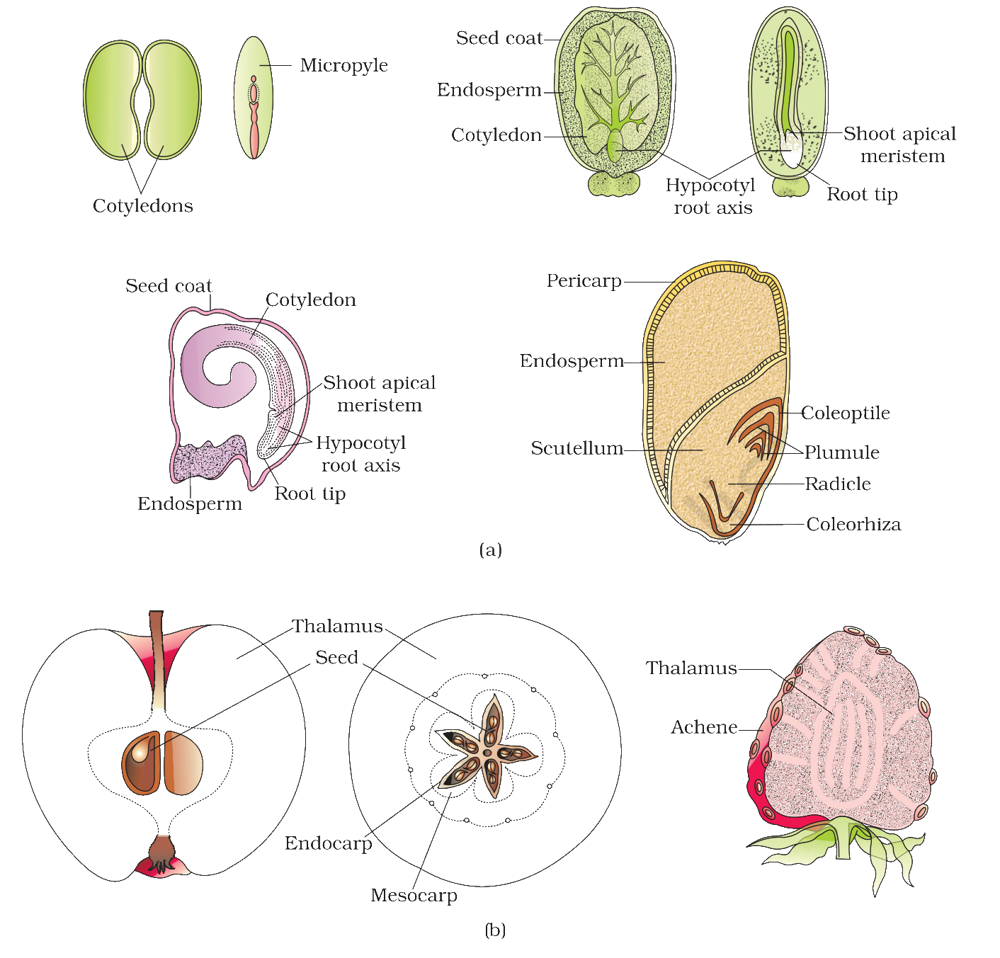
Figure 1.15 (a) Structure of some seeds. (b) False fruits of apple and strawberry