
Read the information given below to answer
In Young’s double slit experiment as shown in figure, interference of light waves were observed on the screen. Thomas Young made two pinholes \( S_1 \) and \( S_2 \) (very close to each other) on an opaque screen in front of parent source \( S \)
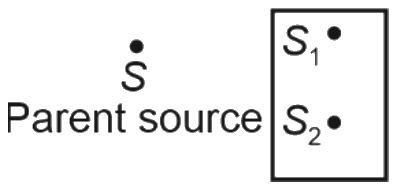
\( S_1 \) and \( S_2 \) behaved as coherent sources, and produced interference pattern on the screen which has alternate bright fringe and dark fringes. This experiment proved Huygens’ wave theory of Light.
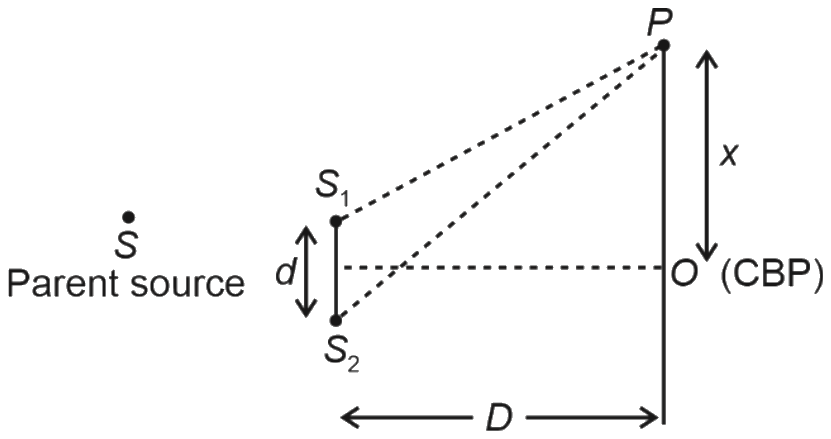
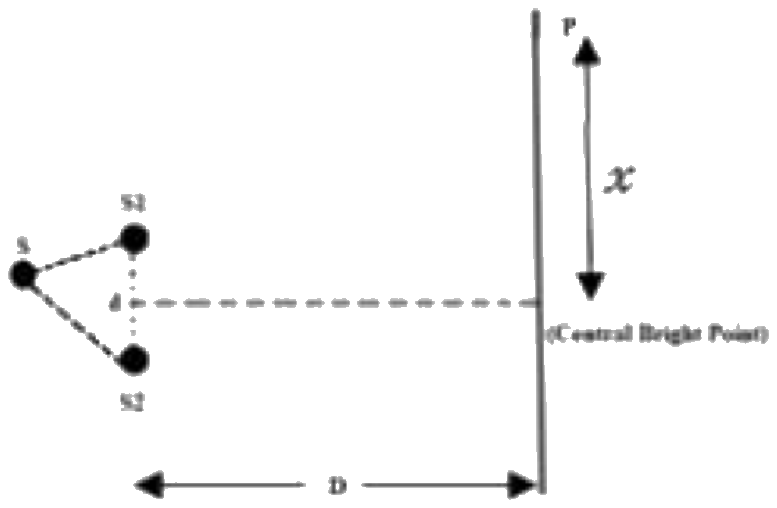
In YDSE as shown, the path difference \( SS_2 - SS_1 = \displaystyle\frac{\lambda}{3} \). This causes the shift in position of central bright point. The new position of central bright point is
Answer & explanation
Correct answer: option 4
The correct answer is Option (4) → \( -\displaystyle\frac{1}{3}\frac{\lambda D}{d} \)
The central bright point is where the two waves arrive in phase, i.e. where the total path difference from the source \( S \) is zero. When \( S \) is not equidistant from the slits, the path difference \( SS_2 - SS_1 \) already exists before the slits, and the central point moves to make up for it.
Take \( x \) along the screen measured from the centre O, positive towards \( P \) (the \( S_1 \) side, as in the figure). At a point \( x \) on the screen the path difference after the slits is
\( \displaystyle S_2P - S_1P = \frac{x\,d}{D} \)
The total path difference from \( S \) to \( P \) by the two routes is
\( \displaystyle (SS_2 + S_2P) - (SS_1 + S_1P) = \frac{\lambda}{3} + \frac{x\,d}{D} \)
For the central bright point this must be zero:
\( \displaystyle \frac{\lambda}{3} + \frac{x\,d}{D} = 0 \)
\( \displaystyle x = -\frac{1}{3}\,\frac{\lambda D}{d} \)
The minus sign means the central bright point moves below O, towards \( S_2 \), the slit with the longer path from the source: the shorter path beyond \( S_2 \) compensates for the longer path before it.