
Case based
The British physicist Thomas used an ingenious technique to lock the phases of the waves emanating from two coherent sources $S_1$ and $S_2$. As these sources were derived from same source symmetrically placed wrt $S_1$ and $S_2$, the phases of waves were same. If any abrupt change happens in original sources, will manifest exactly similar phase changes in the light coming out of two sources $S_1$ to $S_2$. Due to constructive interference and destructive interference at different points in space and screen alternate dark and bright fringes of equal width were obtained. This pattern was called as interference pattern. The width of each band was equal with central fringe as bright fringe.
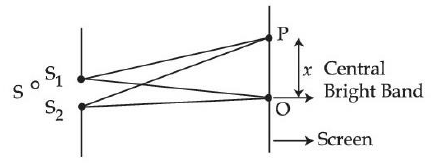
In Young's double slit experiment, interference pattern is obtained on the screen. If one of the slits is closed, then:
Answer & explanation
Correct answer: option 3
The correct answer is Option (3) → Intensity of central maximum decreases and while width of central maximum increases
With both slits open, the intensity at the central maximum,
$I_{max}=4I_0$
with one slit closed, only single-slit diffraction occurs,
$I_{max}=I_0$
In YDSE, the fring width is,
$β=\frac{λD}{d}$
∴ for single-slit diffraction,
$W=\frac{2λD}{a}$ $[a<d]$
∴ Intensity of central maximum decreases while width of central maximum increases.