
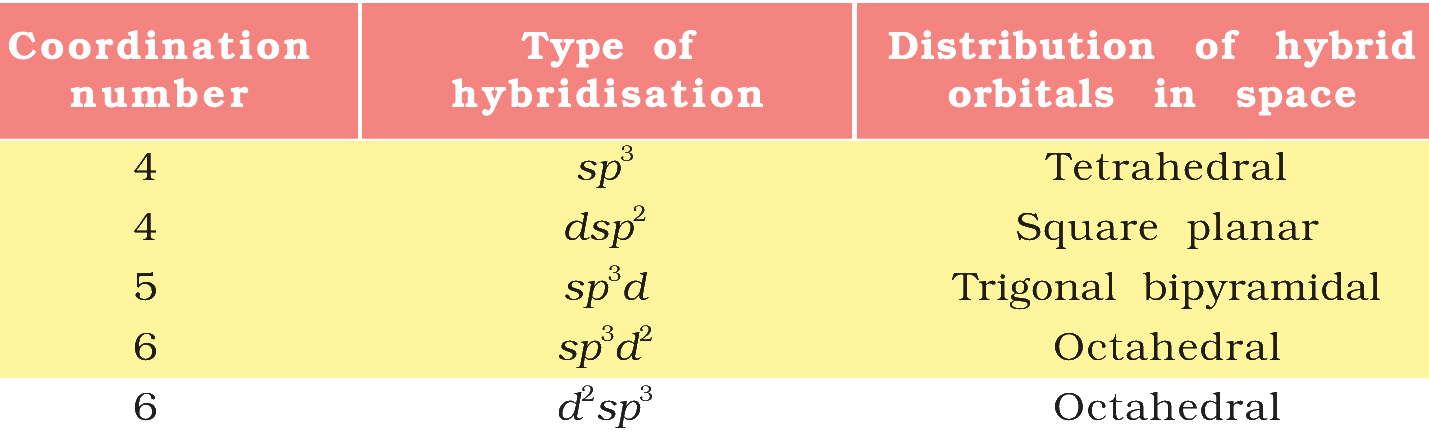
Match List-I with List-II.
| List-I Types of hybridisation | List-II Distribution of hybrid orbitals in space |
| (A) sp3 | (I) Trigonal bipyramidal |
| (B) dsp2 | (II) Octahedral |
| (C) sp3d | (III) Tetrahedral |
| (D) sp3d2 | (IV) Square Planar |
Choose the correct answer from the options given below :
Answer & explanation
Correct answer: option 4
The correct answer is Option (4) → (A)-(III), (B)-(IV), (C)-(I), (D)-(II)
In the valence bond theory the metal uses a set of equivalent hybrid orbitals, and the number and type of orbitals mixed decide the shape. The hybrid orbitals point to the corners of a regular figure, and the ligands sit at those corners.
(A) sp3 — This matches (III) Tetrahedral. One s and three p orbitals give four orbitals at 109.5°, as in \( \ce{[NiCl4]^2-} \).
(B) dsp2 — This matches (IV) Square Planar. One inner d (\( d_{x^2-y^2} \)), one s and two p orbitals give four orbitals in one plane at 90°, as in \( \ce{[Ni(CN)4]^2-} \).
(C) sp3d — This matches (I) Trigonal bipyramidal. Five orbitals: three in a plane at 120° and two along the axis above and below.
(D) sp3d2 — This matches (II) Octahedral. Six orbitals pointing to the corners of an octahedron, as in \( \ce{[CoF6]^3-} \).
Shortcut: (A)-(III) appears only in Option (4).
NCERT (2026-27 edition):
Valence Bond Theory – …
Note: The same/similar question has been asked in different years by NTA as per the details given below:
| 2026 | 2025 | 2024 | 2023 | 2022 |
|---|---|---|---|---|
| – | 16-05 S1 | 19-07 S1 | – | – |