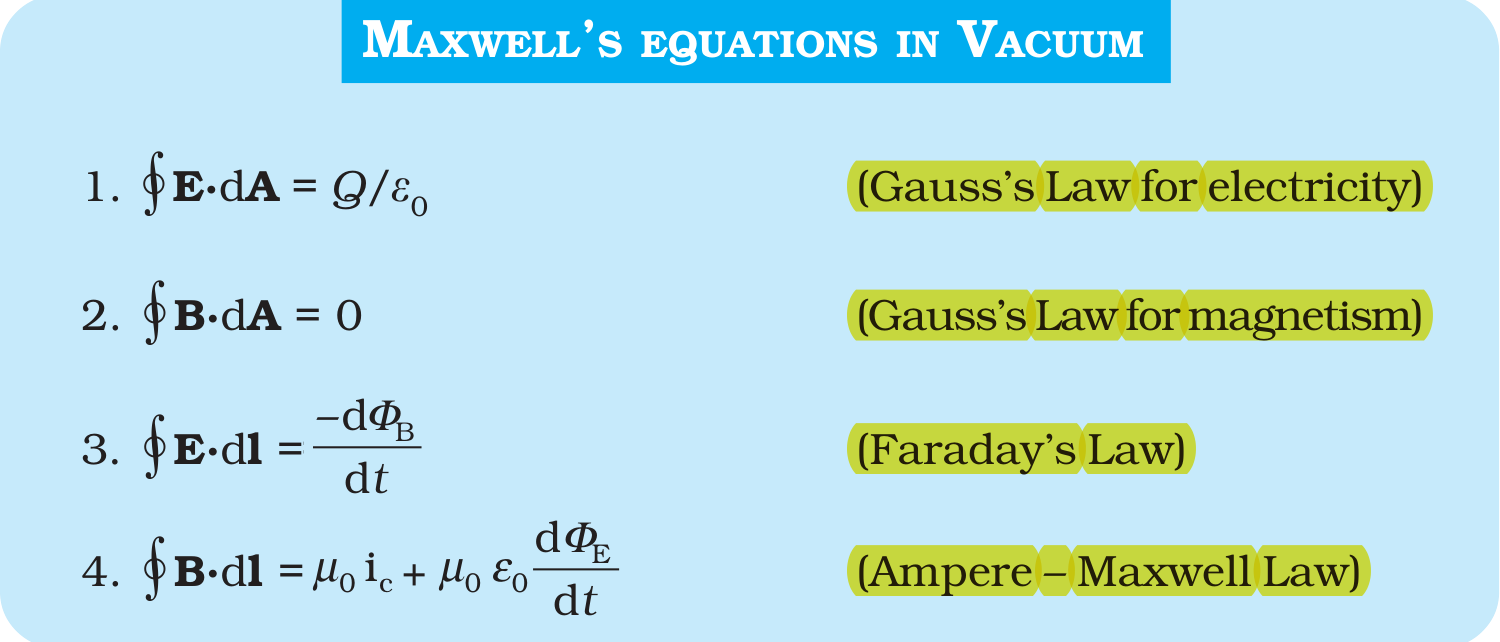
Match List – I with List – II.
| List - I | List - II | ||
|---|---|---|---|
| (A) | \( \oint\vec{B}\cdot d\vec{A}=0 \) | (I) | Gauss’s Law of electricity |
| (B) | \( \oint\vec{E}\cdot d\vec{A}=\displaystyle\frac{Q}{\varepsilon_0} \) | (II) | Gauss’s Law of magnetism |
| (C) | \( \oint\vec{B}\cdot d\vec{l}=\mu_0 i_c+\mu_0\varepsilon_0\displaystyle\frac{d\phi_E}{dt} \) | (III) | Faraday’s Law |
| (D) | \( \oint\vec{E}\cdot d\vec{l}=-\displaystyle\frac{d\phi_B}{dt} \) | (IV) | Ampere-Maxwell Law |
Choose the correct answer from the options given below:
Answer & explanation
Correct answer: option 3
The correct answer is Option (3) → (A)-(II), (B)-(I), (C)-(IV), (D)-(III)
These are the four Maxwell equations. Identify each one from what its left side integrates (a surface integral of a field gives a Gauss law, a line integral gives Faraday’s or Ampere’s law).
(A) \( \oint\vec{B}\cdot d\vec{A}=0 \) — this matches (II) Gauss’s Law of magnetism. The net magnetic flux through any closed surface is zero because isolated magnetic poles do not exist.
(B) \( \oint\vec{E}\cdot d\vec{A}=Q/\varepsilon_0 \) — this matches (I) Gauss’s Law of electricity. The electric flux through a closed surface equals the enclosed charge divided by \( \varepsilon_0 \).
(C) \( \oint\vec{B}\cdot d\vec{l}=\mu_0 i_c+\mu_0\varepsilon_0\,d\phi_E/dt \) — this matches (IV) Ampere-Maxwell Law. The extra term \( \mu_0\varepsilon_0\,d\phi_E/dt \) is the displacement current that Maxwell added to Ampere’s law.
(D) \( \oint\vec{E}\cdot d\vec{l}=-d\phi_B/dt \) — this matches (III) Faraday’s Law. A changing magnetic flux produces an electric field whose line integral is the induced emf.
Note: A similar question was also asked in CUET (UG) 2026 on 21-05-2026 (Slot 1) and on 18-05-2026 (Slot 1), and in CUET (UG) 2023 on 26-05-2023 (Slot 1).
NCERT (2026-27):
Maxwell’s Equations in Vacuum –