Identify the acid with highest pKa value
Answer & explanation
Correct answer: option 1
The correct answer is Option (1) → HCOOH
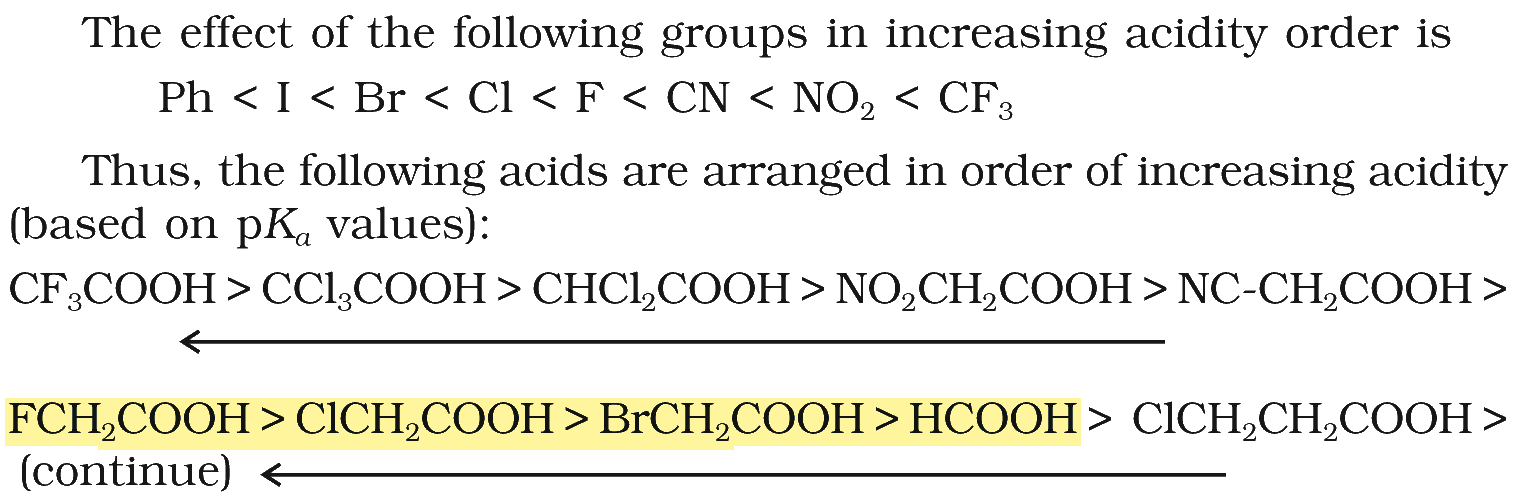
The strength of a carboxylic acid depends on the stability of its carboxylate ion. An electron withdrawing group (−I effect) near the –COOH group spreads out the negative charge, stabilises the anion and increases acidity. The effect is stronger for a more electronegative atom: F > Cl > Br.
A stronger acid has a lower pKa (pKa = −log Ka), so the weakest acid has the highest pKa.
pKa: about 2.6 < 2.86 < 2.90 < 3.75
HCOOH carries no halogen, so it has no −I group to help it. It is the weakest of the four acids and has the highest pKa (3.75).
Why the other options are incorrect
Option (2) BrCH2COOH — Incorrect. The −I effect of Br makes it a stronger acid (pKa 2.90).
Option (3) FCH2COOH — Incorrect. F is the most electronegative, so this is the strongest acid here, with the lowest pKa.
Option (4) ClCH2COOH — Incorrect. The −I effect of Cl makes it a stronger acid (pKa 2.86).
NCERT (2026-27 edition):
Reactions Involving Cleavage of O–H Bond – “… Effect of substituents on the acidity of carboxylic acids: Substituents may affect the stability of the conjugate base and thus, also affect the acidity of the carboxylic acids. Electron withdrawing groups increase the acidity of carboxylic acids by stabilising the conjugate base through delocalisation of the negative charge by inductive and/or resonance effects. …”