
CUETMOCK
  • Pricing
  • Mentors
Log inStart freeStart free mocks→

First test, then trust

Try a free CUET mock test.

Join 5,00,000+ students who rehearsed exam day on the exact NTA screen before sitting CUET. On the web and on Android.

Start free mocks →Get the Android app
CUETMOCK

India's #1 CUET Mock Test Platform. Original NCERT-based questions on the exact NTA exam screen — trusted by 5,00,000+ students since CUET 2022.

Get it onGoogle PlayScan to download the CUETMOCK app

Mock tests

  • CUET mock test series
  • Browse all papers
  • Commerce mocks
  • Humanities (Arts) mocks
  • Science mocks
  • Languages & GAT mocks
  • Free practice questions
  • Pricing

Resources

  • CUET exam guide
  • CUET syllabus
  • Universities accepting CUET
  • Expert blogs
  • News & notifications
  • Webinars & counselling
  • CUET score calculator
  • How we estimate your rank
  • FAQs

Company

  • About us
  • Our leadership & team
  • Our toppers
  • Mentors
  • For schools
  • Contact us
  • Terms
  • Privacy
  • Refund policy

Talk to us

+91 7696 6630 56info@cuetmock.comWhatsApp us

Our other platforms

  • JEE Mock — For IIT-JEE aspirants
  • NEET Mock — For NEET aspirants

Newsletter

Exam updates, study material and offers — no spam.

© 2026 NYC Ventures Pvt. Ltd.

701-702, Royal Business Park, Zirakpur, Punjab - 140603

  • Terms of use
  • Privacy policy
  • Refund policy
  • Contact us

iCUETMOCK is an independent preparation platform, not affiliated with the National Testing Agency (NTA). Always check exam details on the official NTA website.

  • Home
  • Mock tests
  • CUET guide
  • Pricing
  • Log in
Home/Practice questions/Fine Arts
Fine ArtsThe Bengal School and Cultural Nationalism

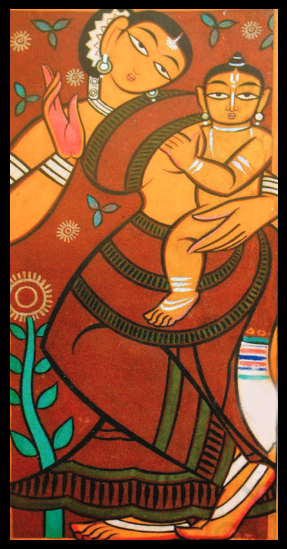
Who is the artist of the shown painting?

Who is the artist of the shown painting?

Answer & explanation+

Correct answer: option 2

The correct answer is Option 2- Jamini Roy

The shown painting is Woman with Child painted by Jamini Roy.

Woman with Child: This is a gouache painting on paper made by Jamini Roy (1887–1972) in 1940. He was called the father of the folk renaissance in India, who created an alternative vision of modern Indian identity. In the mid –1920s, he travelled to the countryside of Bengal to collect folk paintings (pats) and learn from folk artisans. He wanted to learn from the expressive power of their lines. In this painting, a mother and her child are rendered with bold simplifications and thick outlines with sweeping brush strokes. The painting exudes a crude vigour hitherto unknown in Indian art. Figures are coloured in dull yellow and brick-red background, emulating the terracotta relief of his home village in Bankura. The two-dimensional nature of the painting is derived from pat paintings and his search for simplicity and pure form is visible. Roy borrowed volume, rhythm, decorative clarity and instrumentality of the pat in his artworks. To achieve and learn the purity of the pat, he first made many monochrome brush drawings, and then, gradually, moved to basic seven colours applied with tempera. He used Indian red, yellow ocher, cadmium green, vermilion, charcoal gray, cobalt blue and white made from organic material, such as rockdust, tamarind seeds, mercury powder, alluvial mud, indigo and common chalk. He used lamp black to outline the drawings and started making his own canvas with home-spun fabric (pats used paper or cloth or baked paper). Roy used the notion of village community as a weapon of resistance to colonial rule and a political act of making local signify national.

Advertisement

Practise more on The Bengal School and Cultural Nationalism

Chapter-wise mocks on the real NTA exam screen, with solutions and your rank. Your first mocks are free.

Start free mocks →

Advertisement

Next questions

  1. The probability of drawing a one-hundred rupee currency from two boxes one of which contain 3 fifty-rupee currency and 2 one-hundred rupee…Maths. Section B1 · Probability
  2. The current gain of a transistor in common – emitter mode is 49. The change in collector current and emitter current corresponding to the c…Physics · Semiconductors and Electronic Devices
  3. Which of the following Article of the Constitution deals with the Fundamental Duties?Legal Studies · Human Rights in India
  4. ______ is the final value of the goods and services produced within the geographical boundaries of a country during a year.General Aptitude Test · General Knowledge
  5. A train can completely cross a 1000-metrn long bridge in 15 seconds. It can completely cross another 1300-metre long bridge in 19 seconds.…General Aptitude Test · Numerical Ability
  6. Statement I: The regulatory gene in the lac operon is the "i" gene, which codes for the inducer of the operon. Statement II: The z gene in…Biology · Molecular Basis of Inheritance
  7. After arranging the given words according to dictionary order, which word will come at 'Second' position ? 1. Dietetic 2. Diestrus 3. Diest…General Aptitude Test · Verbal Reasoning
  8. Which of the following pairs of a stock exchange function and its meaning is correctly matched?Business Studies · Financial Markets
  9. Study the graph and answer the question. The number of workers in the factory whose daily wages are ₹450 or more but less than ₹600 is ____.General Aptitude Test · Quantitative Reasoning
  10. The ratio of efficiences of A, B and C is 1 : 3 : 5. Working together they can complete 60% of the work in 20 days. Find out how much time…General Aptitude Test · Numerical Ability