A company needs total funds of Rs. 80 lakh and expects an EBIT of Rs. 12 lakh. It may raise Rs. 40 lakh as debt at 9% p.a. and the rest by equity shares of Rs. 10 each, or raise all of it by equity shares of Rs. 10 each. The tax rate is 20%.
Statement I: If the company raises all the funds by equity shares, its EPS will be Rs. 1.20.
Statement II: If the company raises Rs. 40 lakh as debt, its EPS will be Rs. 2.10.
In the light of the above statements, choose the correct answer from the options given below:
Answer & explanation
Correct answer: option 3
The correct answer is Option (3) → Statement I is correct but Statement II is incorrect.
Given:
Total funds = Rs. 80 lakh
EBIT = Rs. 12 lakh
Debt option = Rs. 40 lakh at 9% p.a.
Equity shares of Rs. 10 each
Tax rate = 20%
Formula: EPS = (EBIT − Interest) × (1 − tax rate) / Number of equity shares
All equity: EAT = 12 × 0.80 = Rs. 9.6 lakh
All equity: EPS = 9.6 / 8 lakh shares = Rs. 1.20
With debt: interest = 9% of 40 = Rs. 3.6 lakh
With debt: EAT = (12 − 3.6) × 0.80 = Rs. 6.72 lakh
With debt: EPS = 6.72 / 4 lakh shares = Rs. 1.68
Statement I: If the company raises all the funds by equity shares, its EPS will be Rs. 1.20. — Correct. This matches the working above.
Statement II: If the company raises Rs. 40 lakh as debt, its EPS will be Rs. 2.10. — Incorrect. The EPS is Rs. 1.68. Rs. 2.10 is 8.4 / 4, the EBT per share with the tax left out.
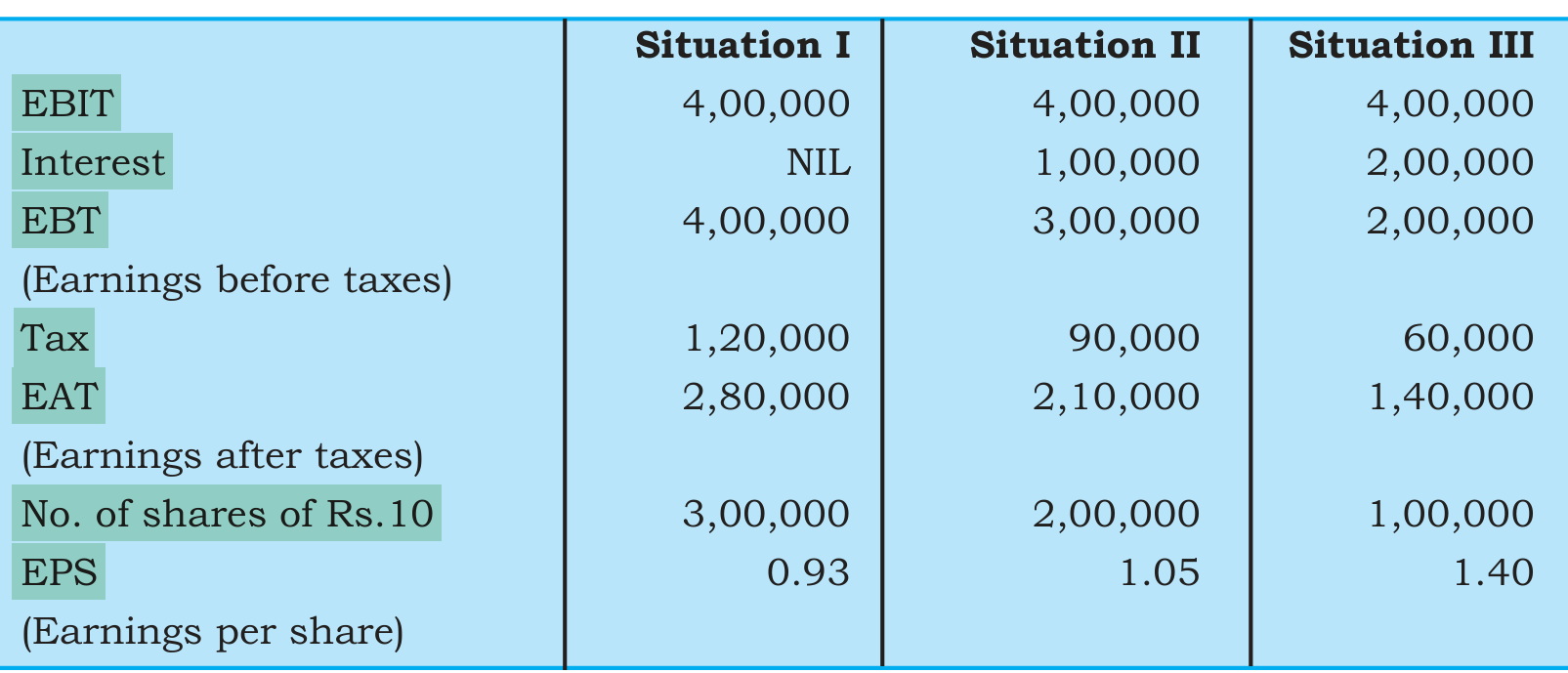
NCERT (2026-27 Edition): “EBIT-EPS Analysis … The impact of financial leverage on the profitability of a business can be seen through EBIT-EPS (Earning before Interest and Taxes-Earning per Share) analysis as in the following example. Three situations are considered. There is no debt in situation-I i.e. (unlevered business). Debt of Rs. 10 lakh and 20 lakh are assumed in situations-II and III, respectively. All debt is at 10% p.a. …”
|