
CUETMOCK
  • Pricing
  • Mentors
Log inStart freeStart free mocks→

First test, then trust

Try a free CUET mock test.

Join 5,00,000+ students who rehearsed exam day on the exact NTA screen before sitting CUET. On the web and on Android.

Start free mocks →Get the Android app
CUETMOCK

India's #1 CUET Mock Test Platform. Original NCERT-based questions on the exact NTA exam screen — trusted by 5,00,000+ students since CUET 2022.

Get it onGoogle PlayScan to download the CUETMOCK app

Mock tests

  • CUET mock test series
  • Commerce mocks
  • Humanities (Arts) mocks
  • Science mocks
  • Languages & GAT mocks
  • Free practice questions
  • Pricing

Resources

  • CUET exam guide
  • CUET syllabus
  • Universities accepting CUET
  • Expert blogs
  • News & notifications
  • Webinars & counselling
  • CUET score calculator
  • How we estimate your rank
  • FAQs

Company

  • About us
  • Our leadership & team
  • Our toppers
  • Mentors
  • For schools
  • Contact us
  • Terms
  • Privacy
  • Refund policy

Talk to us

+91 7696 6630 56info@cuetmock.comWhatsApp us

Our other platforms

  • JEE Mock — For IIT-JEE aspirants
  • NEET Mock — For NEET aspirants

Newsletter

Exam updates, study material and offers — no spam.

© 2026 NYC Ventures Pvt. Ltd.

701-702, Royal Business Park, Zirakpur, Punjab - 140603

  • Terms of use
  • Privacy policy
  • Refund policy
  • Contact us

iCUETMOCK is an independent preparation platform, not affiliated with the National Testing Agency (NTA). Always check exam details on the official NTA website.

  • Home
  • Mock tests
  • CUET guide
  • Pricing
  • Log in
Home/Practice questions/Chemistry
ChemistryOrganic: Haloalkanes and Haloarenes

Arrange the following alkyl halides in the order of increasing reacti…

Arrange the following alkyl halides in the order of increasing reactivity towards SN1 reaction.

A. C6H5CH2Br
B. C6H5CH(C6H5)Br
C. C6H5CH(CH3)Br
D. C6H5C(CH3)(C6H5)Br

Choose the correct answer:

Answer & explanation+

Correct answer: option 2

The correct answer is Option (2) → A, C, B, D

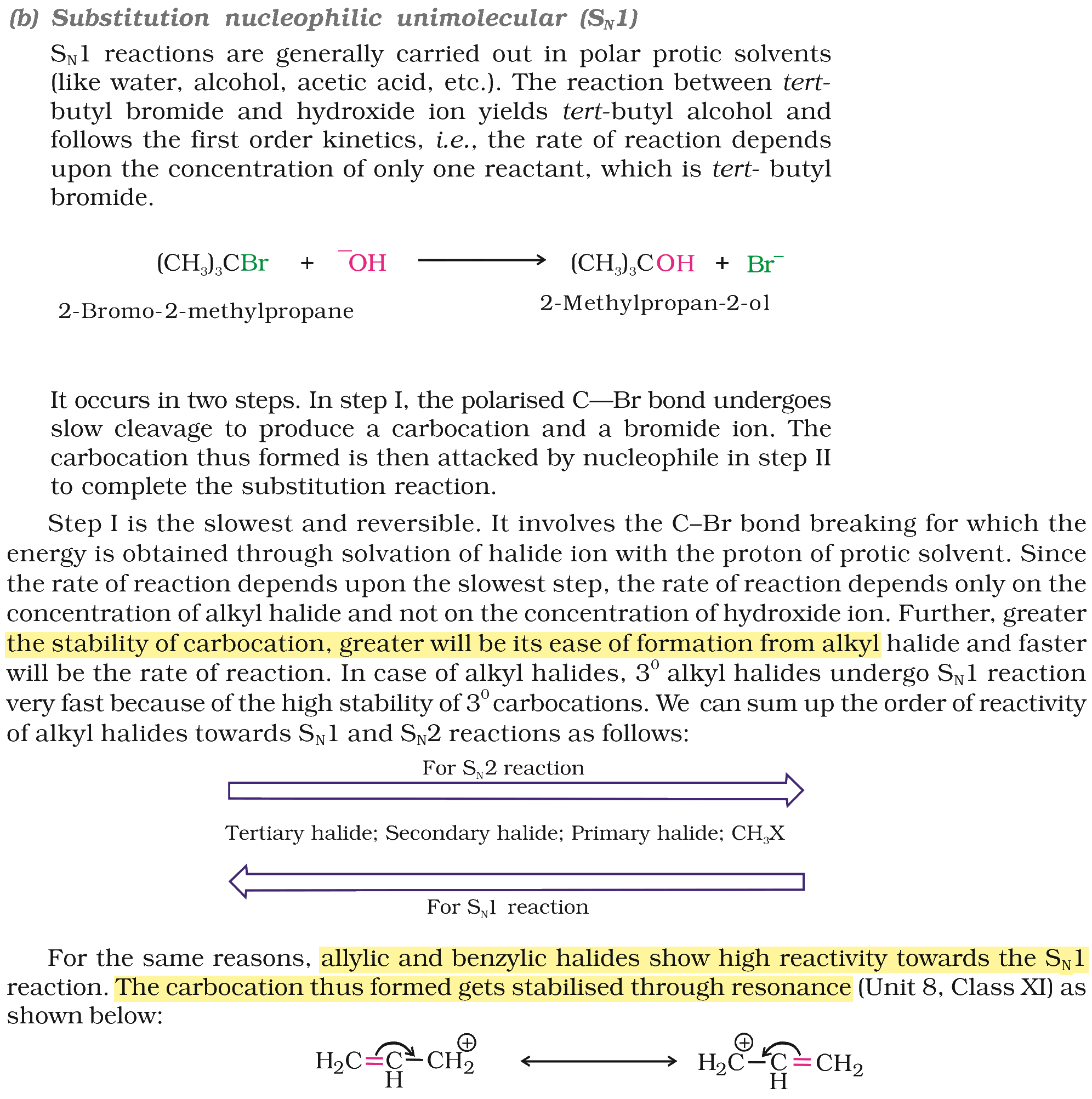
An SN1 reaction takes place in two steps. The slow, rate-determining step is the loss of the halide ion to form a carbocation, so the more stable the carbocation, the faster the reaction. Two factors stabilise the carbocation formed from these benzylic halides:

  • Resonance with a phenyl group: the positive charge is spread over the benzene ring. Each extra phenyl group on the positive carbon spreads the charge further, so this is the stronger effect.

  • Alkyl groups (+I effect and hyperconjugation): a methyl group pushes electron density towards the positive carbon, so 3° > 2° > 1°.

Combining the two, the stability of the carbocations increases as follows:

    1° benzylic < 2° (one phenyl, one methyl) < 2° (two phenyls) < 3° (two phenyls, one methyl)
    \( \ce{C6H5CH2^{+}} \) < \( \ce{C6H5CH^{+}(CH3)} \) < \( \ce{(C6H5)2CH^{+}} \) < \( \ce{(C6H5)2C^{+}(CH3)} \)

Matching the given compounds:

  • A. \( \ce{C6H5CH2Br} \): benzyl bromide (1°, one phenyl)

  • C. \( \ce{C6H5CH(CH3)Br} \): 1-bromo-1-phenylethane (2°, one phenyl)

  • B. \( \ce{C6H5CH(C6H5)Br} \): bromodiphenylmethane (2°, two phenyls)

  • D. \( \ce{C6H5C(CH3)(C6H5)Br} \): 1-bromo-1,1-diphenylethane (3°, two phenyls)

NCERT (2026-27 edition):
Substitution Nucleophilic Unimolecular (SN1)
Textbook extract

Note: The same/similar question has been asked in different years by NTA as per the details given below:

20262025202420232022
26-05 S2
11-05 S1
29-05 S2
23-05 S2
–––

Advertisement

Practise more on Organic: Haloalkanes and Haloarenes

Chapter-wise mocks on the real NTA exam screen, with solutions and your rank. Your first mocks are free.

Start free mocks →

Advertisement

Next questions

  1. Identify the correct statements regarding the ‘Mahanavami-dibba’:A. It was a massive platform rising from a base of about 11,000 sq. ft. to…History · Medieval India: An Imperial Capital: Vijayanagara
  2. Arrange the following steps of decomposition of detritus in correct sequence.A. LeachingB. HumificationC. FragmentationD. MineralisationCho…Biology · Ecosystem
  3. A man rows 15 km upstream in 5 hours and 25 km downstream in 5 hours. The speed of the current is:Applied Maths. Section B2 · Numbers, Quantification and Numerical Applications
  4. Common Size Statement is also known as ___________.Accountancy Part B · Analysis of Financial Statements
  5. The grandmother's comparison of time to “a toothbrush” that “goes mouldy” chiefly serves to:English · Comprehension - (Poetry / Literary)
  6. According to the passage, what term is used to describe the economic policies that reflect a political vision of free enterprise?Sociology · Social Change and Development in India: Globalisation and Social Change
  7. The area bounded by the curve defined by x=2cosθ and y=3sinθ ; is[where θ is a parameter]Applied Maths. Section A · Application of Integrals (Section A)
  8. Identify the work of Mrinalini Mukherjee from the following.Fine Arts · The Modern Indian Art
  9. The idea of ‘global commons’ does not include—Political Science · Contemporary World Politics: Environment and Natural Resources
  10. India has different issues and concerns with its neighbors:A. Sri Lanka - Ethnic conflict over Sinhala and Tamil populationsB. Bangladesh -…General Aptitude Test · General Knowledge