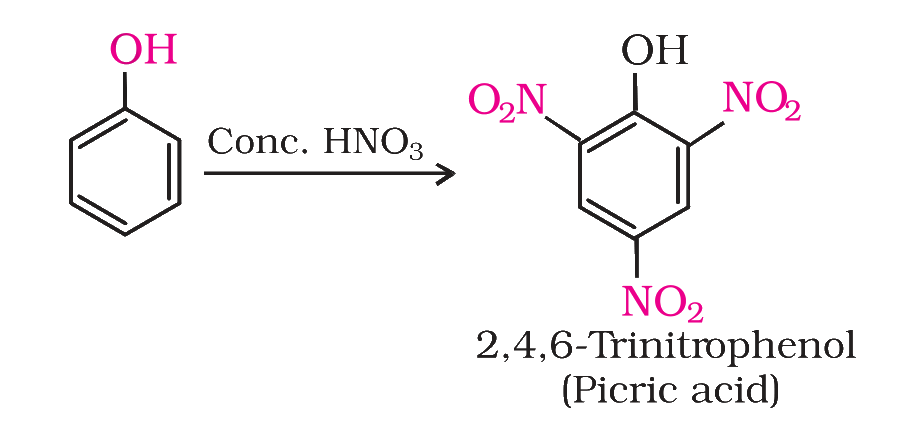
What happens when phenol is treated with concentrated nitric acid?
Answer & explanation
Correct answer: option 4
The correct answer is Option (4) → 2,4,6-Trinitrophenol is produced
The –OH group activates the benzene ring towards electrophilic substitution and directs the incoming group to the ortho and para positions (2, 4 and 6). Concentrated nitric acid is a strong nitrating agent, so all three of these positions are nitrated:
\( \displaystyle \ce{C6H5OH + 3HNO3} \xrightarrow{\text{conc.}} \ce{C6H2(NO2)3OH + 3H2O} \)
The product, 2,4,6-trinitrophenol, is commonly called picric acid.
Why the other options are incorrect
Option (1) 4-Nitrophenol is produced — Incorrect. 4-Nitrophenol forms, together with 2-nitrophenol, with dilute nitric acid at low temperature (298 K), not with concentrated acid.
Option (2) 2-Nitrophenol is produced — Incorrect. 2-Nitrophenol is the ortho product of nitration with dilute nitric acid; concentrated acid does not stop at one nitro group.
Option (3) 2,4-Dinitrophenol is produced — Incorrect. With concentrated nitric acid the third activated position (C6) is also nitrated, so the reaction goes on to the trinitro compound.
NCERT (2026-27 edition):
7.4.4 Chemical Reactions – “With concentrated nitric acid, phenol is converted to 2,4,6-trinitrophenol. The product is commonly known as picric acid. The yield of the reaction product is poor.”