CUETMOCK
  • Pricing
  • Mentors
Log inStart freeStart free mocks→

First test, then trust

Try a free CUET mock test.

Join 5,00,000+ students who rehearsed exam day on the exact NTA screen before sitting CUET. On the web and on Android.

Start free mocks →Get the Android app
CUETMOCK

India's #1 CUET Mock Test Platform. Original NCERT-based questions on the exact NTA exam screen — trusted by 5,00,000+ students since CUET 2022.

Get it onGoogle PlayScan to download the CUETMOCK app

Mock tests

  • CUET mock test series
  • Browse all papers
  • Commerce mocks
  • Humanities (Arts) mocks
  • Science mocks
  • Languages & GAT mocks
  • Free practice questions
  • Pricing

Resources

  • CUET exam guide
  • CUET syllabus
  • Universities accepting CUET
  • Expert blogs
  • News & notifications
  • Webinars & counselling
  • CUET score calculator
  • How we estimate your rank
  • FAQs

Company

  • About us
  • Our leadership & team
  • Our toppers
  • Mentors
  • For schools
  • Contact us
  • Terms
  • Privacy
  • Refund policy

Talk to us

+91 7696 6630 56info@cuetmock.comWhatsApp us

Our other platforms

  • JEE Mock — For IIT-JEE aspirants
  • NEET Mock — For NEET aspirants

Newsletter

Exam updates, study material and offers — no spam.

© 2026 NYC Ventures Pvt. Ltd.

701-702, Royal Business Park, Zirakpur, Punjab - 140603

  • Terms of use
  • Privacy policy
  • Refund policy
  • Contact us

iCUETMOCK is an independent preparation platform, not affiliated with the National Testing Agency (NTA). Always check exam details on the official NTA website.

  • Home
  • Mock tests
  • CUET guide
  • Pricing
  • Log in
Home/Practice questions/Economics
EconomicsMicro Economics: Theory of Consumer behaviour

Price of a commodity increases. The demand is inelastic if;

Price of a commodity increases. The demand is inelastic if;

Answer & explanation+

Correct answer: option 2

The correct answer is Option (2) → T.E. on the commodity increases.

When the price rises and demand is inelastic, the quantity falls by a smaller percentage than the price rises, so total expenditure (T.E.) increases.

Demand is inelastic when the quantity demanded changes by a smaller percentage than the price. T.E. on a good is its price times the quantity bought. When the price rises, the result depends on how much the quantity falls:

  • Quantity falls by a smaller percentage than the price rises (inelastic demand): T.E. increases.

  • Quantity falls by a larger percentage (elastic demand): T.E. decreases.

  • Quantity falls by the same percentage (unitary elastic demand): T.E. stays the same.

T.E. becomes zero only if nothing at all is bought, which none of these cases gives.

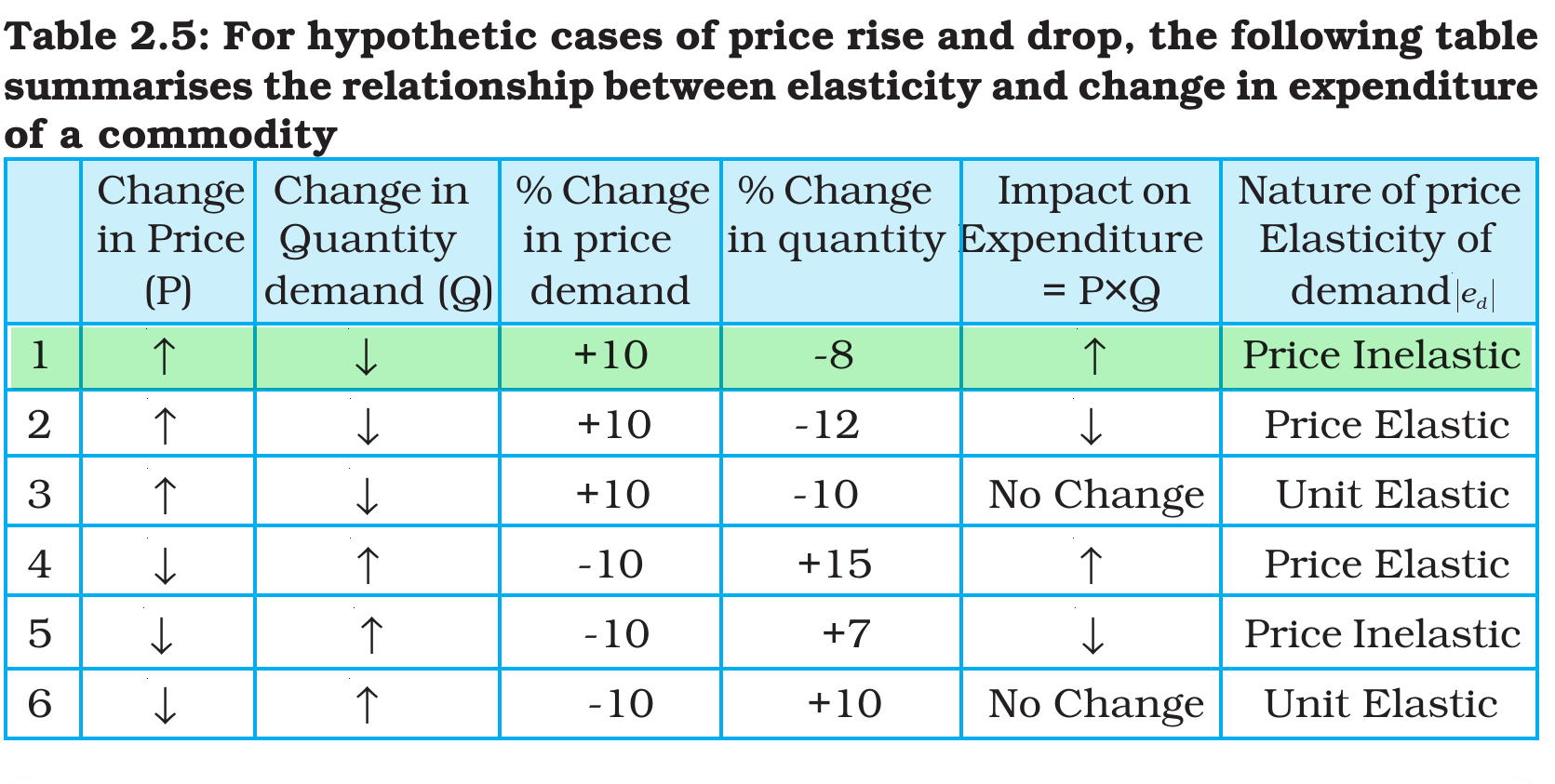
NCERT (2026-27): “2.6.3 Elasticity and Expenditure …Consider an increase in the price of a good. If the percentage decline in quantity is greater than the percentage increase in the price, the expenditure on the good will go down.… On the other hand, if the percentage decline in quantity is less than the percentage increase in the price, the expenditure on the good will go up (See row 1 in table 2.5). And if the percentage decline in quantity is equal to the percentage increase in the price, the expenditure on the good will remain unchanged (see row 3 in table 2.5).…

…The expenditure on the good would change in the same direction as the price change if and only if the percentage change in quantity is less than the percentage change in price, i.e., if the good is price inelastic (see rows 1 and 5 in table 2.5).…”

NCERT extract

Advertisement

Practise more on Micro Economics: Theory of Consumer behaviour

Chapter-wise mocks on the real NTA exam screen, with solutions and your rank. Your first mocks are free.

Start free mocks →

Advertisement

Next questions

  1. Three of the following are part of M1 (narrow money). Which one is the odd one out?Economics · Macro Economics: Money and Banking
  2. Change the underlined part of the '-ing clause' with 'adjective + to infinitive.' Namita wasn't ashamed of committing the mistake.English · Grammar: Adjective
  3. Who said, "They need props" about the minorities?History · Modern India: Framing the Constitution
  4. Budgeting Policy includes:A. Revenue Repo RateB. TaxesC. Public BorrowingD. Public ExpenditureE. Open Market operationChoose the correct an…Economics · Macro Economics: Government Budget and Economy
  5. Which of the following is NOT a reason why people join groups?Psychology · Social Influence and Group Processes
  6. If focal length of a concave lens is 50 cm , then the power of the lens would bePhysics · Ray Optics
  7. Social inequality and exclusion are social because: (A) They are structured(B) They are systematic (C) They are unstructured(D) They are no…Sociology · Indian Society: Patterns of Social Inequality and Exclusion
  8. In a ΔABC, the bisector of ∠B and ∠C meet at point O, inside the triangle. If ∠BOC = 106°, then the measure of ∠A is?General Aptitude Test · Quantitative Reasoning
  9. Sixteenth-century Ahmadnagar paintings show the dress of the time. Given below are two statements: one is labelled as Assertion (A) and the…Fine Arts · The Deccani Schools of Painting
  10. Fence posts stand in a single straight line, 5 m apart. A painted post is 8th from the left end and 18th from the right end of the line. Ho…General Aptitude Test · Verbal Reasoning