
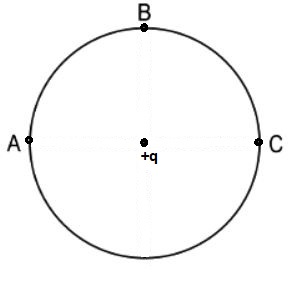
A positive charge +q is located at the centre of a circle as shown in the figure. \( W_1 \) is the work done in taking a unit positive charge from A to B and \( W_2 \) is the work done in taking the same charge from A to C. Then
Answer & explanation
Correct answer: option 4
The correct answer is Option (4) → \( W_1=W_2=0 \)
The potential of a point charge, \( V=q/4\pi\varepsilon_0r \), depends only on the distance \( r \) from the charge. So a circle centred on the charge lies on an equipotential surface. The work done in taking a unit positive charge from one point to another equals the potential difference between them.
From the figure, A, B and C all lie on the circle centred at \( +q \), so all three points are at the same potential.
\( \begin{aligned} W_1 &= V_B-V_A \\ &= 0 \end{aligned} \)
\( \begin{aligned} W_2 &= V_C-V_A \\ &= 0 \end{aligned} \)
Option (1) \( W_1\gt W_2 \) — Incorrect. Both works are potential differences between points at the same distance from the charge, so neither can be larger.
Option (2) \( W_1\lt W_2 \) — Incorrect. C is farther from A than B is. But the work depends only on the potentials of the two end points. The path and the distance between the points do not matter.
Option (3) \( W_1=W_2\neq0 \) — Incorrect. The two works are equal, but each is zero because every end point is at the same potential.
Option (4) \( W_1=W_2=0 \) — Correct. There is no potential difference between points on an equipotential surface. So no work is needed to move the charge from A to B or from A to C.
NCERT (2026-27):
Equipotential Surfaces – “An equipotential surface is a surface with a constant value of potential at all points on the surface. For a single charge q, the potential is given by Eq. (2.8):
\( \displaystyle V=\frac{1}{4\pi\varepsilon_0}\,\frac{q}{r} \qquad (2.8) \)
This shows that V is a constant if r is constant. Thus, equipotential surfaces of a single point charge are concentric spherical surfaces centred at the charge.”
Equipotential Surfaces – “… there is no potential difference between any two points on the surface and no work is required to move a test charge on the surface.”