
Case: Read the passage and answer the question.
Consider a coil C1 connected to a galvanometer G as shown. A bar magnet is placed near the coil with its North pole facing the coil and its South pole away from it. The magnet is then moved towards the coil.
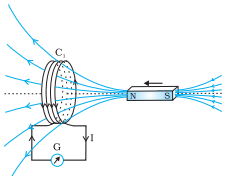
Answer the following question in this context.
What happens when the bar magnet is moved towards the coil more slowly than before?
Answer & explanation
Correct answer: option 3
The correct answer is Option (3) → The current developed is smaller.
By Faraday’s law, the emf induced in the coil equals the rate of change of magnetic flux through it. Moving the magnet more slowly changes the flux through the coil more slowly.
Option (1) The current is developed in the opposite direction. — Incorrect. The North pole is still approaching the coil, so the flux still increases and the current keeps its earlier direction; only its size changes.
Option (2) The emf developed is now negative. — Incorrect. The sign of the emf depends on whether the flux is increasing or decreasing. The flux still increases as the magnet approaches, so the emf has the same sign as before.
Option (3) The current developed is smaller. — Correct. A slower motion gives a smaller rate of change of flux, hence a smaller emf and, in the same coil and galvanometer, a smaller current.
Option (4) The emf developed is higher. — Incorrect. A higher emf needs a faster change of flux. That would need a faster motion of the magnet.
NCERT (2026-27):
The Experiments of Faraday and Henry – “… When the North-pole of a bar magnet is pushed towards the coil, the pointer in the galvanometer deflects, indicating the presence of electric current in the coil. … Further, the deflection (and hence current) is found to be larger when the magnet is pushed towards or pulled away from the coil faster.”