
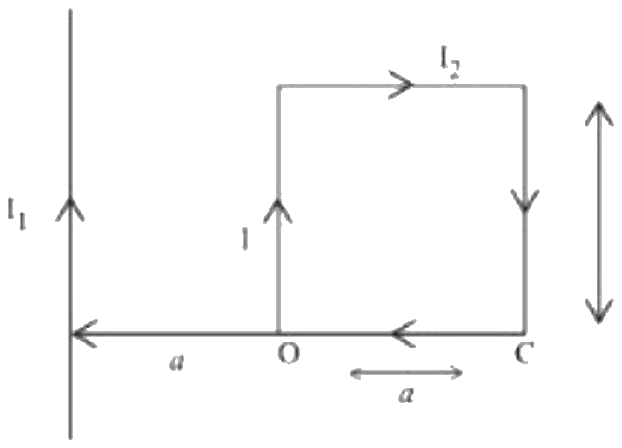
A current carrying square loop is placed near an infinitely long current carrying wire as shown in figure. The torque acting on the loop is:
Answer & explanation
Correct answer: option 4
The correct answer is Option (4) → Zero
The loop lies in the same plane as the wire. The magnetic field of the wire at every point of the loop is perpendicular to this plane, and the magnetic moment \( \vec{M} \) of a plane loop is also perpendicular to its plane. So \( \vec{M} \) and \( \vec{B} \) are parallel (or antiparallel):
\( \displaystyle |\vec{\tau}| = |\vec{M}\times\vec{B}| = MB\sin 0^\circ = 0 \)
The same result follows from the forces. With \( \vec{B} \) perpendicular to the plane, every force \( I\,d\vec{l}\times\vec{B} \) lies in the plane of the loop.
The sides parallel to the wire are at distances \( a \) and \( 2a \); they feel forces along the line joining their midpoints, unequal (so there is a net force) but along the same line, so they produce no turning effect.
The two sides perpendicular to the wire carry opposite currents through the same field values, so their forces are equal, opposite and along the same line; they cancel without a couple.
Hence the loop feels a net force but no torque.