
Statements:
Some bottles are papers.
Some papers are pens.
No pen is a pencil.
Conclusions:
(I) Some bottles are pencils.
(II) No bottle is a pencil.
(III) Some bottles are pens.
Answer & explanation
Correct answer: option 4
The correct answer is Option (4) → Either conclusion (I) or (II) follows
A conclusion follows only if it is true in every diagram the statements allow. The statements join bottles to papers and papers to pens, and keep pens away from pencils; they say nothing that joins bottles to pencils or to pens.
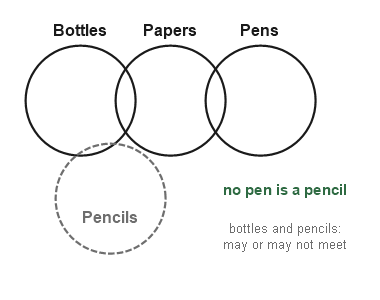
(I) Some bottles are pencils. Does not follow: the pencils may lie wholly away from the bottles.
(II) No bottle is a pencil. Does not follow: the pencils may also overlap the bottles, which no statement forbids.
(III) Some bottles are pens. Does not follow: the papers that are bottles need not be the papers that are pens.
Conclusions (I) and (II) are about the same two groups, one with “some” and the other with “no”. Bottles and pencils either share members or do not, so one of the two must be true: this pair is an “either-or” case.