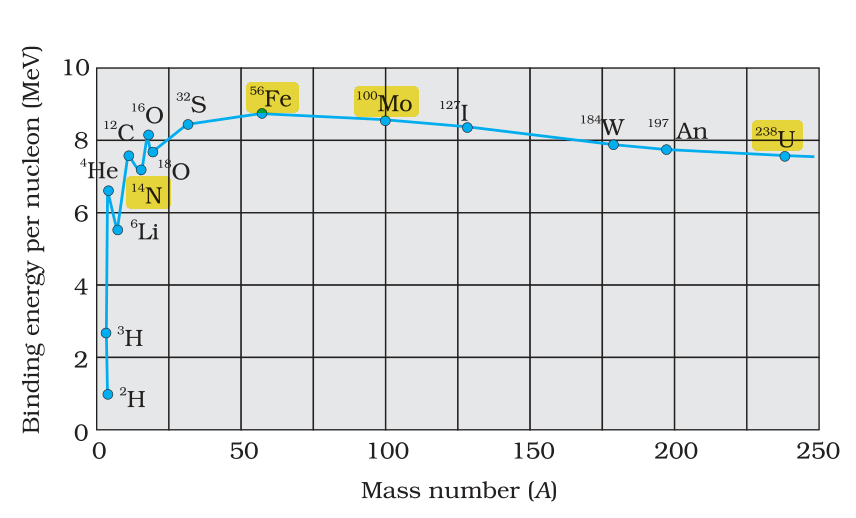
Arrange the following elements in the ascending order of their binding energies per nucleon.
A. 56Fe
B. 100Mo
C. 14N
D. 238U
Choose the correct answer from the options given below:
Answer & explanation
Correct answer: option 1
The correct answer is Option (1) → C, D, B, A
The binding energy per nucleon rises steeply for light nuclei, reaches its maximum of about 8.8 MeV near A = 56 (iron), and then falls slowly for heavier nuclei. So very light and very heavy nuclei both have lower values. Typical values:
\( \text{(C) } {}^{14}\mathrm{N}: \text{ about } 7.5\,\mathrm{MeV} \)
\( \text{(D) } {}^{238}\mathrm{U}: \text{ about } 7.6\,\mathrm{MeV} \)
\( \text{(B) } {}^{100}\mathrm{Mo}: \text{ about } 8.6\,\mathrm{MeV} \)
\( \text{(A) } {}^{56}\mathrm{Fe}: \text{ about } 8.8\,\mathrm{MeV} \)
So the ascending order is (C), (D), (B), (A).
NCERT (2026-27):
Nuclear Binding Energy – “… Figure 13.1 is a plot of the binding energy per nucleon Ebn versus the mass number A for a large number of nuclei. We notice the following main features of the plot: (i) the binding energy per nucleon, Ebn, is practically constant, i.e. practically independent of the atomic number for nuclei of middle mass number ( 30 < A < 170). The curve has a maximum of about 8.75 MeV for A = 56 and has a value of 7.6 MeV for A = 238. (ii) Ebn is lower for both light nuclei (A<30) and heavy nuclei (A>170).”