CUETMOCK
  • Pricing
  • Mentors
Log inStart freeStart free mocks→

First test, then trust

Try a free CUET mock test.

Join 5,00,000+ students who rehearsed exam day on the exact NTA screen before sitting CUET. On the web and on Android.

Start free mocks →Get the Android app
CUETMOCK

India's #1 CUET Mock Test Platform. Original NCERT-based questions on the exact NTA exam screen — trusted by 5,00,000+ students since CUET 2022.

Get it onGoogle PlayScan to download the CUETMOCK app

Mock tests

  • CUET mock test series
  • Commerce mocks
  • Humanities (Arts) mocks
  • Science mocks
  • Languages & GAT mocks
  • Free practice questions
  • Pricing

Resources

  • CUET exam guide
  • CUET syllabus
  • Universities accepting CUET
  • Expert blogs
  • News & notifications
  • Webinars & counselling
  • CUET score calculator
  • How we estimate your rank
  • FAQs

Company

  • About us
  • Our leadership & team
  • Our toppers
  • Mentors
  • For schools
  • Contact us
  • Terms
  • Privacy
  • Refund policy

Talk to us

+91 7696 6630 56info@cuetmock.comWhatsApp us

Our other platforms

  • JEE Mock — For IIT-JEE aspirants
  • NEET Mock — For NEET aspirants

Newsletter

Exam updates, study material and offers — no spam.

© 2026 NYC Ventures Pvt. Ltd.

701-702, Royal Business Park, Zirakpur, Punjab - 140603

  • Terms of use
  • Privacy policy
  • Refund policy
  • Contact us

iCUETMOCK is an independent preparation platform, not affiliated with the National Testing Agency (NTA). Always check exam details on the official NTA website.

  • Home
  • Mock tests
  • CUET guide
  • Pricing
  • Log in
Home/Practice questions/History
HistoryModern India: Framing the Constitution

Identify the speaker of this passage?

Read the passage and answer the questions:

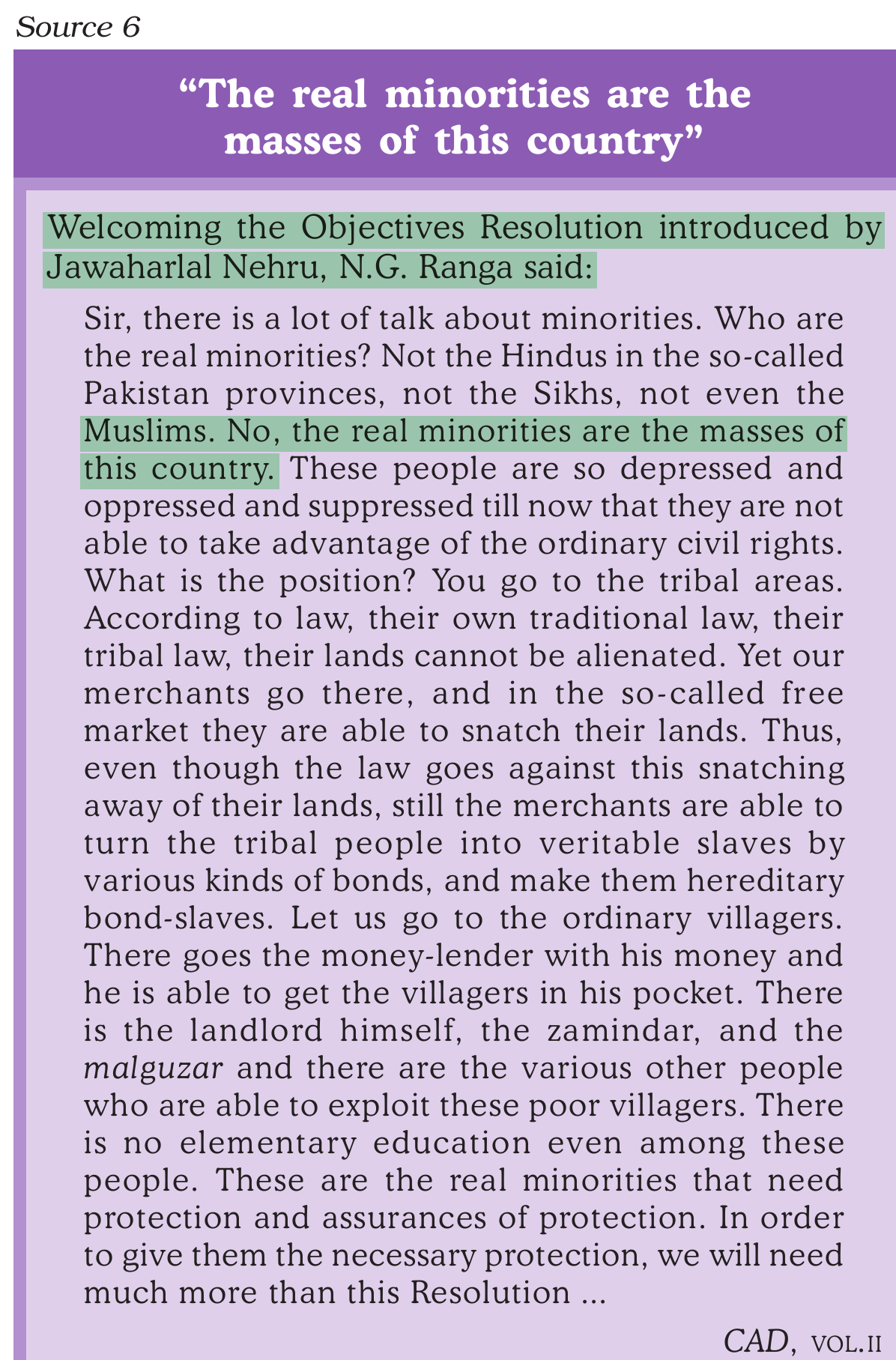
“The real minorities are the masses of this country”

Sir, there is a lot of talk about minorities. Who are the real minorities? Not the Hindus in the so-called Pakistan provinces, not the Sikhs, not even the Muslims. No, the real minorities are the masses of this country. These people are so depressed and oppressed and suppressed till now that they are not able to take advantage of ordinary civil rights. What is the position? You go to the tribal areas. According to law, their own traditional law, their tribal law, their lands cannot be alienated. Yet our merchants go there, and in the so-called free market they are able to snatch their lands. Thus, even though the law goes against this snatching away of their lands, the merchants are still able to turn the tribal people into veritable slaves by various kinds of bonds, and make them hereditary bond-slaves. Let us go to the ordinary villagers. There goes the moneylender with his money, and he is able to get the villagers in his pocket. There is the landlord himself, the zamindar, and the malguzar, and there are various other people who are able to exploit these poor villagers. There is no elementary education even among these people. These are the real minorities that need protection and assurances of protection. In order to give them the necessary protection, we will need much more than this Resolution.

Identify the speaker of this passage?

Answer & explanation+

Correct answer: option 2

The correct answer is Option (2) → N.G. Ranga

N.G. Ranga, a socialist who had been a leader of the peasant movement, welcomed the Objectives Resolution but urged that the term minorities be understood in economic terms. For him the real minorities were the poor and the downtrodden. Legal rights meant little to the poor in the villages unless conditions were created in which they could enjoy them: “They need props. They need a ladder.”

Note 1: This passage is Ranga’s speech in the Constituent Assembly, printed as a source in the NCERT chapter ‘Framing the Constitution’ and reproduced here almost word for word. A speech quoted in a chapter is fair game for the paper, so read the speeches with the speaker’s name in mind.

Note 2: A same/similar question was asked in CUET (UG) in the papers below.

20262025202420232022
11-05 S2*
29-05 S2
––––

* A similar question.


NCERT (2025-26): “3.2 ‘We will need much more than this Resolution’ … While welcoming the Objectives Resolution, N.G. Ranga, a socialist who had been a leader of the peasant movement, urged that the term minorities be interpreted in economic terms. The real minorities for Ranga were the poor and the downtrodden. He welcomed the legal rights the Constitution was granting to each individual but pointed to its limits. In his opinion it was meaningless for the poor people in the villages to know that they now had the fundamental right to live, and to have full employment, or that they could have their meetings, their conferences, their associations and various other civil liberties. It was essential to create conditions where these constitutionally enshrined rights could be effectively enjoyed. For this they needed protection. ‘They need props. They need a ladder,’ said Ranga.”

NCERT extract

Advertisement

Practise more on Modern India: Framing the Constitution

Chapter-wise mocks on the real NTA exam screen, with solutions and your rank. Your first mocks are free.

Start free mocks →

Advertisement

Next questions

  1. Choose the correctly spelled pair of words for the blank spaces in the following sentence:Rahul is known to come up with 1_______ ideas tha…English · Spelling Check
  2. Who among the following were associated with the Baroda School? A. Benode Behari Mukherjee B. K. G. Subramanyan C. Gulam Mohammed Sheikh D.…Fine Arts · The Modern Indian Art
  3. Match List-I with List-IIList-IList-II(Economic Activity)(Example)(A)Primary(I)Mining(B)Tertiary(II)Specialists(C)Quaternary(III)Chain Stor…Geography · Fundamentals of Human Geography: Tertiary and Quaternary Activities
  4. Mr. Albay is the HR Manager at Sero Ltd. He has been assigned the task of hiring 25 sales representatives for the Marketing Department. The…Business Studies · Staffing
  5. If A is a square matrix such that A2 = A and I is identity matrix of same order, then (2I+A)^3-19A is equal to:Maths. Section B1 · Matrices
  6. Which Conservative Prime Minister of Britain was a diehard imperialist?History · Modern India: Mahatma Gandhi and the Nationalist movement
  7. The structure of which of the following sugars is a part of DNA molecule?Chemistry · Organic: Biomolecules
  8. Arrange the following elements in the ascending order of their binding energies per nucleon.A. 56FeB. 100MoC. 14ND. 238UChoose the correct…Physics · Nuclei
  9. ____________ begins archaeogenetic research at Rakhigarhi.History · Ancient India: Bricks, Beads and Bones
  10. 4 cards are drawn from a standard deck of 52 cards. The probability of drawing exactly 2 cards of the same suit is:Maths. Section B1 · Probability