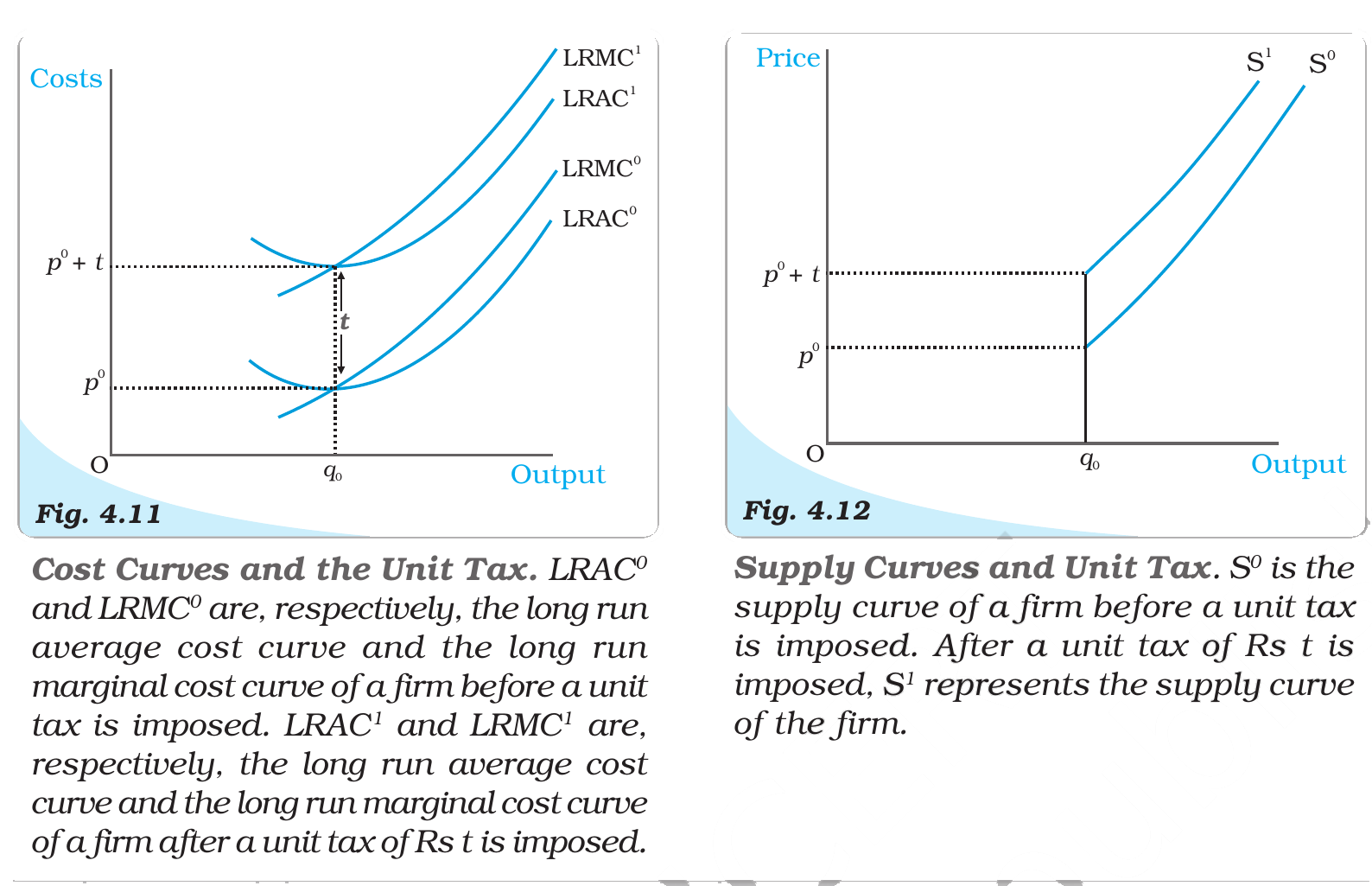
Arrange the following in ascending order as impact of the unit tax on supply :
(A) After imposition of unit tax, firm will supply less unit of output
(B) Firm's long run average cost and marginal cost increases by Rs.t
(C) A unit tax is that tax which is imposed on per unit sale of output.
(D) Suppose the government place a unit tax of Rs.t
Choose the correct answer from the options given below:
Answer & explanation
Correct answer: option 4
The correct answer is Option (4) → (C), (D), (B), (A)
A unit tax reaches a firm’s supply in a natural order: what the tax is, the government imposing it, the rise in the firm’s cost per unit, and the firm then supplying less. The four statements are these four steps.
(C) A unit tax is that tax which is imposed on per unit sale of output. — the definition comes first. A unit tax is a fixed amount charged on every unit sold, whatever the price.
(D) Suppose the government place a unit tax of Rs.t — then the tax is imposed, at Rs. t on each unit sold.
(B) Firm’s long run average cost and marginal cost increases by Rs.t — the firm has to pay Rs. t on every unit, so the cost of each unit rises by t. Its long run average cost and marginal cost curves shift upwards by Rs. t.
(A) After imposition of unit tax, firm will supply less unit of output — the supply curve of a firm is the rising part of its marginal cost curve above minimum average cost. With the marginal cost curve shifted up, the firm supplies less output at each price, so its supply curve shifts to the left.
NCERT (2025-26): “Impact of a unit tax on supply … A unit tax is a tax that the government imposes per unit sale of output.… …Now, suppose the government puts in place a unit tax of Rs t. Since the firm must pay an extra Rs t for each unit of the good produced, the firm’s long run average cost and long run marginal cost at any level of output increases by Rs t.… …Notice that the unit tax shifts the firm’s long run supply curve to the left: at any given market price, the firm now supplies fewer units of output.…”
|