Which of the following reactions involves preparation of alkyl fluoride ?
Answer & explanation
Correct answer: option 3
The correct answer is Option (3) → Swarts Reaction
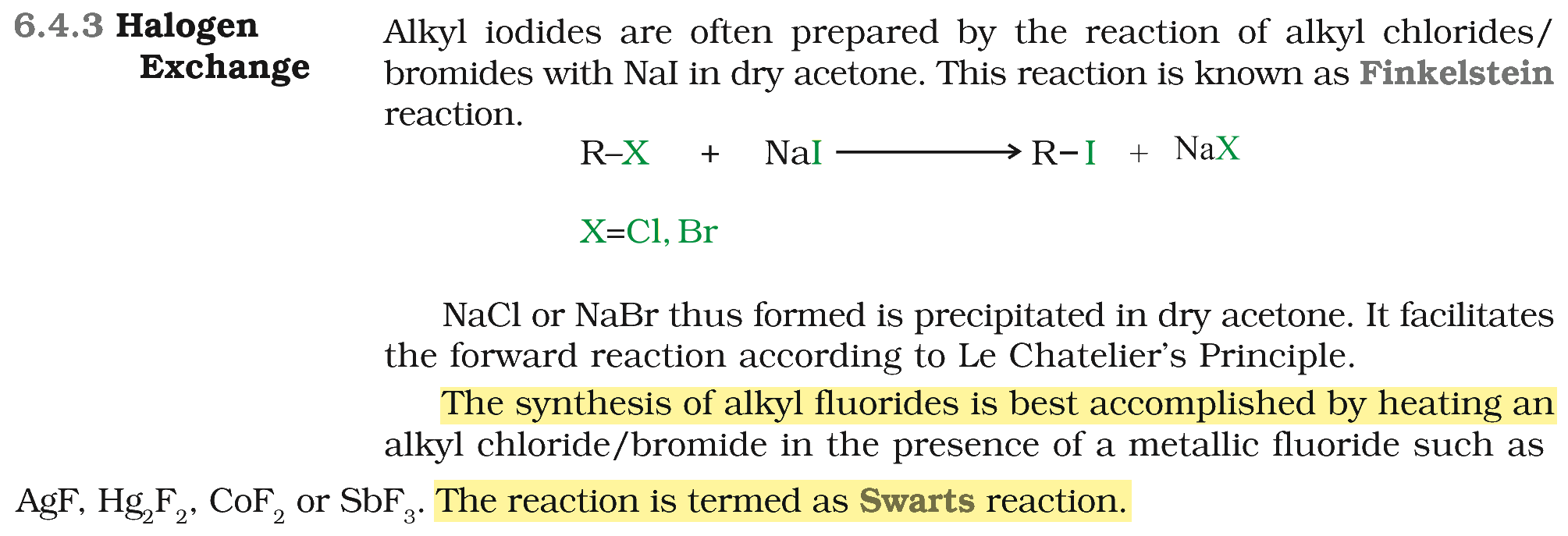
The four named reactions belong to two families. Halogen exchange reactions turn an alkyl chloride or bromide into another alkyl halide: Finkelstein (NaI in dry acetone) gives an alkyl iodide, and Swarts (a metallic fluoride) gives an alkyl fluoride. Reactions of diazonium salts give aryl halides: Sandmeyer (\( \ce{CuCl} \)/HCl or \( \ce{CuBr} \)/HBr) and Gattermann (copper powder with HCl or HBr).
Alkyl fluorides cannot be made easily by direct fluorination, because fluorine reacts violently. They are made by halogen exchange: an alkyl chloride or bromide is heated with a metallic fluoride such as AgF, \( \ce{Hg2F2} \), \( \ce{CoF2} \) or \( \ce{SbF3} \). This is the Swarts reaction:
\( \displaystyle \ce{CH3Br + AgF -> CH3F + AgBr} \)
So the preparation of an alkyl fluoride is the Swarts reaction.
Why the other options are incorrect
Option (1) Gattermann Reaction — Incorrect. A benzene diazonium salt is treated with copper powder and HCl or HBr, giving an aryl chloride or bromide:
\( \displaystyle \ce{C6H5N2^+Cl^-} \xrightarrow{\ce{Cu}/\ce{HCl}} \ce{C6H5Cl + N2} \)
Option (2) Finkelstein Reaction — Incorrect. An alkyl chloride or bromide is treated with NaI in dry acetone, giving an alkyl iodide:
\( \displaystyle \ce{R-X + NaI} \xrightarrow{\text{dry acetone}} \ce{R-I + NaX v} \)
Option (4) Sandmeyer’s Reaction — Incorrect. A benzene diazonium salt is treated with CuCl/HCl or CuBr/HBr, giving an aryl chloride or bromide (or with CuCN, an aryl cyanide):
\( \displaystyle \ce{C6H5N2^+Cl^-} \xrightarrow{\ce{CuCl}/\ce{HCl}} \ce{C6H5Cl + N2} \)
NCERT (2026-27 edition):
Halogen Exchange