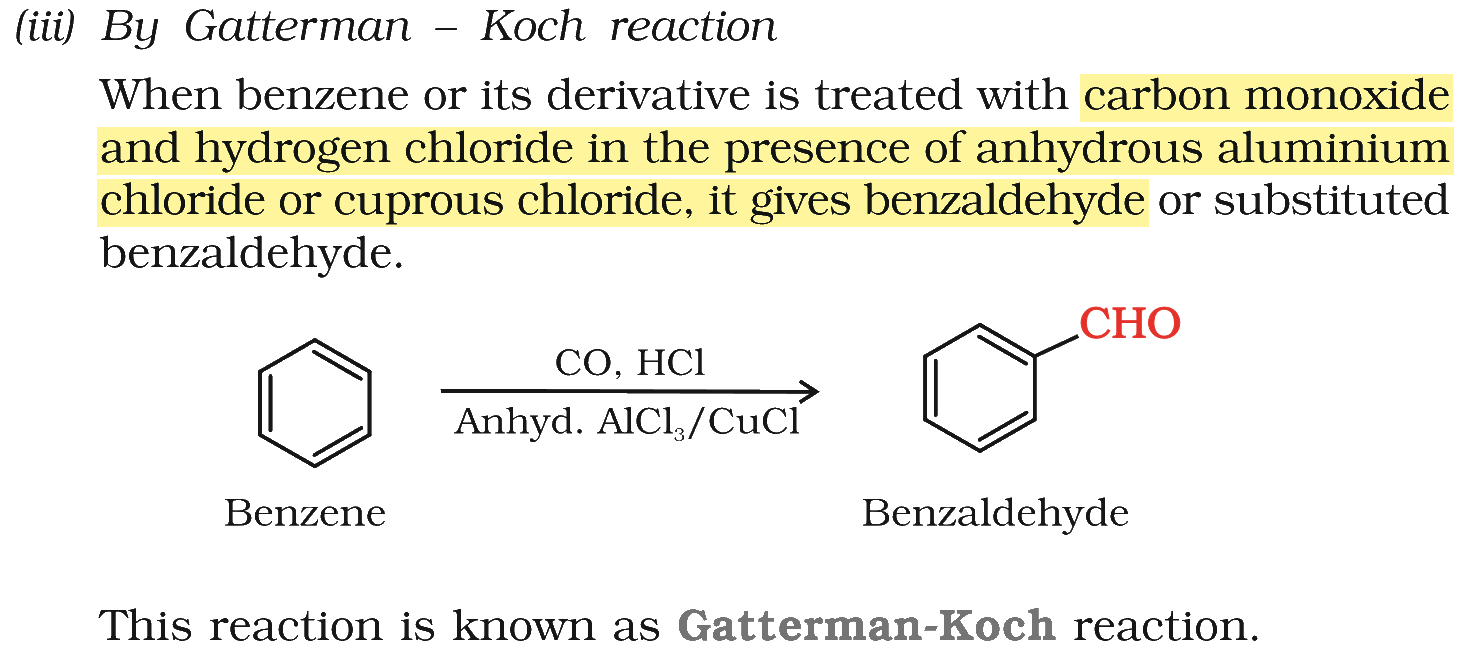
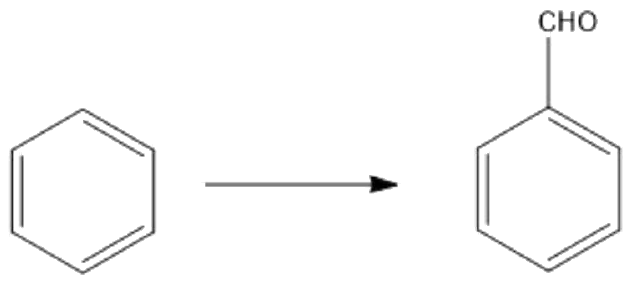
The reagent(s) required to carry out the following conversion are
Answer & explanation
Correct answer: option 2
The correct answer is Option (2) → CO, HCl, Anhyd. AlCl3/CuCl
Benzaldehyde can be prepared in several ways, and the right method depends on the starting material:
From benzene – Gattermann-Koch reaction: carbon monoxide and HCl, with anhydrous \( \ce{AlCl3} \)/CuCl, put a –CHO group directly on the ring.
From toluene – Etard reaction: chromyl chloride (\( \ce{CrO2Cl2} \)) oxidises the methyl group.
From toluene – chromic oxide: \( \ce{CrO3} \) in acetic anhydride gives benzylidene diacetate, which is hydrolysed to benzaldehyde.
From toluene – side chain chlorination: \( \ce{Cl2} \)/hv gives benzal chloride, which is hydrolysed to benzaldehyde.
From benzoyl chloride – Rosenmund reduction: \( \ce{H2} \) over Pd-\( \ce{BaSO4} \).
Here the starting material is benzene, which has no side chain to oxidise, so the –CHO group must be introduced directly:
\( \displaystyle \ce{C6H6 + CO} \xrightarrow{\ce{HCl}\text{, anhyd. }\ce{AlCl3}\text{/}\ce{CuCl}} \ce{C6H5CHO} \)
So the reagents required are CO, HCl and anhydrous AlCl3/CuCl.
Why the other options are incorrect
Option (1) CrO3 and (CH3CO)2O — Incorrect. This oxidises the methyl group of toluene; benzene has no methyl group.
\( \displaystyle \ce{C6H5CH3} \xrightarrow{\ce{CrO3}\text{, }\ce{(CH3CO)2O}} \ce{C6H5CH(OCOCH3)2} \xrightarrow{\ce{H3O+}} \ce{C6H5CHO} \)
Option (3) Cl2/hv, H2O — Incorrect. Side chain chlorination followed by hydrolysis works on toluene. Benzene with \( \ce{Cl2} \) in sunlight undergoes addition and gives benzene hexachloride.
\( \displaystyle \ce{C6H5CH3} \xrightarrow{\ce{Cl2}\text{/}h\nu} \ce{C6H5CHCl2} \xrightarrow{\ce{H2O}\text{, 373 K}} \ce{C6H5CHO} \)
Option (4) H2/Pd-BaSO4 — Incorrect. This is the Rosenmund reduction of benzoyl chloride; it cannot add a carbon atom to benzene.
\( \displaystyle \ce{C6H5COCl + H2} \xrightarrow{\ce{Pd-BaSO4}} \ce{C6H5CHO + HCl} \)
NCERT (2026-27 edition):
By Gattermann-Koch Reaction