The number of ligand donor atoms to which the metal is directly bonded in the complexes [Cr(en)2(ox)]+, [Zn(en)Cl2], and [Co(C2O4)2 (OH)2]3−, respectively are:
Answer & explanation
Correct answer: option 3
The correct answer is Option (3) → six, four, six
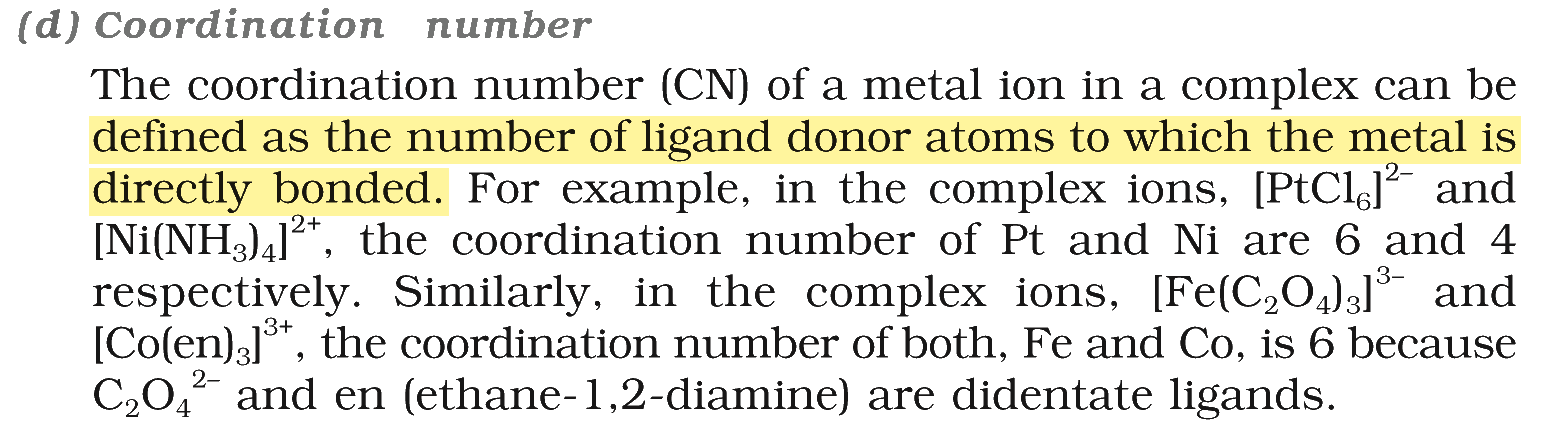
The number of ligand donor atoms directly bonded to the metal is the coordination number. It is not the number of ligands, because a ligand may bind through more than one atom:
Monodentate ligands bind through one atom: \( \ce{Cl^{-}} \), \( \ce{OH^{-}} \), \( \ce{NH3} \), \( \ce{H2O} \).
Bidentate ligands bind through two atoms: ethane-1,2-diamine (en, two N atoms) and oxalate (ox or \( \ce{C2O4^{2-}} \), two O atoms).
Counting donor atoms in each complex:
\( \displaystyle \ce{[Cr(en)2(ox)]^+}:\quad 2\times2+1\times2=6 \)
\( \displaystyle \ce{[Zn(en)Cl2]}:\quad 1\times2+2\times1=4 \)
\( \displaystyle \ce{[Co(C2O4)2(OH)2]^3-}:\quad 2\times2+2\times1=6 \)
So the numbers of donor atoms are six, four and six.
Why the other options are incorrect
Option (1) three, three, four — Incorrect. These are the numbers of ligands (3, 3 and 4), not of donor atoms. Each en and ox ligand binds through two atoms.
Option (2) five, four, four — Incorrect. The first and third values treat some bidentate ligands as monodentate.
Option (4) four, four, six — Incorrect. The first value counts only four donor atoms around chromium; the two en and one ox ligands give six.
NCERT (2026-27 edition):
Coordination Number