
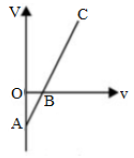
The stopping potential V for photoelectric emission from a metal surface is plotted along the Y-axis and the frequency \( \nu \) (marked v in the figure) of the incident light along the X-axis. A straight line is obtained, as shown in the figure. Planck’s constant is given by
Answer & explanation
Correct answer: option 2
The correct answer is Option (2) → the product of the slope of the line and the charge on the electron
Combining Einstein’s photoelectric equation \( K_{\mathrm{max}}=h\nu-\phi_0 \) with \( K_{\mathrm{max}}=eV_0 \) gives a straight line between the stopping potential and the frequency:
\( \displaystyle V_0=\frac{h}{e}\,\nu-\frac{\phi_0}{e} \)
Option (1) the slope of the line — Incorrect. The slope of the line is \( h/e \). It gives Planck’s constant only after multiplying by \( e \).
Option (2) the product of the slope of the line and the charge on the electron — Correct. From the figure, the line AC has slope \( h/e \), so \( h=e\times\text{slope} \).
Option (3) the intercept along the Y-axis divided by the charge on the electron — Incorrect. From the figure, the line meets the Y-axis at A, where \( \nu=0 \) and \( V_0=-\phi_0/e \). This intercept depends on the work function. Dividing it by \( e \) gives \( -\phi_0/e^2 \), which is not \( h \).
Option (4) the product of the intercept along the X-axis and the mass of the electron — Incorrect. The line meets the X-axis at B, where \( V_0=0 \) and \( \nu=\phi_0/h \), the threshold frequency \( \nu_0 \). The mass of the electron does not appear in the photoelectric equation, so this product is not \( h \).
NCERT (2026-27):
Einstein’s Photoelectric Equation: Energy Quantum of Radiation – “… the photoelectric equation … can be written as
\( e\,V_0=h\nu-\phi_0;\ \text{for}\ \nu\ge\nu_0 \)
or
\( \displaystyle V_0=\frac{h}{e}\,\nu-\frac{\phi_0}{e} \qquad (11.4) \)
This is an important result. It predicts that the V0 versus ν curve is a straight line with slope = (h/e), independent of the nature of the material.”