
CUETMOCK
  • Pricing
  • Mentors
Log inStart freeStart free mocks→

First test, then trust

Try a free CUET mock test.

Join 5,00,000+ students who rehearsed exam day on the exact NTA screen before sitting CUET. On the web and on Android.

Start free mocks →Get the Android app
CUETMOCK

India's #1 CUET Mock Test Platform. Original NCERT-based questions on the exact NTA exam screen — trusted by 5,00,000+ students since CUET 2022.

Get it onGoogle PlayScan to download the CUETMOCK app

Mock tests

  • CUET mock test series
  • Browse all papers
  • Commerce mocks
  • Humanities (Arts) mocks
  • Science mocks
  • Languages & GAT mocks
  • Free practice questions
  • Pricing

Resources

  • CUET exam guide
  • CUET syllabus
  • Universities accepting CUET
  • Expert blogs
  • News & notifications
  • Webinars & counselling
  • CUET score calculator
  • How we estimate your rank
  • FAQs

Company

  • About us
  • Our leadership & team
  • Our toppers
  • Mentors
  • For schools
  • Contact us
  • Terms
  • Privacy
  • Refund policy

Talk to us

+91 7696 6630 56info@cuetmock.comWhatsApp us

Our other platforms

  • JEE Mock — For IIT-JEE aspirants
  • NEET Mock — For NEET aspirants

Newsletter

Exam updates, study material and offers — no spam.

© 2026 NYC Ventures Pvt. Ltd.

701-702, Royal Business Park, Zirakpur, Punjab - 140603

  • Terms of use
  • Privacy policy
  • Refund policy
  • Contact us

iCUETMOCK is an independent preparation platform, not affiliated with the National Testing Agency (NTA). Always check exam details on the official NTA website.

  • Home
  • Mock tests
  • CUET guide
  • Pricing
  • Log in
Home/Practice questions/Chemistry
ChemistryPhysical: Chemical Kinetics

Match List-I with List-II. (Concentration is in mol L−1 and time in s…

Match List-I with List-II. (Concentration is in mol L−1 and time in seconds.)

List-I
(Rate law)
List-II
(Units of the rate constant, k)
(A) Rate = k[A]1/2[B]3/2(I) s−1
(B) Rate = k[A]3/2[B]−1(II) mol−1/2 L1/2 s−1
(C) Rate = k[A][B]1/2(III) mol−1 L s−1
(D) Rate = k[A]2[B]−1(IV) mol1/2 L−1/2 s−1

Choose the correct answer from the options given below:

Answer & explanation+

Correct answer: option 2

The correct answer is Option (2) → A-III, B-IV, C-II, D-I

First add the exponents in the rate law to get the order of the reaction, n. Then the units of k follow from k = Rate/(concentration)n:

    \( \displaystyle k = \frac{\mathrm{mol\,L^{-1}\,s^{-1}}}{(\mathrm{mol\,L^{-1}})^{n}} = (\mathrm{mol\,L^{-1}})^{1-n}\,\mathrm{s^{-1}} \)

(A) Rate = k[A]1/2[B]3/2 — This matches (III) mol−1 L s−1. n = 1/2 + 3/2 = 2, so 1 − n = −1, the unit of a second order rate constant.

(B) Rate = k[A]3/2[B]−1 — This matches (IV) mol1/2 L−1/2 s−1. n = 3/2 + (−1) = 1/2, so 1 − n = 1/2 and k has the unit (mol L−1)1/2 s−1.

(C) Rate = k[A][B]1/2 — This matches (II) mol−1/2 L1/2 s−1. n = 1 + 1/2 = 3/2, so 1 − n = −1/2 and k has the unit (mol L−1)−1/2 s−1.

(D) Rate = k[A]2[B]−1 — This matches (I) s−1. n = 2 + (−1) = 1, so 1 − n = 0 and only s−1 is left, as for a first order reaction.

NCERT (2026-27 edition):
3.2.3 Order of a Reaction – “Sum of these exponents, i.e., x + y in (3.4) gives the overall order of a reaction whereas x and y represent the order with respect to the reactants A and B respectively.” … “Order of a reaction can be 0, 1, 2, 3 and even a fraction.”

Example 3.3 – “(a) Rate = k [A]1/2 [B]3/2 (b) Rate = k [A]3/2 [B]–1 … So order = 1/2 + 3/2 = 2, i.e., second order (b) order = 3/2 + (–1) = 1/2, i.e., half order.”

Units of rate constant – “Taking SI units of concentration, mol L–1 and time, s, the units of k for different reaction order are listed in Table 3.3”
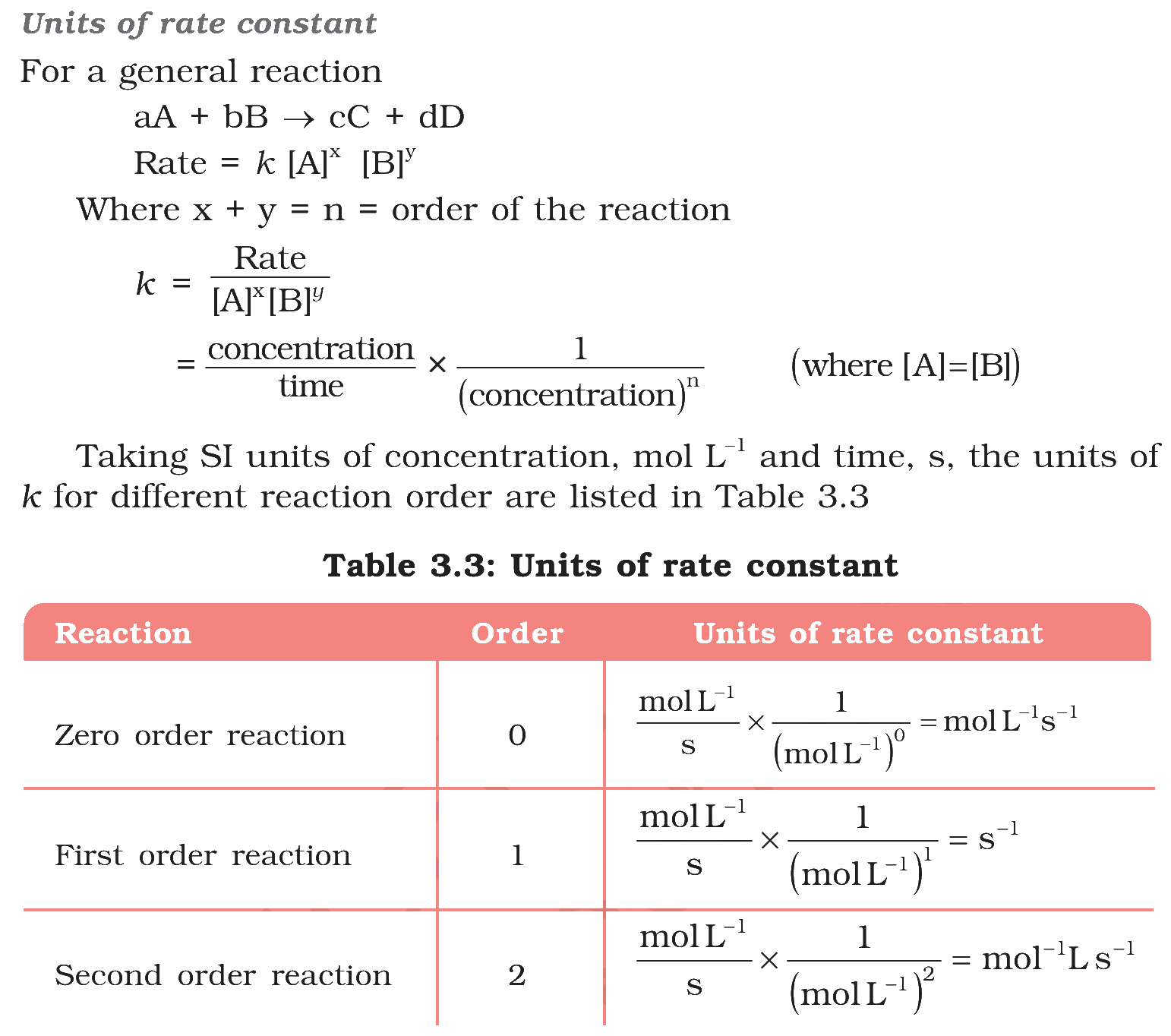
Units of rate constant and Table 3.3

Advertisement

Practise more on Physical: Chemical Kinetics

Chapter-wise mocks on the real NTA exam screen, with solutions and your rank. Your first mocks are free.

Start free mocks →

Advertisement

Next questions

  1. Which term is used for the measure that describes the greater probability of certain communities or individuals becoming, or remaining, poo…General Aptitude Test · General Knowledge
  2. Match the words given in List-I with their meanings given in List-II.List-I (Words)List-II (Meanings)(A) Incumbent(I) A shy person who is l…English · One Word
  3. Choose the correct word to fill in the blank:A heavy ______ of the old mango tree broke off in last night’s storm and fell on our wall.English · Homonyms
  4. A rise in three of the following raises the transaction demand for money (MdT = kPY). Which one is the odd one out?Economics · Macro Economics: Money and Banking
  5. Which range of IQ is classified as profound intellectual disability?Psychology · Variations in Psychological Attributes
  6. ‘यमक’ अलंकार के उदाहरण हैं –A. कानन कठिन भयंकर भारी, घोर धाम हिमवारि बयारी।B. तीन बेर खाती थी वो तीन बेर खाती हैं।C. सिंधु-सा विस्तृत और अथ…Hindi · Alankar
  7. Which of the following does NOT name a body of still water?English · Odd One Out
  8. Fill in the blank with the correct article:After college, Meena spent two years working for ________ NGO in a small town near Pune.English · Grammar: Articles
  9. What was the position of the masses of this country?History · Modern India: Framing the Constitution
  10. निम्नलिखित पंक्तियों में कौन-सा छंद है?"वन में नाचें मोर, घटा छाई है काली।कोयल गाती गीत, खिली है डाली डाली।।"Hindi · छंद