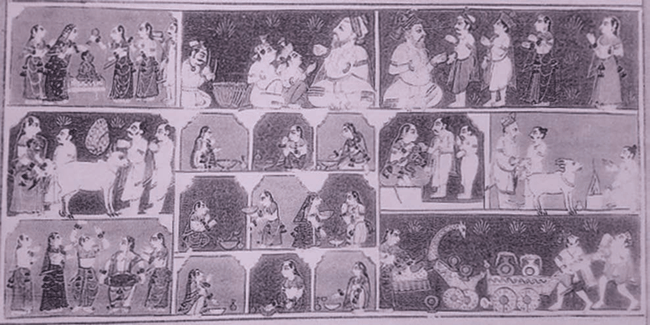
A Malwa Bhagvata Purana folio shows Krishna and the cart demon. Given below are two statements: one is labelled Assertion (A) and the other is labelled Reason (R).
Assertion (A): This one folio narrates several scenes of an episode, from the festivities in the house of Nanda and Yashoda after Krishna’s birth to Krishna toppling the cart demon.
Reason (R): In this folio the space is carefully compartmentalised, with each section narrating a different scene of the episode.
In the light of the above statements, choose the correct answer from the options given below:
Answer & explanation
Correct answer: option 1
The correct answer is Option (1) → Both (A) and (R) are true and (R) is the correct explanation of (A).
Assertion (A): This one folio narrates several scenes of an episode, from the festivities in the house of Nanda and Yashoda after Krishna’s birth to Krishna toppling the cart demon. — True. The folio shows the celebrations after the birth, and its narrative ends with Krishna’s gentle kick that topples the demon.
Reason (R): In this folio the space is carefully compartmentalised, with each section narrating a different scene of the episode. — True. This is why the folio is called a typical example of Malwa style.
Why R explains A? The space is divided into sections, and each section tells one scene. So the whole episode, from the birth festivities to the end of the demon, fits into a single folio.
Note: This topic was not named in the CUET 2026 syllabus, but it was part of the NCERT chapter. In 2025 and 2026, NTA also asked questions on topics in NCERT that the CUET syllabus did not name. So our mocks have questions from every part of the NCERT chapter, to give you enough practice. Read the whole chapter, not only the sub-topics named in the syllabus.
NCERT (2026-27): “Bhagvata Purana …This folio from Bhagvata Purana is a typical example of Malwa style, where the space is carefully compartmentalised with each section narrating different scenes of an episode. One observes scenes of celebration and festivities in the house of Nanda and Yashoda after the birth of Krishna. …and the narrative concludes with Krishna toppling, and thus, liberating the cart demon, Shakatasura, with a gentle kick.”
|