
Which of the following coordination compounds cannot show geometrical isomerism?
Answer & explanation
Correct answer: option 2
The correct answer is Option (2) → [Co(en)3]3+
Geometrical isomerism arises in heteroleptic complexes, where different ligands can be placed next to each other (cis) or opposite each other (trans), or in fac and mer arrangements.
In \( \ce{[Co(en)3]^3+} \) all three ligands are the same didentate en. Each en spans two adjacent (cis) positions of the octahedron, and every way of placing three identical en groups gives the same relative arrangement, so no geometrical isomers exist. The complex shows only optical isomerism (d and l forms).
Why the other options are incorrect
Option (1) [PtCl2(NH3)2] — Incorrect. It is a square planar [MX2L2] complex; the two Cl may be adjacent (cis) or opposite (trans).
Option (3) [CoCl2(NH3)4]+ — Incorrect. It is an octahedral [MX2L4] complex; the two Cl may be cis or trans to each other.
Option (4) [Co(NO2)3(NH3)3] — Incorrect. It is an octahedral [Ma3b3] complex; it shows facial (fac) and meridional (mer) isomers.
NCERT (2026-27 edition):
5.4.1 Geometric Isomerism – “This type of isomerism arises in heteroleptic complexes due to different possible geometric arrangements of the ligands. Important examples of this behaviour are found with coordination numbers 4 and 6. In a square planar complex of formula [MX2L2] (X and L are unidentate), the two ligands X may be arranged adjacent to each other in a cis isomer, or opposite to each other in a trans isomer as depicted in Fig. 5.2. … Such isomerism is not possible for a tetrahedral geometry but similar behaviour is possible in octahedral complexes of formula [MX2L4] in which the two ligands X may be oriented cis or trans to each other (Fig. 5.3). … Another type of geometrical isomerism occurs in octahedral coordination entities of the type [Ma3b3] like [Co(NH3)3(NO2)3]. If three donor atoms of the same ligands occupy adjacent positions at the corners of an octahedral face, we have the facial (fac) isomer. When the positions are around the meridian of the octahedron, we get the meridional (mer) isomer (Fig. 5.5).”
5.4.2 Optical Isomerism – “Optical isomers are mirror images that cannot be superimposed on one another. These are called as enantiomers. … Optical isomerism is common in octahedral complexes involving didentate ligands (Fig. 5.6).”
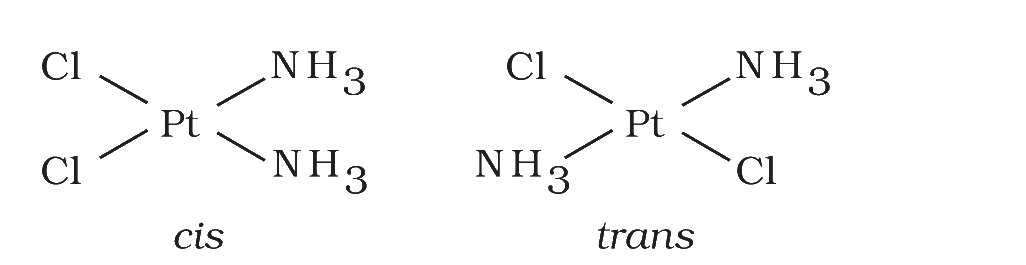
Fig. 5.2: Geometrical isomers (cis and trans) of Pt [NH3)2Cl2]
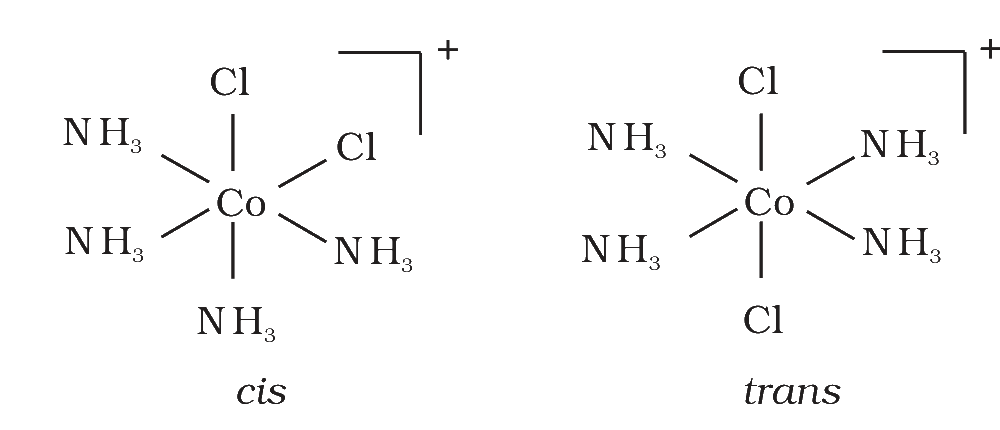
Fig. 5.3: Geometrical isomers (cis and trans) of [Co(NH3)4Cl2]+
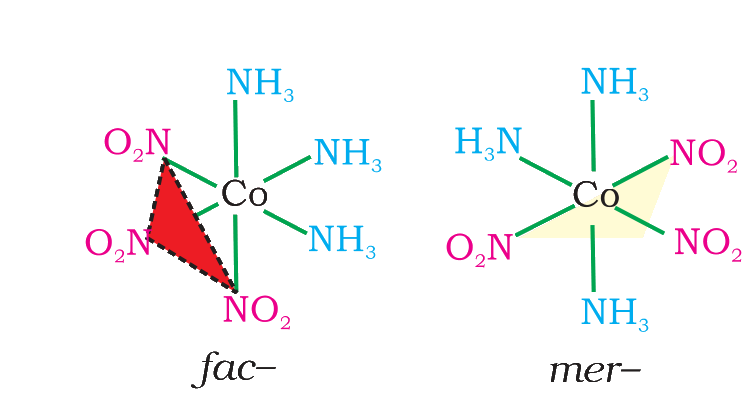
Fig. 5.5: The facial (fac) and meridional (mer) isomers of [Co(NH3)3(NO2)3]
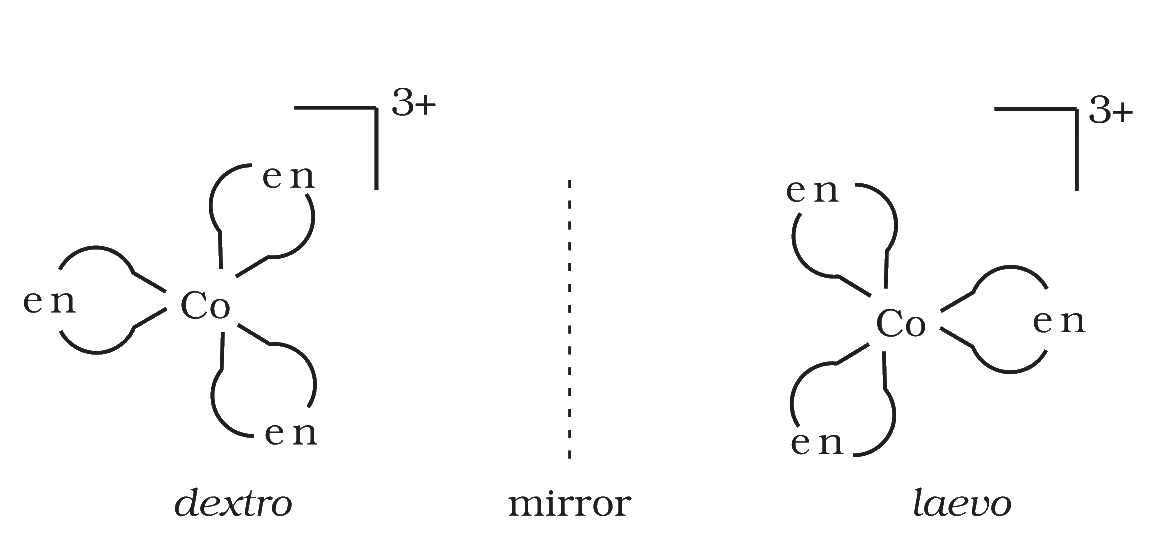
Fig. 5.6: Optical isomers (d and l) of [Co(en)3]3+