
The activation energies of the forward and the reverse reactions of \(A_2 + B_2 \rightleftharpoons 2AB\) are 180 kJ mol−1 and 200 kJ mol−1 respectively. A catalyst lowers the activation energy of both the forward and the reverse reactions by 100 kJ mol−1. What is the enthalpy change of the reaction \(A_2 + B_2 \rightarrow 2AB\) in the presence of the catalyst (in kJ mol−1)?
Answer & explanation
Correct answer: option 3
The correct answer is Option (3) → −20
On a plot of potential energy against reaction coordinate, the reactants (A), the activated complex (C) and the products (B) each have a fixed energy:
Forward reaction: Ea(forward) = energy of C − energy of A.
Reverse reaction: Ea(reverse) = energy of C − energy of B.
Enthalpy change: ΔH = energy of B − energy of A = Ea(forward) − Ea(reverse).
Effect of the catalyst: it gives a path with a lower energy barrier but leaves the energies of the reactants and products unchanged, so both activation energies fall by the same 100 kJ mol−1.
\( \displaystyle \Delta H=E_a(\text{forward})-E_a(\text{reverse}) \)
\( \displaystyle \Delta H=(180-100)-(200-100)=80-100 \)
\( \displaystyle \Delta H=-20\,\mathrm{kJ\,mol^{-1}} \)
This is the same as without the catalyst (180 − 200 = −20 kJ mol−1): a catalyst does not change ΔH.
NCERT (2026-27 edition):
3.4 Temperature Dependence of the Rate of a Reaction – “The energy required to form this intermediate, called activated complex (C), is known as activation energy (Ea). Fig. 3.7 is obtained by plotting potential energy vs reaction coordinate. … Some energy is released when the complex decomposes to form products. So, the final enthalpy of the reaction depends upon the nature of reactants and products.”
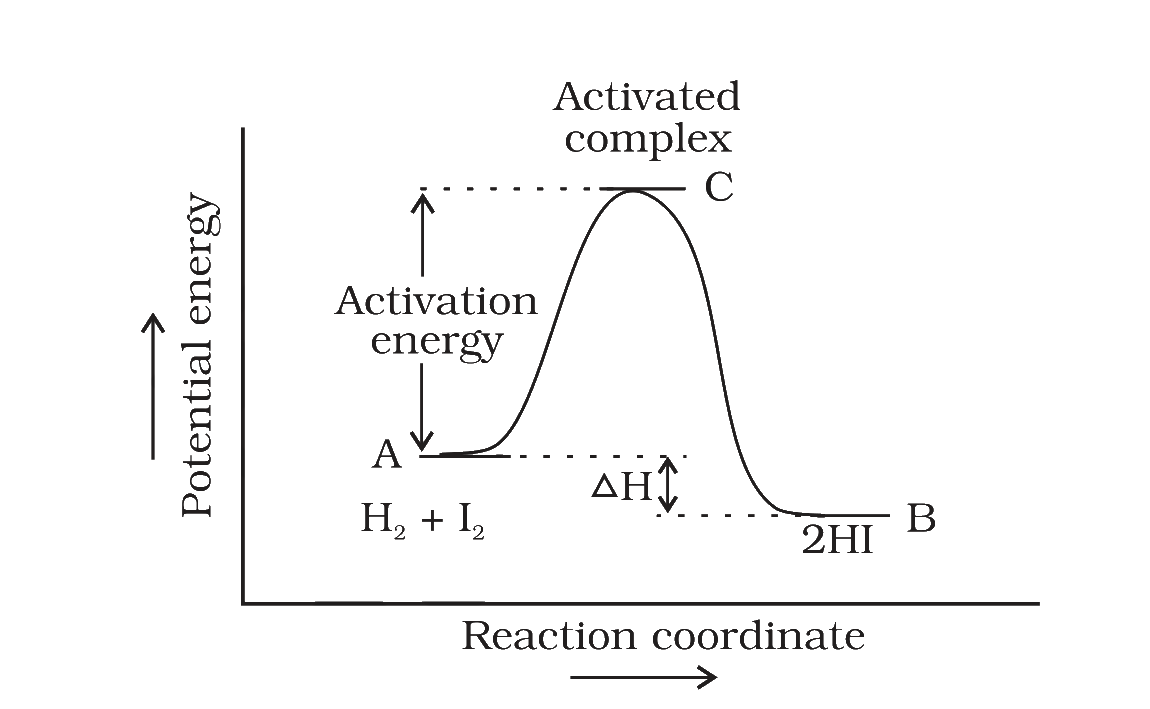
Fig. 3.7: Diagram showing plot of potential energy vs reaction coordinate
3.4.1 Effect of Catalyst – “… It is believed that the catalyst provides an alternate pathway or reaction mechanism by reducing the activation energy between reactants and products and hence lowering the potential energy barrier as shown in Fig. 3.11.”
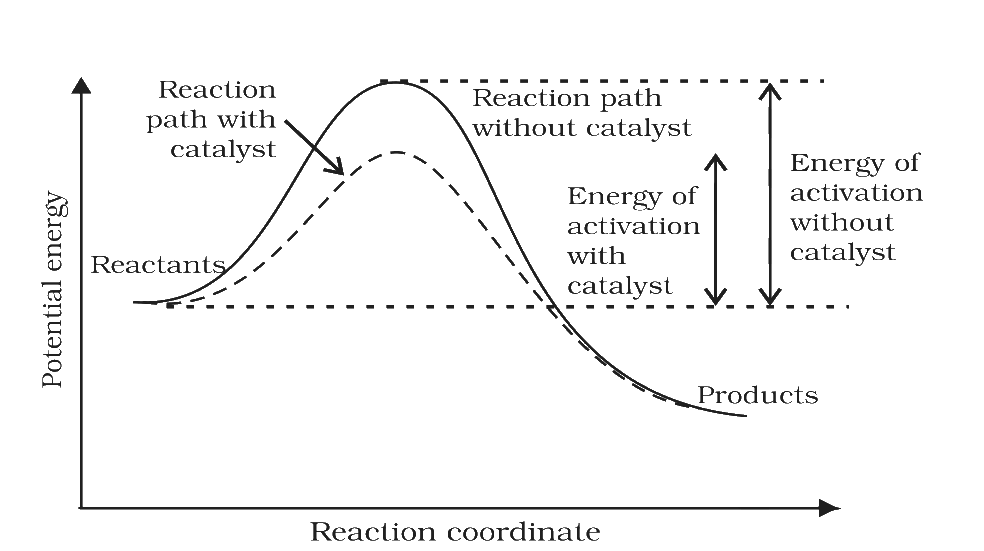
Fig. 3.11: Effect of catalyst on activation energy