
For a first-order reaction R → P, match List-I with List-II.
| List-I | List-II |
|---|---|
| (A) Slope of the straight-line plot of ln[R] against t | (I) \( \frac{k}{2.303} \) |
| (B) Intercept of the straight-line plot of ln[R] against t | (II) ln[R]0 |
| (C) Slope of the straight-line plot of log([R]0/[R]) against t | (III) Zero |
| (D) Intercept of the straight-line plot of log([R]0/[R]) against t | (IV) −k |
Choose the correct answer from the options given below:
Answer & explanation
Correct answer: option 2
The correct answer is Option (2) → A-IV, B-II, C-I, D-III
The integrated rate equation of a first-order reaction can be written in two straight-line forms, y = mx + c, with t on the x-axis:
\( \displaystyle \ln[\mathrm{R}] = -kt + \ln[\mathrm{R}]_0 \)
\( \displaystyle \log\frac{[\mathrm{R}]_0}{[\mathrm{R}]} = \frac{k}{2.303}\,t \)
(A) Slope of the straight-line plot of ln[R] against t — This matches (IV) −k. ln[R] falls as the reactant is used up, so the slope is negative.
(B) Intercept of the straight-line plot of ln[R] against t — This matches (II) ln[R]0. At t = 0 the concentration is the initial concentration.
(C) Slope of the straight-line plot of log([R]0/[R]) against t — This matches (I) k/2.303. This ratio grows with time, so the slope is positive; 2.303 comes from changing ln to log.
(D) Intercept of the straight-line plot of log([R]0/[R]) against t — This matches (III) Zero. At t = 0, [R] = [R]0 and log 1 = 0, so the line passes through the origin (Fig. 3.5 below starts at 0).
NCERT (2026-27 edition):
3.3.2 First Order Reactions – “Comparing equation (3.9) with y = mx + c, if we plot ln [R] against t (Fig. 3.4) we get a straight line with slope = –k and intercept equal to ln [R]0”
\( \displaystyle \log\frac{[\mathrm{R}]_0}{[\mathrm{R}]} = \frac{kt}{2.303} \)
“If we plot a graph between log [R]0/[R] vs t, (Fig. 3.5), the slope = k/2.303”
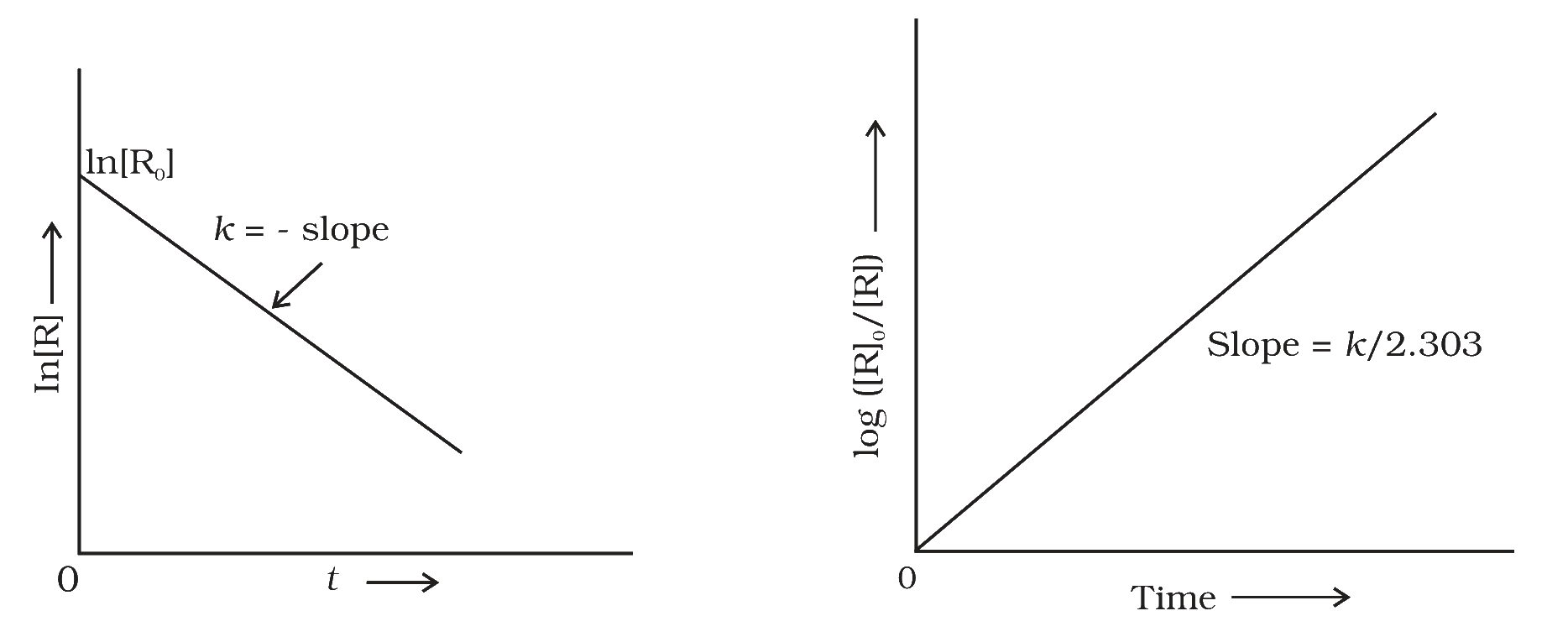
Fig. 3.4: A plot between ln[R] and t for a first order reaction; Fig. 3.5: Plot of log [R]0/[R] vs time for a first order reaction