CUETMOCK
  • Pricing
  • Mentors
Log inStart freeStart free mocks→

First test, then trust

Try a free CUET mock test.

Join 5,00,000+ students who rehearsed exam day on the exact NTA screen before sitting CUET. On the web and on Android.

Start free mocks →Get the Android app
CUETMOCK

India's #1 CUET Mock Test Platform. Original NCERT-based questions on the exact NTA exam screen — trusted by 5,00,000+ students since CUET 2022.

Get it onGoogle PlayScan to download the CUETMOCK app

Mock tests

  • CUET mock test series
  • Commerce mocks
  • Humanities (Arts) mocks
  • Science mocks
  • Languages & GAT mocks
  • Free practice questions
  • Pricing

Resources

  • CUET exam guide
  • CUET syllabus
  • Universities accepting CUET
  • Expert blogs
  • News & notifications
  • Webinars & counselling
  • CUET score calculator
  • How we estimate your rank
  • FAQs

Company

  • About us
  • Our leadership & team
  • Our toppers
  • Mentors
  • For schools
  • Contact us
  • Terms
  • Privacy
  • Refund policy

Talk to us

+91 7696 6630 56info@cuetmock.comWhatsApp us

Our other platforms

  • JEE Mock — For IIT-JEE aspirants
  • NEET Mock — For NEET aspirants

Newsletter

Exam updates, study material and offers — no spam.

© 2026 NYC Ventures Pvt. Ltd.

701-702, Royal Business Park, Zirakpur, Punjab - 140603

  • Terms of use
  • Privacy policy
  • Refund policy
  • Contact us

iCUETMOCK is an independent preparation platform, not affiliated with the National Testing Agency (NTA). Always check exam details on the official NTA website.

  • Home
  • Mock tests
  • CUET guide
  • Pricing
  • Log in
Home/Practice questions/Physics
PhysicsDual Nature of Radiation and Matter

Which metal in figure (b) will have the higher stopping potential at…

Read the following passage and answer the questions.

A student uses a photocell to study how the stopping potential \(V_0\) depends on the frequency \(\nu\) of the incident light. She uses one source of light and puts a different filter in front of it for each frequency. The source stays at the same distance from the cell in every run. For each frequency, she records the photocurrent while she changes the potential of the collector plate. Figure (a) shows her results for three frequencies \(\nu_1\), \(\nu_2\) and \(\nu_3\). Each curve meets the potential axis at a different negative potential.

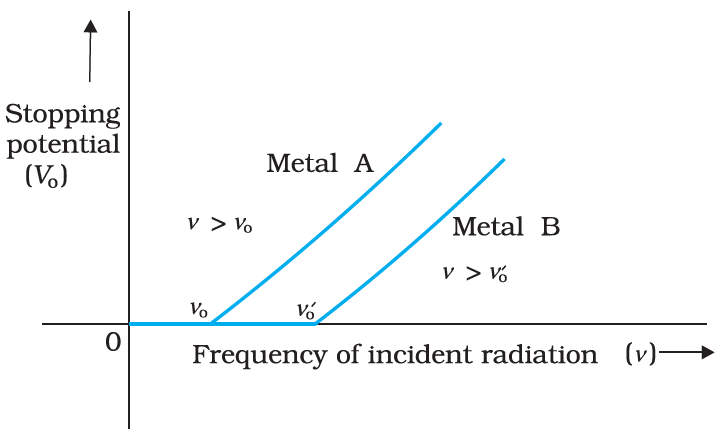
She then repeats the work with emitters of two different metals, A and B. For each metal she plots the stopping potential against the frequency and gets a straight line, as in figure (b). The line for metal A starts at the cut-off frequency \(\nu_0\), and the line for metal B starts at \(\nu_0^{\prime}\). In her experiment, \(\nu_0 = 5.0\times10^{14}\ \mathrm{Hz}\) and \(\nu_0^{\prime} = 8.0\times10^{14}\ \mathrm{Hz}\).
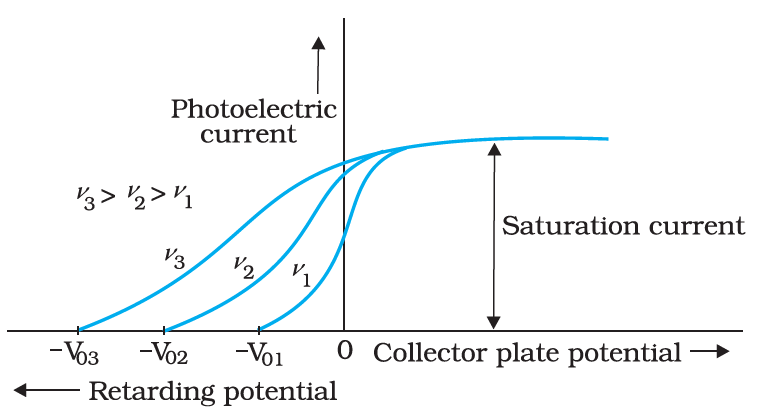
Figure for the question

(a)

Figure for the question

(b)

Which metal in figure (b) will have the higher stopping potential at a particular frequency \( \nu\gt \nu_0^{\prime}\gt \nu_0 \)?

Answer & explanation+

Correct answer: option 1

The correct answer is Option (1) → Metal A

The passage says that the stopping potential varies linearly with the frequency. Each metal also has a cut-off frequency at which the stopping potential is zero. In figure (b), the two lines rise with the same slope. The line of metal A starts at the lower cut-off frequency \( \nu_0 \), and the line of metal B at the higher \( \nu_0^{\prime} \). So at any frequency \( \nu \) above \( \nu_0^{\prime} \), the line of metal A lies above the line of metal B.

Option (1) Metal A — Correct. Metal A has the lower cut-off frequency. So less of the photon energy is used to free an electron, and the photoelectrons get a larger maximum kinetic energy. A larger stopping potential is needed to stop them.

Option (2) Metal B — Incorrect. Metal B needs a higher frequency \( \nu_0^{\prime} \) to start emission. So at the same \( \nu \) its electrons come out with less kinetic energy, and its line lies below that of metal A.

Option (3) Both metal A and metal B — Incorrect. The two metals have different cut-off frequencies. So at the same \( \nu \) their stopping potentials are different, and only one of them is higher.

Advertisement

Practise more on Dual Nature of Radiation and Matter

Chapter-wise mocks on the real NTA exam screen, with solutions and your rank. Your first mocks are free.

Start free mocks →

Advertisement

Next questions

  1. Aluminium has a density of 2.7×10^3\ mathrmkg m^-3 and an atomic mass of 27 u. Each aluminium atom gives 3 free electrons. Take Avogadro’s…Physics · Current Electricity
  2. Artists worked in Haripur–Guler from the reign of Raja Dalip Singh (1695–1743). Which of the following is true of his son Bishan Singh?Fine Arts · The Pahari Schools of Painting
  3. What is the charge on a photon?Physics · Dual Nature of Radiation and Matter
  4. The probability that he copied it given that his answer is correct :Maths. Section B1 · Probability
  5. Among the following, choose the CORRECT statement?Chemistry · Physical: Chemical Kinetics
  6. The angular frequency of the source is raised steadily from a low value to a high value. How does the ammeter reading change?Physics · Alternating Current
  7. 'स्वल्प' का सही संधि विच्छेद है-Hindi · संधि
  8. Select the sentence that is grammatically correct:English · Sentence Correction
  9. निम्नलिखित में से कौन-सा 'रात' का पर्यायवाची नहीं है?Hindi · पर्यायवाची शब्द
  10. A person ‘holds a grudge’ when he or she goes on feeling resentment towards someone for a wrong that person did long ago. Which of the foll…General Aptitude Test · Verbal Reasoning