Read the following passage and answer the questions.
A student studies a series LCR circuit like the tuning circuit of a radio. She connects a 50 Ω resistor, a 20 mH inductor and a 50 μF capacitor in series with an ac source. The rms voltage of the source stays at 10 V. Its angular frequency \(\omega\) can be changed over a wide range. An ac ammeter in the circuit reads the rms current. An ac voltmeter can be joined across each element in turn. She starts with \(\omega\) at a low value and raises it slowly. At each step she notes the ammeter reading and the three voltmeter readings. She then repeats the whole run with a 100 Ω resistor in place of the 50 Ω one. The inductor, the capacitor and the source stay the same.
The angular frequency of the source is raised steadily from a low value to a high value. How does the ammeter reading change?
Answer & explanation
Correct answer: option 3
The correct answer is Option (3) → It rises to a maximum and then falls.
The current amplitude is \( i_m=v_m/Z \), where \( Z=\sqrt{R^{2}+(X_C-X_L)^{2}} \). Here \( X_C=1/\omega C \) and \( X_L=\omega L \). The smaller the impedance, the larger the ammeter reading.
Option (1) It keeps increasing. — Incorrect. Beyond \( \omega_0 \), \( X_L \) keeps growing and \( X_C \) keeps shrinking. So \( Z \) increases again and the current falls.
Option (2) It keeps decreasing. — Incorrect. At a low frequency \( X_C=1/\omega C \) is very large, so the current starts small. It grows as \( \omega \) comes near \( \omega_0 \).
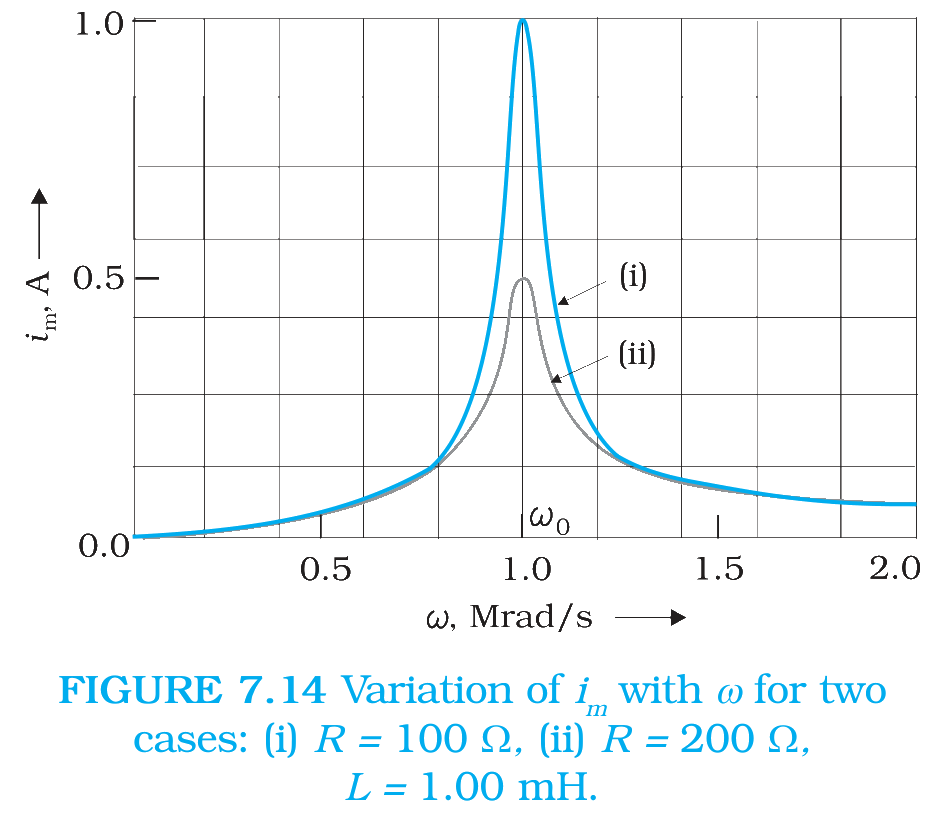
Option (3) It rises to a maximum and then falls. — Correct. \( Z \) falls as \( X_C-X_L \) shrinks. It becomes equal to \( R \) at \( \omega_0 \), where \( X_C=X_L \), and grows again above \( \omega_0 \). So the current is largest at the resonant frequency, as the curves of Fig. 7.14 show.
Option (4) It falls to a minimum and then rises. — Incorrect. At \( \omega_0 \) the impedance is the least, so the current there is the largest.
NCERT (2026-27):
AC Voltage Applied to a Series LCR Circuit – “… the variation of im with ω in a RLC series circuit … We see that the current amplitude is maximum at the resonant frequency.”