
CUETMOCK
  • Pricing
  • Mentors
Log inStart freeStart free mocks→

First test, then trust

Try a free CUET mock test.

Join 5,00,000+ students who rehearsed exam day on the exact NTA screen before sitting CUET. On the web and on Android.

Start free mocks →Get the Android app
CUETMOCK

India's #1 CUET Mock Test Platform. Original NCERT-based questions on the exact NTA exam screen — trusted by 5,00,000+ students since CUET 2022.

Get it onGoogle PlayScan to download the CUETMOCK app

Mock tests

  • CUET mock test series
  • Commerce mocks
  • Humanities (Arts) mocks
  • Science mocks
  • Languages & GAT mocks
  • Free practice questions
  • Pricing

Resources

  • CUET exam guide
  • CUET syllabus
  • Universities accepting CUET
  • Expert blogs
  • News & notifications
  • Webinars & counselling
  • CUET score calculator
  • How we estimate your rank
  • FAQs

Company

  • About us
  • Our leadership & team
  • Our toppers
  • Mentors
  • For schools
  • Contact us
  • Terms
  • Privacy
  • Refund policy

Talk to us

+91 7696 6630 56info@cuetmock.comWhatsApp us

Our other platforms

  • JEE Mock — For IIT-JEE aspirants
  • NEET Mock — For NEET aspirants

Newsletter

Exam updates, study material and offers — no spam.

© 2026 NYC Ventures Pvt. Ltd.

701-702, Royal Business Park, Zirakpur, Punjab - 140603

  • Terms of use
  • Privacy policy
  • Refund policy
  • Contact us

iCUETMOCK is an independent preparation platform, not affiliated with the National Testing Agency (NTA). Always check exam details on the official NTA website.

  • Home
  • Mock tests
  • CUET guide
  • Pricing
  • Log in
Home/Practice questions/Chemistry
ChemistryPhysical: Chemical Kinetics

Among the following, choose the CORRECT statement?

Rate of reaction

Consider a general reaction: aA + bB → cC + dD

where a, b, c and d are the stoichiometric coefficients of reactants and products. The rate expression for this reaction is Rate ∝ [A]x[B]y

where exponents x and y may or may not be equal to the stoichiometric coefficients (a and b) of the reactants. Above equation can also be written as Rate = k[A]x[B]y

Sum of these exponents, i.e., x + y gives the overall order of a reaction whereas x and y represent the order with respect to the reactants A and B, respectively.

    \( \displaystyle -\frac{d[\mathrm{R}]}{dt}=k[\mathrm{A}]^x[\mathrm{B}]^y \)

The above equation is known as differential rate equation, where k is a proportionality constant called rate constant. The equation, which relates the rate of a reaction to concentration of reactants is called rate law or rate expression.

In the rate law expression reaction rate is given in terms of molar concentration of reactants with each term raised to some power, which may or may not be same as the stoichiometric coefficient of the reacting species in a balanced chemical equation. For example:

    2NO2(g) + O2(g) → 2NO3(g)

The rate of this reaction is measured as a function of initial concentrations either by keeping the concentration of one of the reactants constant and changing the concentration of the other reactant or by changing the concentration of both the reactants. The results obtained are tabulated in table below:

ExperimentInitial [NO2]/mol L−1Initial [O2]/mol L−1Initial rate of formation of [NO3]/mol L−1s−1
10.250.250.090
20.500.250.360
30.250.500.180
40.500.500.720

Among the following, choose the CORRECT statement?

Answer & explanation+

Correct answer: option 1

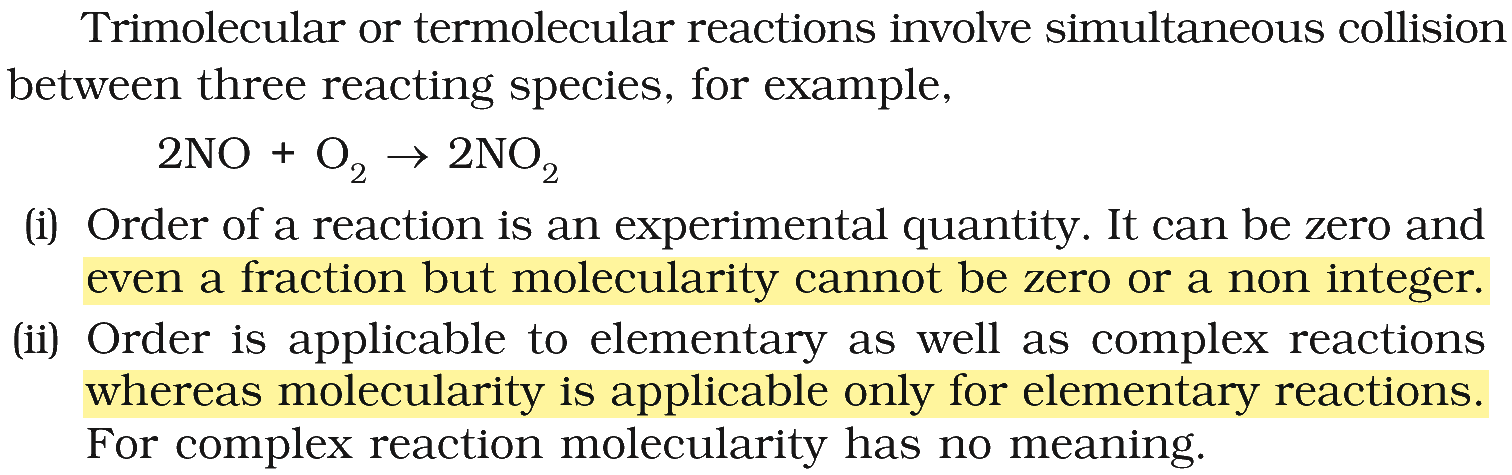
The correct answer is Option (1) → Molecularity is applicable for elementary reaction only and the given reaction has molecularity three.

Molecularity is the number of reacting species that must collide at the same time in an elementary (single-step) reaction.

Taken as one step, \( \ce{2NO2} \) + \( \ce{O2} \) → \( \ce{2NO3} \) needs two \( \ce{NO2} \) molecules and one \( \ce{O2} \) molecule to collide together, so its molecularity is three, as in 2NO + \( \ce{O2} \) → \( \ce{2NO2} \), a termolecular reaction. This agrees with the experimental rate law, Rate = k[NO2]2[O2], whose order is also 2 + 1 = 3.

Why the other options are incorrect

  • Option (2) Molecularity is applicable for complex reactions only and the given reaction has molecularity three — Incorrect. It is the other way round; molecularity applies only to elementary reactions.

  • Option (3) Molecularity is applicable to elementary and complex reactions — Incorrect. For a complex reaction as a whole, molecularity has no meaning; only its individual steps have one.

  • Option (4) Molecularity and order can be fractional, zero and whole number — Incorrect. This is true only of order; molecularity is always a whole number (1, 2 or 3).

Note: It seems that there is a mistake in the original NTA paper, which prints 2NO2(g) + O2(g) → 2NO3(g) when it should read 2NO(g) + O2(g) → 2NO2(g).

NCERT (2026-27 edition):
Molecularity of a Reaction – …
Textbook extract

Advertisement

Practise more on Physical: Chemical Kinetics

Chapter-wise mocks on the real NTA exam screen, with solutions and your rank. Your first mocks are free.

Start free mocks →

Advertisement

Next questions

  1. The angular frequency of the source is raised steadily from a low value to a high value. How does the ammeter reading change?Physics · Alternating Current
  2. 'स्वल्प' का सही संधि विच्छेद है-Hindi · संधि
  3. Select the sentence that is grammatically correct:English · Sentence Correction
  4. निम्नलिखित में से कौन-सा 'रात' का पर्यायवाची नहीं है?Hindi · पर्यायवाची शब्द
  5. A person ‘holds a grudge’ when he or she goes on feeling resentment towards someone for a wrong that person did long ago. Which of the foll…General Aptitude Test · Verbal Reasoning
  6. Match List-I with List-II:List-IList-II(A)Returns to scale(I)One factor is held fixed and the other is increased(B)Law of variable proporti…Economics · Micro Economics: Production and Costs
  7. Which of the following reactions is an example of self oxidation and reduction?Chemistry · Organic: Aldehydes, Ketones and Carboxylic Acids
  8. After a tubectomy, which part of the female reproductive system remains blocked?General Aptitude Test · General Knowledge
  9. Given 0^°<θ<90^° , the positive square root √((1+sinθ)/(1-sinθ)) can be written more simply as:General Aptitude Test · Quantitative Reasoning
  10. सूची -I को सूची -II से सुमेलित कीजिए :सूची -I रससूची -II आलंबन(A). वीभत्स(I). नायक-नायिका(B). शृंगार(II). मृत प्रियजन(C). वात्सल्य(III). दु…Hindi · व्याकरण - रस